

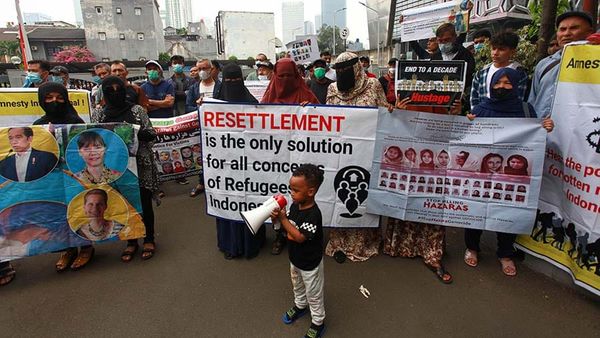
JAFFNA, Sri Lanka — A Sri Lankan Tamil widow who has lived as a refugee in Indonesia since 2014 has publicly appealed for help returning home, saying that the organization that paid for her housing and food is ending its support and that she and her daughter may soon have nothing to eat.
Geethabanu Pranavan, who is from Point Pedro on the northern tip of the Jaffna Peninsula, said in a Facebook post that she and her daughter, Anchana, had been registered with the United Nations refugee agency, UNHCR, for 12 years. The agency’s local partner stopped paying their rent in July, she wrote, and has now told her that their food allowance will end.
“From next month onwards, my daughter and I may have nothing to eat,” she wrote.
Ms. Pranavan’s husband, Pranavan, died in Indonesia in 2022. She said he did not receive adequate medical care. After his death, she wrote, UNHCR referred her and her daughter to Yayasan Cita Wadah Swadaya, known as YCWS, an Indonesian organization that works with the agency to support refugees.
Twice, she said, UNHCR raised the possibility of resettling the family in a third country. Neither offer came through.
She said YCWS had cut their food allowance before it stopped paying their rent. She did not say how much the family had received or what reason the organization gave for the reductions.
Ms. Pranavan said she had written to UNHCR repeatedly, by email and through KoboToolbox, an online platform the agency uses to collect requests from refugees, asking for help to go back to Sri Lanka. She said she had received no answer.
“I am not asking for resettlement in another country anymore,” she wrote. “We simply want to return to our homeland because we can no longer survive in Indonesia without food or financial assistance.”
Jaffna Monitor was unable to reach UNHCR’s office in Indonesia for comment. Ms. Pranavan’s account of her husband’s death and of the cuts to her assistance could not be independently verified.
Indonesia has not signed the 1951 Refugee Convention. It allows refugees to stay while UNHCR seeks solutions for them, but it does not let them work legally or settle permanently. Most of the roughly 12,100 refugees registered there come from Afghanistan, Myanmar and Somalia, and most depend on aid.
That aid has been shrinking. UNHCR said in its report on 2025 that funding for its work in Indonesia had fallen considerably, forcing it to cut staff and assistance programs. In March 2025, the International Organization for Migration told 925 Rohingya refugees in the Sumatran city of Pekanbaru that it could no longer pay for their health care and living costs after the United States cut foreign aid. It restored the support about a week later.
For many Sri Lankan Tamils, Indonesia was meant to be a stop on the way to Australia. In the years after the civil war ended in 2009, Tamils were among those who boarded boats from Indonesian ports bound for Christmas Island. In late 2013, Australia began turning those boats back, and in November 2014 it announced that it would no longer resettle refugees who registered with UNHCR in Indonesia on or after July 1 of that year. Those who arrived after that date were left with few ways out.
It is not clear when in 2014 Ms. Pranavan registered with UNHCR, or whether the Australian policy affected her case.
Going home would not mean going back to family. Ms. Pranavan said her parents and her husband’s parents had died, and that her other relatives seldom speak to her.
“Perhaps they are afraid that I might ask them for financial help,” she wrote.
UNHCR can help refugees who choose to return to their home countries, a process that usually involves interviews, travel documents and an assessment of conditions on arrival. Ms. Pranavan did not say whether she and her daughter held valid Sri Lankan passports or whether she had approached the Sri Lankan Embassy in Jakarta.
Her Facebook account, under the name Banu PG, lists her as living in Jakarta. In the post, she asked anyone able to arrange the family’s return to contact her privately.
“I am a single mother trying my best to protect and care for my daughter,” she wrote, “but I have reached a point where I no longer know what to do.”