
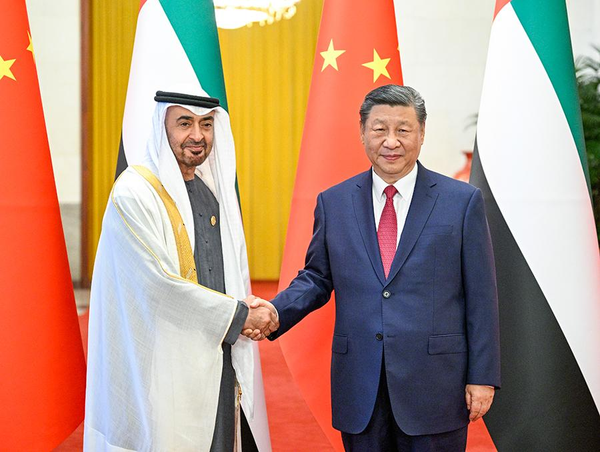
With the Gulf reeling from a U.S.-Israeli military operation against Iran, Beijing advances a four-point framework positioning itself as a steady, alternative diplomatic voice.
BEIJING — President Xi Jinping of China used a high-profile meeting at the Great Hall of the People this week to outline China’s approach to peace in the Middle East, presenting a four-point framework that underscores Beijing’s growing diplomatic ambitions in a region unsettled by war.
Receiving Khaled bin Mohamed bin Zayed Al Nahyan on April 14, Mr. Xi set out proposals centered on peaceful coexistence, national sovereignty, the authority of international law and a balance between development and security. The meeting came as oil markets remain volatile following a joint United States–Israeli military operation against Iran, a crisis that has heightened anxieties across the Gulf and renewed competition among global powers for influence.
Mr. Xi’s remarks reflected a consistent theme in Chinese diplomacy: that stability is best achieved through dialogue and respect for state sovereignty rather than coercion. At the same time, his emphasis on the consistent application of international norms appeared to signal a broader critique of how global rules are enforced. “The authority of the international rule of law should be upheld and cannot be used when convenient and discarded when not,” Mr. Xi said, according to China’s state news agency, warning against a return to what he described as “the law of the jungle.”
A Framework for a Fractured Region
At the core of Mr. Xi’s message was a call for regional coexistence. Describing Gulf states as neighbors that “cannot move away from one another,” he urged efforts to build what he termed a “common, comprehensive, cooperative and sustainable” security architecture — language that points to a preference for collective arrangements over bloc-based alignments.
His second proposition elevated national sovereignty as a central pillar of order, arguing that territorial integrity and political independence must be respected, particularly for developing nations. The principle, long emphasized by Beijing, resonates strongly in a region where external intervention has shaped decades of conflict.
On international governance, Mr. Xi placed the United Nations at the center of any durable settlement, calling for a rules-based order grounded in international law and applied consistently across all conflicts.
The fourth element of his framework linked peace to economic progress. Stability, he argued, depends not only on security arrangements but also on development, with China offering to expand cooperation and share opportunities tied to its own modernization.
Gulf Reception and Strategic Calculus
Sheikh Khaled welcomed China’s role, describing it as constructive and expressing support for continued coordination to promote a ceasefire, stabilize the region and safeguard global shipping routes — a critical concern as tensions threaten key energy corridors.
The visit also underscored deepening economic ties. China remains the United Arab Emirates’ largest trading partner, with bilateral trade exceeding $100 billion last year, while Emirati investment in Chinese sectors has expanded steadily.
For Gulf states, engagement with China reflects a broader strategy of diversifying partnerships amid an increasingly uncertain geopolitical environment. Beijing’s emphasis on dialogue, sovereignty and development offers an approach that contrasts with more security-driven frameworks, even as its direct influence over military dynamics in the region remains limited.