
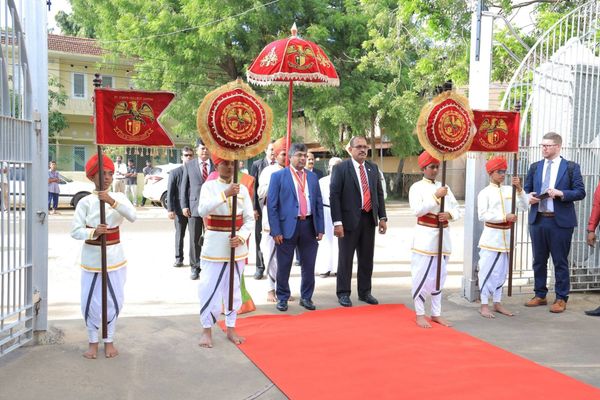
JAFFNA, Sri Lanka — Nishan Canagarajah, the Jaffna-born vice-chancellor of the University of Leicester, returned to his old school on Monday and gave it 6 million rupees in memory of its students and staff who were killed during Sri Lanka’s ethnic conflict.
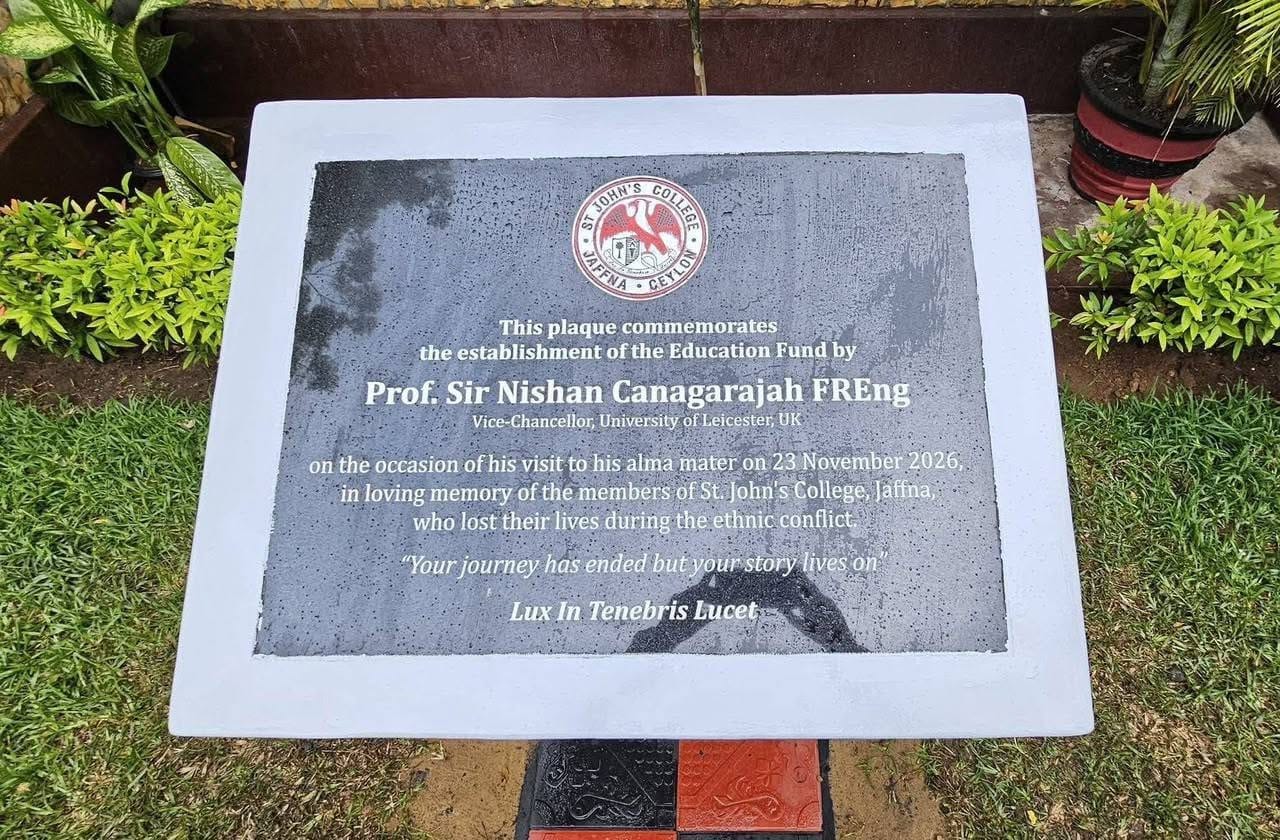
At a special assembly at St. John’s College, where he studied from 1973 until he finished his A-levels in 1985, he unveiled a plaque that reads: “In loving memory of the members of St. John’s College, Jaffna, who lost their lives during the ethnic conflict. Your journey has ended, but your story lives on.”
The money, from his own funds, will establish a Student Opportunities Fund at the college. “We remember them not only for the futures that were taken away from them, but for the lives they lived and the place they will always hold in this school’s history,” he told the assembly.
He linked the gift to the history of his own university. Leicester began in 1921 as Leicester, Leicestershire and Rutland University College, built with money raised from the public on a site donated by a local businessman, Thomas Fielding Johnson, as a living memorial to the local people who made sacrifices in the First World War. Its Latin motto, Ut Vitam Habeant, means “So that they may have life.” The words, proposed by the college’s principal at the time, Robert Rattray, and adopted in 1922, come from the Gospel of John. In the Latin Vulgate, Jesus says, “Ego veni ut vitam habeant, et abundantius habeant,” rendered in the King James Bible as “I am come that they might have life, and that they might have it more abundantly.”
The visit, arranged by the British Council, is his first to Jaffna in two years and his first since King Charles III knighted him for services to higher education. Alongside the remembrance, he is using it to argue that young people in the North need more places to study at home, including at private universities.
His trip falls in the week before Maaveerar Naal on 27 November, when Tamils across the North and East remember those who died fighting for the Liberation Tigers of Tamil Eelam. The plaque makes no distinction among the dead. Asked in an interview with Jaffna Monitor on Monday evening whether the memorial included Johnians who had died as members of the militant groups, Sir Nishan said it was meant for everyone from the school community who was lost in the conflict.
For St. John’s, an Anglican school founded in 1823, the war is part of its own history. Its principal, C. E. Anandarajah, was shot dead in Jaffna in June 1985, the year Sir Nishan completed his schooling there.
Some of his classmates took a different road. In an interview with Jaffna Monitor in January, his first after the knighthood was announced, Sir Nishan said many of his school friends had joined the armed groups, and many of them had died. One close friend, Mahendraraja, left school at about 18 to join “the movement” and later lost his life. Another schoolmate, Raheem, went on to serve as a spokesman for Kittu, the Tigers’ Jaffna commander.
“I often asked myself whether I was being selfish by not doing the same, by not doing what I thought might be expected of me for the community,” he said then. Asked what he felt when he thought of those classmates, he said it was grief, guilt and gratitude at once, and that “some of the things I have been able to do may not have been possible without what they went through and what they did.”
Sir Nishan grew up poor. His parents were both teachers, but the family never owned a house and moved between rented homes every couple of years. He borrowed boots to play football, and there were times he went to school without food. His father died when he was 15, after three nights in Jaffna Hospital with his son at his side.
At school he was senior prefect and captained the football, hockey, basketball and athletics teams. The college’s principal, V. S. B. Thuseetharan, who was a year behind him at St. John’s, told Monday’s assembly that he had run alongside him in a relay team that set a ground record in 1984.
A scholarship scheme set up for students from the North after the 1983 riots took him to Christ’s College, Cambridge, where he earned his degree in 1989 and his doctorate in 1993. He joined the University of Bristol as a research assistant, rose to pro vice-chancellor for research and enterprise, and in 2019 became Leicester’s first vice-chancellor from an ethnic minority.
“I had opportunities. I was given opportunities,” he said on Monday. In his speech to the students, he put the lesson as an instruction: “When a door opens for you, hold it open for the next person.”
On Monday he signed a memorandum of understanding between the University of Leicester and Northern Uni, a private campus in Kantharmadam run as a joint venture between the Sri Lanka Institute of Information Technology and Indrakumar “Indy” Pathmanathan, a Canadian investor. Sir Nishan said Mr. Pathmanathan approached him after the knighthood and asked for his help and guidance in developing education in Jaffna.
Under the agreement, he said, Northern Uni will be able to learn from Leicester, and its students may in future be able to earn Leicester degrees.
He also met Thirunavukkarasu Velnampy, the University of Jaffna’s vice-chancellor, and the deans of its faculties. Leicester and Jaffna already collaborate on archaeology and the reconstruction of ancient sites, he said, and they discussed expanding into health research. He attended a celebration at the Centre for Digital Epidemiology at the university’s Faculty of Medicine, which he opened in March 2023.
St. John’s old boys in Colombo are hosting a dinner for him on Tuesday to mark his knighthood. He is scheduled to meet Prime Minister Harini Amarasuriya, who also holds the education and higher education portfolio, on Wednesday, and the University Grants Commission and senior university leaders on Thursday, to discuss how he can work with Sri Lankan universities and link them with Leicester.
Of Jaffna itself, he said he saw little that was new. “There is this hunger to do well in education, but there are limited opportunities,” he said. “People still think life is better abroad and they want to go.” He said he had not seen it himself, but people had told him about the prevalence of drugs and alcohol abuse. “That is concerning,” he said.
His answer to the shortage of opportunity places him in one of Sri Lanka’s longest-running debates over education. Degrees at state universities are free, and attempts to open private degree-granting institutions, medical colleges above all, have met fierce resistance from student unions and the government doctors’ union. In 2017, after months of strikes by state doctors and class boycotts by medical students, the government announced it would abolish the South Asian Institute of Technology and Medicine, a private medical college outside Colombo.
Asked about that resistance, Sir Nishan said the question was one of capacity. “Sri Lanka has so many talented students, but they don’t get the opportunity to go to university and pursue higher education,” he said. “So there are two options. One is, the government can create more opportunities. But if it can’t, it needs to allow other providers to provide that service, because otherwise these students are going abroad, and we should be retaining the talent.”
Asked whether that should hold for all disciplines, he said, “Absolutely.” In January he made the same case for medicine, citing India, where opposition to private universities gave way once the government accepted that the state alone could not meet demand. Students who fail to win places at state universities go to India, Bangladesh or Dubai if their families can afford it, he said then. “Why not allow them the opportunity to study medicine in Sri Lanka itself, under a properly regulated system?”
Students he met at the University of Jaffna on Monday, he said, all wanted to know what opportunities there were for them in England. “They want to go to good universities, but they also know it can be very difficult,” he said.