
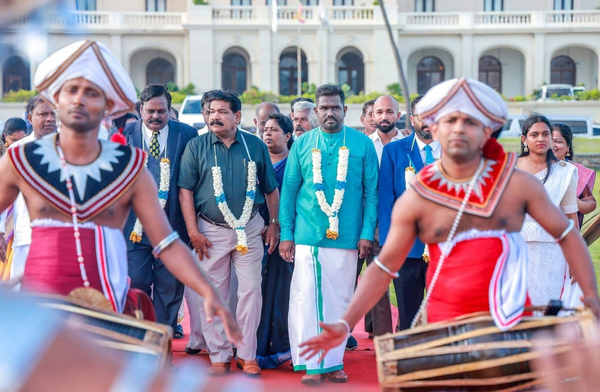
COLOMBO, Sri Lanka — A social activist has challenged the way credit was assigned for a Bharatanatyam performance that set a Guinness World Record in Colombo over the weekend, arguing that the thousands of students and teachers central to the achievement were overlooked while recognition went to the event's private organizers and a single instructor.
The activist, Rajkumar Rajeevkanth, laid out his objections in a series of social media posts on Monday, a day after more than 5,000 dancers performed in unison at Galle Face Green, the seaside promenade in the Sri Lankan capital. He congratulated the participants but questioned the event's organization, financing, and official recognition.
The performance, billed as the largest Bharatanatyam dance lesson, was jointly organized by Sangamam Global Academy of India and the Sri Lankan group Sangamizh Liya. It drew dancers from Sri Lanka, India, and other countries and was attended by senior Sri Lankan ministers and officials.
Among those taking part were the fisheries minister, Ramalingam Chandrasekar, and the deputy minister of plantation and community infrastructure, Sundaralingam Pradeep, both members of the governing National People's Power.
The offices of the two ministers, along with social media accounts aligned with them, promoted the achievement as a national triumph, with their media teams highlighting the efforts the politicians had invested in helping secure the record.
That, Mr. Rajeevkanth and a number of parents said, was precisely the problem. If two sitting government ministers had worked so hard to land the record, they asked, why did it belong, in the end, to a private company and a single foreign instructor rather than to the state or to the thousands who danced?
Mr. Rajeevkanth said the certificate named only Sangamizh Liya Holidays (Pvt.) Ltd. of Sri Lanka, Sangamam Global Academy of India, and an Indian dance teacher, T. Venmani Selvi, as the record holders. The thousands of students and the Sri Lankan instructors who trained them, he said, went unmentioned.
"The names appearing on the certificate are those of the organizations and the Indian dance teacher," he wrote. "But the students and teachers from across Sri Lanka are the true owners of this achievement."
He also said parents, students, and dance teachers had lodged numerous complaints about how the event was run. Among them, he wrote, were that participants had each been charged about 4,500 rupees, or roughly $15, to take part, with families bearing additional costs. He asked how the money collected had been spent and whether regulators had adequately overseen the program.
By the participants' own arithmetic, the registration fees alone — about 4,500 rupees from each of more than 5,000 dancers — would have brought in more than 22 million rupees, or roughly $75,000. The expense did not end there. Many of the performers had traveled from the Tamil-majority north and east regions, still rebuilding from the country's long civil war, and parents said the students were left to arrange and pay for their own transport, board, and meals in the capital. Some families spent at least 20,000 rupees, about $65, per child on top of the fee, they alleged — no small sum in areas where household incomes remain among the lowest in the country.
Though the event was promoted under the patronage of government ministers, Mr. Rajeevkanth argued, the recognition tied to the record had accrued to private entities and an individual rather than to the performers.
"If this was a national achievement made possible by our students and teachers, why are only the organizers and one teacher named?" he wrote.
He called on the government to ensure that future large-scale cultural initiatives prioritized the recognition of participating students and teachers over private or commercial interests.
The organizers did not respond publicly to the allegations. The offices of Mr. Chandrasekar and Mr. Pradeep did not immediately respond to the criticism. The claims about participant fees, the use of the funds, and the precise wording of the Guinness certification could not be independently verified.