

By A. Muttulingam
Translated from Tamil by eḻuttukkiṉiyavaṉ
As I write this story, a court case in Pakistan is dominating the headlines. It is about a popular song one hears in every bazaar and shanty in Pakistan. It goes as follows: Ne Parveen tu bari namkeen—Hey, Parveen, aren’t you very spicy! The song was generally popular among young men and women, except for one woman named Parveen who did not like it. The singer-songwriter behind this song was Abrar ul-Haq. The woman sued him alleging that the song was an insult to her and womankind. If the court decides in her favor, Abrar ul-Haq may spend the bulk of his remaining life not singing but gulping down bland flavorless roti in prison.
The case reminded me of my sister, who also took a dislike to a song when she was young. She was known by many names. At home, she was referred to as akkā (elder sister), thaṅkachchi (younger sister), Rāsu, or Rājēsvari. Only when the census takers came by did we discover her real name: Parvatharāsakumāri. To this day, I marvel at the sheer stamina my parents must have summoned to come up with such a name.
Once, my sister—Parvatharāsakumāri alias Rāsu alias Rājēsvari—returned home right in the middle of a school day, sprinting at breakneck speed. She didn’t even bring back her school bag. Everyone else froze with alarm, but my mother shooed us away. Soon, we learned that akkā had “come of age,” becoming a woman. As soon as her “saree ceremony” was completed, our father announced that akkā no longer needed to go to school. Never before had I witnessed the joy that blossomed on akkā’s face when she heard that.
But our father had a secret plan that akkā’ didn’t know about. Had she known, she would have scrambled back to school right away. Instead, she dreamt of lounging all day in our backyard hunting for tamarind pods or raw mangoes, of playing kokkāṉ, the pebble-throwing game, for hours on end, and of hiding in some corner where no one could find her and losing herself in a book.
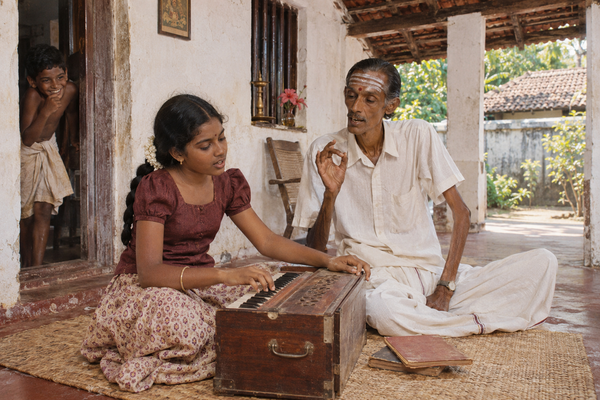
One day, a tall, emaciated man came to see our father. He wore the holy ash and a poṭṭu on his forehead, and carried an umbrella tucked under his arm. The way he walked, swinging his free hand, was bizarre. His form was like that of a tall stalk of grass, bending at the top, unable to bear its own weight. He looked as if he might break in two if he sat down abruptly. We took bets amongst ourselves as to who he was: a cattle broker, an astrologer, an umbrella repairer. All our guesses proved wrong. He was the music teacher my father had arranged to put a swift end to my akkā’s dreams of a carefree future. His name was Bālakrishnan. He was charged with deciding what akkā was to learn over the next four years.
My mother laid out the least-torn mat. As soon as the music teacher sat down, he was to be served a mug full of water; that responsibility fell on me. He would crane his neck towards the roof ridge, like a magician preparing to swallow a sword. He would lift up the mug with both hands, raise it above his head, and slowly tilt it downward. The stream of water would descend into his throat like a waterfall without even a single drop spilling to the floor. He would gulp down the entire contents of the mug in one go. Had the mug been larger, I thought he would still have gulped down the whole thing.
Akkā’s torture began with the musical notes. They enveloped the house at all hours of the day. Akkā was not blessed with a natural aptitude for music. My mother would colorfully compare akkā’s rasping voice to the teeth of palmyrah petioles. Anxious to complete the work the music teacher assigned her, akkā sang at the top of her voice. The walls, the roof, and the floor reverberated, as if the entire house shuddered involuntarily.
On beautiful evenings, instead of roaming the backyard, playing pallānguzhi, or reading a book, akkā sat in front of a harmonium and sang the saraḷi varisai, the first musical exercise for beginners in which they repeat each of the seven musical notes in sequence. Even after she finished it, she would go on, unable to stop, with jaṇta varisai, where each note is repeated, in sequence.
sa-sa ri-ri ga-ga
sa-sa ri-ri ga-ga ma-ma
ri-ri ga-ga ma-ma
ri-ri ga-ga ma-ma pa-pa
It was pathetic to watch her toil like this, day after day. Whenever I happened to pass by where she was sitting, I would lean over to jab a white key or a black key on the harmonium, making it produce a dissonant wail. Akkā would raise her hand to smack my wrist and chase me away, saying “chee, get lost!”
Bālakrishnan had trained in music in India, though not well enough to perform on stage himself. He had memorized a handful of classical Carnatic kīrttaṉai songs that were popular at the time. When he returned to Sri Lanka, equipped with these songs, his musical expertise was only good enough to offer private music lessons to students in their own homes.
Once akkā became reasonably proficient in reciting musical notes, the music teacher taught her to sing the kīrttaṉai song yārō ivar yārō—Who is he? Who could he be? The eighteenth-century poet-composer Aruṇāchala Kavi had toiled day and night to compose this exquisite song in raga Bhairavi, which, thanks to akkā’s rote memorization, transmogrified into unrecognizable doggerel. The teacher was not satisfied. “Listen child, this is the scene when Lord Rama and Sita meet for the very first time. Sita sings in anguish because she doesn't know who Rama is. Pour that anguish into your voice. Sing with feeling, child, with feeling!” he would say.
Akkā took these words to heart and sang with so much feeling at all times, as though she was melting like a candle. Her plaintive wail was heard throughout the house and on to the road outside. My father did not like it one bit when some wag going by our house heard the lament and responded, “It is me!” He could not identify the offender. So, he banned the song. This was his first ban.
The music teacher did not quite understand why the song was banned. But undaunted, he moved on to the next kīrttaṉai.
Go find out why, my friend,
My beloved is yet to turn up,
Go find out why.
Akkā practiced this song, written in the raga Pantuvarāli, relentlessly. Just when it looked like everything was going well and everyone had been lulled into believing that everything would continue to go well, my father banned this song, too. He had been told that there was a young man called Sithamparanāthan in some distant corner of our village and promptly issued the prohibition order. The music teacher was irritated because he still could not figure out why his songs kept being banned. My father did not bother to explain to him either. The teacher, upset with this arbitrary sequence of bans without explanation while he was still in the middle of teaching a song, took it as a personal insult. Akkā, too, was vexed because each ban took away the opportunity for her to proudly display her newly acquired skill.
The next kīrttaṉai brought the conflict between my father and the music teacher to its peak. This time, the teacher chose the next song with utmost care, a kīrttaṉai by Gopālakrishna Bhārati. It began:
When will he come,
To take my troubles away,
When will he come …
This was the pallavi, the refrain. Akkā practiced it for a month, belting it out with true feeling. Once she mastered the pallavi, they moved on to the anupallavi, the second stanza. Neither my father nor the music teacher realized that the anupallavi had a mine waiting to go off. Akkā, poor soul, was totally oblivious.
When will he come,
To take my troubles away,
When will he come,
Sithamparanāthan didn’t utter a word.
My father felt dizzy. He pounced on the hapless music teacher, asking him why he had concealed this incendiary anupallavi for a month.
“What is this, I say! You keep teaching her about Sithamparanāthan?” he demanded.
“What can I do?” responded the beleaguered teacher, “I can only teach her what I know. This is the name of Lord Siva. If it is not this name, then it would be some other name for him. Did I write this song myself? I have had enough of this nonsense!”
He shook his sālvai, threw it over his shoulder, and stood up abruptly to leave. He almost hit the ceiling. Somehow, both calmed down and made their peace.
The music teacher’s repertoire of songs was being exhausted rapidly. Before starting on the next song, he read the entire song to my father. It did contain a male name. My father made thorough inquiries to make sure that there was no young man in our village by that name. He then gave his consent to proceed.
The sight of Kaṉagasabāpathy, one day,
Will take my troubles away.
Among all the songs that she learned during her music tutelage, this was the one she sang with the utmost feeling, savoring every word. She practised it for many months and her renditions became flawless. When she sang this song, joy and sorrow melded seamlessly within her. Whenever we had visitors, akkā sang this song. Even the saint Nandaṉār, an ardent devotee of the deity in question, could not have sung this song with so much feeling as akkā did.
One day, the end came from a totally unexpected direction. When the music teacher asked akkā to sing the song, she flatly refused. My mother and father tried to persuade her, to no effect. When she was asked why she had changed her mind suddenly, she remained silent, tightly clutching the harmonium, her head bowed, and her teeth sunk into her lower lip. Days turned into weeks, and weeks into months, but nothing changed. For reasons known only to her, she had taken a permanent dislike to that song, and it remained banished forever from her repertoire.
Fifty years had passed since all this happened. Recently, I reminded her of her music tutelage when she was a budding young woman. She had no recollection. I asked if she remembered Yārō Ivar Yārō. She shook her head. Nor did she remember When will he come, to take my troubles away or Go ask for the reason or any of the other songs.
“The sight of Kaṉagasabāpathy?” I asked.
A certain brilliance, like being lit by the headlights of an oncoming car, flickered on her face and disappeared. I told her the story about the Pakistani young woman—the woman who did not like a song and sued the songwriter.
“Who knows what troubles she faced?” akkā replied.
“At least she had a reason.” I said, “She felt that the song degraded women. Would she have sued if the song had said, “aren’t you very sweet!”
Akkā pondered this for a moment, “‘You are very sweet!’ would be a lie; ‘spicy’ is the truth, truth hurts.”
“But why did you refuse to sing the Kaṉagasabāpathy song? Everyone was begging you,” I asked.
Akkā looked up directly into my eyes and said sternly, “Why? Are you going to write a story?”
Akkā had been a widow for a decade. Her children had all started their own families.
“There is no longer anything for you to be concerned about. You can tell me. What happened?” I pestered again.
Akkā fixed her gaze at a point halfway between her and me. Her teeth bit into her 68-year-old lips as she thought about my question.
“Was it love?” I asked. Akkā raised her hand to smack my wrist and chased me away, saying “chee, get lost!”
Her music tutelage continued even after she refused to sing the Kaṉagasabāpathy song. When the music teacher taught her Mārimuttu Piḷḷai’s, With one foot raised in divine dance, there was no opposition from anyone. My father had approved that song after making doubly certain that it featured no male names. Akkā gave it her all. Her rendition was perfect. When she sang, “The child wielding the spear,” the veins on her throat would puff up, turn blue, and push against her skin. But she could never muster the depth of feeling with which she used to sing ‘The sight of Kaṉagasabāpathy. I believe that was the last song she learned. Thereafter, my father stopped the tutelage, perhaps it was because akkā fathomed the depths of the musical sea.
Although it was Akkā’s last song, it achieved the status of the first song in our village. Its fame grew day by day in Kokuvil and the surrounding villages. The foot raised back then has not been put down to this day.