

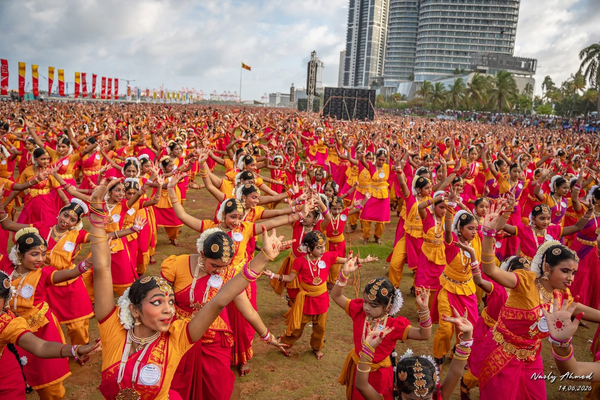
COLOMBO, Sri Lanka — The organizers of a Bharatanatyam performance that set a Guinness World Record in the Sri Lankan capital recently have found defenders among people familiar with how the event was arranged, who say that the costs borne by participants and the process for obtaining official certificates were spelled out well in advance and accepted in writing.
The pushback follows criticism from social activist Rajkumar Rajeevkanth, as well as several parents and activists, who argued in a series of social media posts that the thousands of students and teachers central to the achievement had been sidelined while recognition was given to private organizers and a single foreign instructor, despite participants paying registration fees.
According to people with knowledge of the event’s organization, who spoke on the condition of anonymity, dancers, teachers, and participating institutions were told before the performance that they would have to cover their own expenses, and the procedure for receiving Guinness certificates was explained to them in detail. Participating institutions, these people said, signed undertakings acknowledging those terms.
The certificates at the center of the complaint, they added, are sold by Guinness World Records to individual participants and are not issued free of charge by organizers — an arrangement they described as standard for record attempts of this kind, given that both the event and the record-keeping body are private.
That account aligns with Guinness World Records’ own published practices. The London-based, privately held company routes mass-participation attempts through a paid consultancy division and treats attempts undertaken for commercial or promotional purposes as fee-bearing agreements quoted on a case-by-case basis. Individuals who take part in a successful mass attempt are offered the chance to buy a personalized Certificate of Participation — recently priced at roughly $29 for a printed version and about $10 for a digital one — using serialized codes that organizers are responsible for distributing. Inviting an official adjudicator to verify an attempt on site, the company says, starts at £4,500.
Under that model, the people familiar with the Colombo event said, the naming of the organizing companies and the lead instructor on the record documentation, and the requirement that participants pay for their own certificates, reflected Guinness’s procedures rather than any diversion of credit or funds. They characterized the online criticism as the work of commentators unfamiliar with how such records are administered.
Mr. Rajeevkanth, in his posts, had congratulated the more than 5,000 dancers who performed in unison at Galle Face Green, the seaside promenade in the capital, but questioned the event’s financing and recognition. He said participants had each been charged about 4,500 rupees, or roughly $15, and that many families from the Tamil-majority north and east, among the poorest regions in the country, still rebuilding from the long civil war,had spent considerably more on travel, board, and meals. By the participants’ own arithmetic, the registration fees alone would have exceeded 22 million rupees, about $75,000. He called on the government to ensure that future cultural initiatives prioritized the recognition of participating students and teachers over private or commercial interests.
The performance, billed as the largest Bharatanatyam dance lesson, was jointly organized by Sangamam Global Academy of India and the Sri Lankan group Sangamizh Liya, and drew dancers from Sri Lanka, India, and elsewhere. It was attended by senior officials, including the fisheries minister, Ramalingam Chandrasekar, and the deputy minister of plantation and community infrastructure, Sundaralingam Pradeep, both members of the governing National People’s Power. Their offices had promoted the record as a national triumph — a framing that, for the activist and some parents, sharpened the question of why the recognition ultimately attached to private entities and one instructor rather than to the state or to the dancers themselves.
Several elements of the competing accounts could not be independently verified. They include the existence and precise terms of the written undertakings said to have been signed, and how the registration fees were spent. The organizers have not responded publicly to the activist’s allegations, and the offices of Mr. Chandrasekar and Mr. Pradeep did not immediately respond to requests for comment. The people who defended the event’s organization declined to be identified.