
By M.R. Narayan Swamy
Former intelligence chief Suresh Sallay may or may not be involved with the deadly 2019 Easter bombings in Sri Lanka, but the carnage will rank among one of the worst examples of officials failing to act despite pin-pointed, credible and actionable intelligence received in advance about the impending disaster.
The island nation’s security establishment has been shaken although it was anticipated by many that Sallay could be taken into custody someday over the terror attack which killed 279 people and injured hundreds.
It has been alleged that Sallay, who had ceased to head the military intelligence when the bloodbath occurred and later became the country’s intelligence chief, had links with the perpetrators and permitted the gruesome bombings to go ahead with a political motive in mind.
Apparently, Sallay wanted former Defence Secretary Gotabaya Rajapaksa to come to power. Indeed, two days after the mass slaughter created widespread revulsion, Gotabaya announced his candidature for the presidency and went on to win the elections with a thumping majority.
One of Gotabaya’s first decisions as the president was to appoint Sallay as head of Sri Lanka’s State Intelligence Service (SIS), betraying the suspicion. On his part, Sallay has repeatedly denied the charges and the insinuations regarding his role.
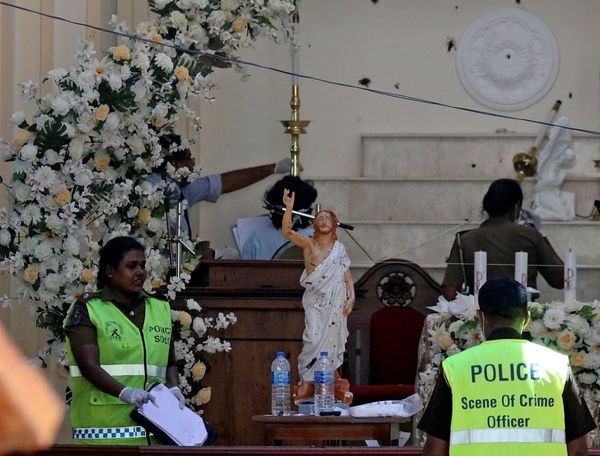
The coordinated multiple explosions on Easter Sunday (April 21, 2019) targeted three churches in Sri Lanka (two Catholic and one Protestant) and three luxury hotels in Colombo. Two smaller blasts also took place. The dead included 45 foreigners, three police officers and eight suicide bombers.
An overwhelming majority of the dead were Sri Lankan Christians. It was the worst massacre in the country since the long-drawn ethnic conflict ended in May 2019. Curiously, although one of the targeted churches was highly revered, no notable VIP was present despite it being the Easter holiday.
It is by now public knowledge that an Indian agency passed on highly credible intelligence which, had it been acted upon, could not only have failed the murder conspiracy but also led to the arrests of the bombers.
Sadly, the inputs received were not followed up. No amount of planning by the terrorists and no amount of overt or covert help they allegedly received from anyone within Sri Lanka or outside could have succeeded in killing people en masse if the warnings had been heeded.
The year 2021 was the first time the Indian intelligence tip-off was brought to light by Asanga Abeyagoonasekera, who was then the Director General of the Institute of National Security Studies Sri Lanka.
Later Sri Lankan court documents which became public knowledge showed that the Indian intelligence had shared specific, actionable intelligence multiple times in the days and even hours leading up to the horrific bombings.
The warnings included information on the threat to the churches and hotels (most of which ended up being targeted) as well as the Indian High Commission in Colombo (which was not attacked).
The Indian intelligence input also correctly identified the Islamist group involved in the planning as the National Thowheeth Jama’ath or NTJ, which was linked to the Islamic State of Iraq and the Levant (ISIL). ISIL leader Abu Bakr al-Baghdadi praised the bombers. But Sri Lankan authorities say the Islamic State was not directly involved in the killings.
The Indian intelligence also warned that the NTJ’s intention was to target Catholic churches, particularly during Easter services. This information was the closest to when the attacks would likely take place.
The first Indian intelligence alert was communicated to the Sri Lankan counterparts on April 4. The next tip came on the night of April 20, a day before the bombings.
The third and final warning – almost beseeching for urgent action – was made on the morning of April 21 – two hours before the carnage.
It is not clear if the information from India was based on an Islamist in Indian custody or technical intelligence. Either way it was almost precise. (It is known that supporters of the NTJ were also active in Tamil Nadu.)
The Indian tip proved futile because nobody in Sri Lanka’s then dysfunctional government – President Maithiripala Sirisena and Prime Minister Ranil Wickremesinghe were not even on talking terms – failed to act and thus save innocent lives. Sirisena was in Singapore at the time of the bombings while Wickremesinghe, who much later became the president, claimed he was never shown any of the intelligence information.
Sri Lanka’s Supreme Court relied on this Indian intelligence reports which were ignored to direct high-ranking officials, including Sirisena, to pay a huge monetary compensation to the victims of the terror attack. In a clear after thought, Sirisena, after ceasing to be the president, sought to blame India for the attacks, claiming this was told to him by an Indian diplomat himself!
Sri Lankan media have also reported a similar warning regarding a potential terror attack given by a police chief 10 days before the fated Eastern Sunday. This warning – almost a week after the first Indian alert -- also referred to the NTJ group, which was founded by a Sri Lankan, Mohammaed Zahran alias Zahran Hashim.
It was a Sri Lankan Muslim close to a former Tamil chief minister of Sri Lanka’s eastern province who made the allegation against Sallay in an interview to Britain’s Channel 4 in 2023. The Muslim man is seeking asylum in a European country. This gave birth to the needle of suspicion about Sallay, who has now been remanded to 90 days in custody under the Prevention of Terrorism Act.