
By M.R. Narayan Swamy
“For every Sinhalese soldier killed, we will kill a thousand Tamils!”
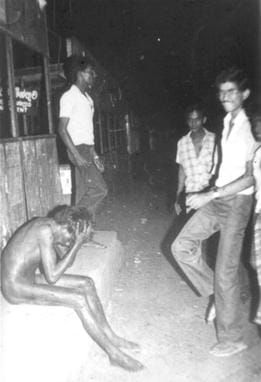
This was the war cry echoing on the streets of strife-hit Colombo in July 1983 as Sharmala Kanagasundram and her family sped to safety in a car while vicious anti-Tamil violence swept the Sri Lankan capital.
Sharmala, her husband Ajit, and their three young boys were part of the Colombo elite and led an idyllic life. They were sure they could be happy in the country until Ajit retired from the Central Bank.
Fate willed otherwise. Their world was thrown into turmoil once the Tamil Tigers ambushed and massacred 13 Sri Lankan soldiers in faraway Jaffna on the night of July 23-24, 1983.
In a very readable recount of her family’s rise, fall, and rise, Sharmala says the horrendous violence was planned by senior ministers Cyril Mathew, Gamini Dissanayake, and Lalith Athulathmudali, with the green light coming from none other than President J.R. Jayewardene.
The carefully planned mayhem not only killed hundreds of Tamils and made thousands homeless, but it also shattered the faith of the Tamil minority in the very concept of Sri Lanka, forcing tens of thousands to flee the country for safety and greener pastures abroad.
The savagery also metamorphosed a nascent Tamil militancy, until then largely confined to Jaffna, into a full-fledged insurgency across the north and east of Sri Lanka, which at one point threatened to break up the island nation.
That was not on the minds of any of the battered and frightened Tamils as they tried to cheat death at the hands of Sinhalese thugs who, with the blessings of the state, seemed to be armed with a license to kill at will.
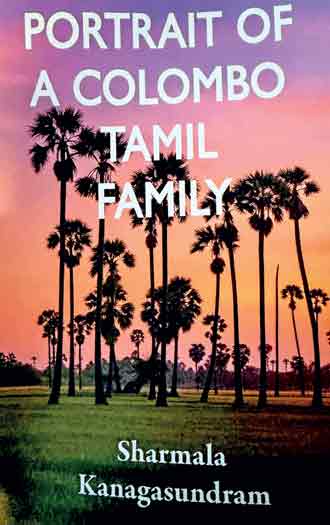
“For our family, the world turned upside down. From a well-settled and integrated upper-class family, we were overnight turned into stateless refugees,” Sharmala says in the Portrait of a Colombo Tamil Family (Vijitha Yapa Publishers).
It was a Sinhalese friend who drove Sharmala and the children to a safe house that day. The journey was terrifying. The roads were filled with men with glassy, drugged eyes, looking for Tamils to kill.
This is when she heard the mobs shouting in Sinhala: “For every Sinhalese soldier killed, we will kill a thousand Tamils!”
After a couple of hours, the distressed family shifted to Sharmala’s husband’s grandmother’s house, Ratna Bhavan, which was deemed safer as it was located in front of the President’s house.
Her husband Ajit, was at the Central Bank when he was warned by colleagues not to drive home on his own as he was a Tamil.
As he sat on the pillion on a colleague’s motorcycle, a shocked Ajit saw innocent and screaming Tamils being pulled out of their cars and slaughtered. Policemen and soldiers looked the other way.
Eventually, he too reached Ratna Bhavan, which by then was sheltering 52 shaken Tamils – friends and relatives from Colombo and its suburbs.
The family’s tragic moments were not over.
The family estate at Hokandara, about 16 kilometres from Colombo, was burnt and vandalised by frenzied trade union leaders affiliated to the ruling United National Party (UNP).
As if sadism has no limits, the vandals chopped the throats of all the dairy cows at the estate. Did the cows speak Tamil?
Crucially, the flames lit at the estate also consumed the draft of a completed exhaustive research of the constitutional history of Ceylon prior to independence. Authored by Ajit’s late father, who worked on it for five years, it was about to be published.
That was it. A stunned Ajit got tickets for the entire family to fly to Singapore the very next day.
A friend, Anton Balasuriya, drove the family to the Katunayake international airport at great personal risk. The violence was still raging in the city.
Ajit and Sharmala saw mobs setting fire to cars with Tamils. There was none to save them. It appeared that the Sri Lankan state was massacring Tamils.
Assuming the occupants in Balasuriya’s cars to be Sinhalese, some in the mob approached them with a request: Mahathaya, Rata Jathika sevaganna petrol tikkak thenna! (Sir, to save the country and the race, please give us some petrol.)
The family learnt that the person who led the mob to the Hokandara estate was none other than a local Buddhist Monk with whom Ajit was very friendly and to whose temple he donated food every month.
Ajit, who later went on to build a fabulous career with Citibank in Singapore, told his equally agonizing wife in 1983: It is clearly the end of the road for Tamils in Sri Lanka.
The Sharmala-Ajit family was no ordinary Tamil family. They were one of the leading Colombo families for eight decades. Ajit’s grandfather, Lambert Navaratnam, was a medical doctor of excellence and was reputedly one of the highest income tax payers in colonial Ceylon.
Ajit’s father, K. Kanagasundram, was the Chairman of the Gal Oya project from 1952 to 1957. This was the brainchild of Sri Lanka’s first Prime Minister, D.S. Senanayake, who wanted to settle Sinhala colonists from the Kandyan area to undo the injustice done to them when the British expropriated their ancestral lands.
Once, Federal Party leader S.J.V. Chelvanayagam told Kanagasundram: “Young man, do you realise that you are driving a dagger into the heart of the Tamil people?” He told Chelvanayagam that he had witnessed the dire land hunger of the Kandyan peasantry as the assistant government agent at Kegalle, and that the lands colonized were uninhabited jungle.
Whatever the case, once the SLFP came to power in 1956, Kanagasundram was unceremoniously eased out as the Chairman. Minister Philip Gunawardene told the new Prime Minister, “We can’t have a Tamil in such a powerful capacity”. The civil service protested. The government realised it had done an injustice to a highly respected civil servant. So, it made him the Deputy High Commissioner in London. He accepted the post but later died a broken man.
Ajit Kanagasundram is a frequent visitor to Sri Lanka, where he has plenty of friends. In his part of the book, he compares Sri Lanka with Singapore, where he still lives, and explains lucidly why the city-state is a global success story, whereas the island nation, after showing great promise, has failed on most counts.
Singapore’s founder-leader Lee Kuan Yew, never allowed the Chinese majority, to which he belonged, to dominate over Malays and Indians. Mandarin, Malay, and Tamil have equal status as national languages. Indeed, the Singapore national anthem is always sung in Malay. (Remember the hullabaloo when the Sri Lankan national anthem was sung in Tamil a few years back?) The executive presidency is rotated among the three races in Singapore. The Chinese accepted this as they realised that it was necessary to build a united country in a multi-ethnic community before economic progress could be achieved. Singapore is among the least corrupt countries. Sri Lankans know more than anyone else where their country stands vis-à-vis corruption. The Singapore elite, Ajit says, do not take Sri Lanka seriously as a business partner.
Ajit has ideas for a better Sri Lanka. In the north and east, he wants Tamil-speaking policemen to be recruited so that Tamils can make a report or complaint in their own language. He wants Provincial Councils to be activated. He says that Tamils are ill-served by politicians who prefer confrontation with Colombo. “They prefer grandstanding to the Tamil Diaspora and making impractical demands for ‘Tamil self-determination’ and a federal state, blithely ignoring the reality that more Tamils live in the Sinhala south than in the north after 25 years of war!”
He suggests the implementation of the “River for Jaffna” project, first advanced 60 years ago, to block the exits to the sea from the Elephant Pass lagoon, thus turning it into fresh water after two monsoons. He also advocates improving dairy farming in Jaffna, preferably with the involvement of forward-looking organisations.
Ajit is full of praise for the all-round progress achieved by neighbouring Tamil Nadu. “Tamil Nadu has achieved this progress because its people are intelligent, humble and hardworking; they do not believe the world owes them a living or depend on handouts. They do not go on strike; there has never been a communal riot; they have embraced science, technology and English… Sri Lanka, too, can profit from their experience if we can only get over our innate sense of superiority over the humble and hardworking South Indian Tamil.”