By Aruliniyan Mahalingam
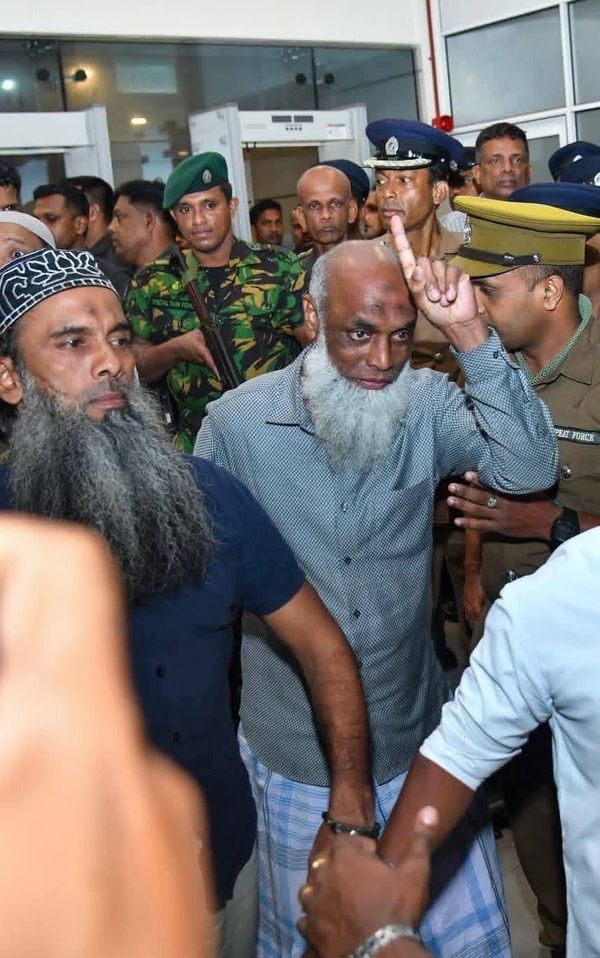
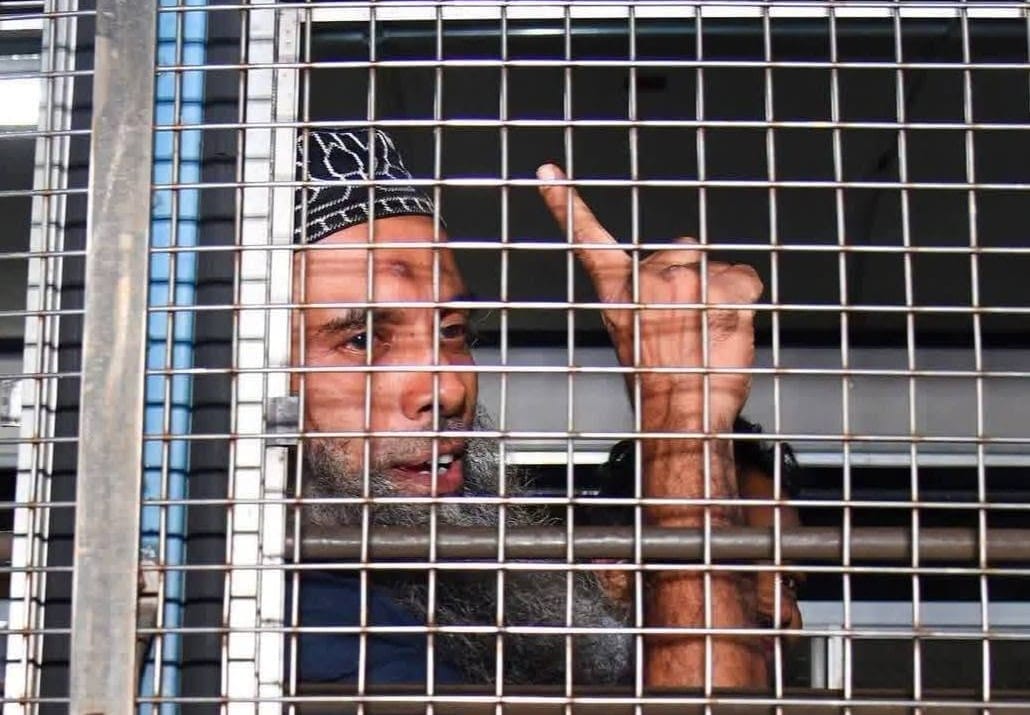
JAFFNA, Sri Lanka — The sentences had just been read: up to 260 years in prison. As they were led out of the Colombo High Court complex, two men convicted over the 2019 Easter Sunday bombings raised their index fingers toward the sky.
In Sri Lanka, that gesture is tied to one man, Zahran Hashim, the preacher who led the attacks.
One of the two was Mohamed Sariboo Adam Lebbe, known as Gafoor Mama. Investigators say he led the killing of two police constables five months before the bombings.
The bombings on April 21, 2019, hit three churches and three hotels and killed more than 260 people. On Sept. 22, a Permanent High Court Trial-at-Bar convicted 15 of the 24 defendants of crimes linked to the attacks.
Within hours, photographs of the two men were circulating across Sri Lankan social media. Some of the sharpest condemnation came from Muslims. Sajeeth Ahamed, a Muslim writer, wrote on Facebook that the pictures shook him. He acknowledged that some Muslims raise a single finger to affirm the oneness of God. But when men convicted of crimes linked to Zahran's attacks use Zahran's own sign, he wrote, it cannot be overlooked. A verdict like that would shake any ordinary person, he wrote, and these men showed no sign of it.
Others traced the gesture to Zahran's family. One Facebook user recalled a video that circulated after security forces surrounded a safe house in Sainthamaruthu on April 26, 2019, five days after the bombings. It was recorded shortly before the deadly confrontation. Zahran's father, Mohamed Hashim, and his brothers Rilwan and Zainee speak of martyrdom and urge violence against nonbelievers. Rilwan calls for jihad while children cry in the background. As the men speak, they raise their index fingers.
"To raise your hand and point to Allah, you must either have walked the path Allah laid down or have been punished unjustly," the user wrote. "Neither is true here."
A sign Zahran made his own
Muslim scholars who spoke to the Jaffna Monitor said the gesture was rarely seen in public in Sri Lanka before Zahran. "It became his signature sign," one said.
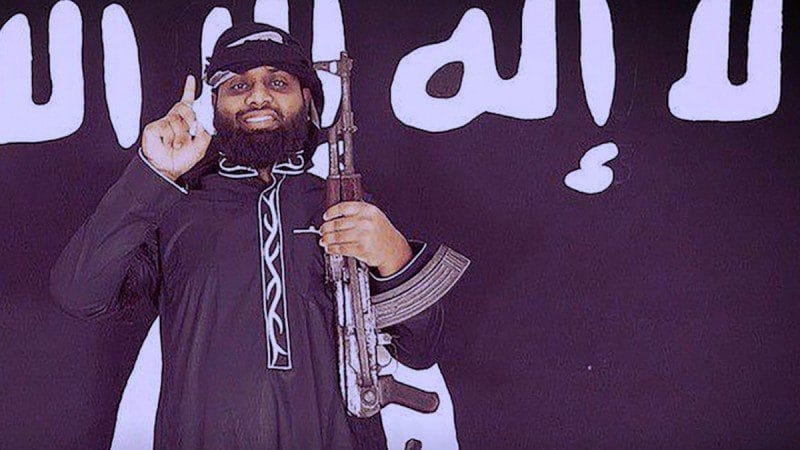
Zahran makes the gesture in many of the photographs and clips that circulated before and after the bombings. The best-known is the video in which he and his associates pledged allegiance to the Islamic State. He was the only one in it whose face was uncovered, and he held up his index finger as he spoke.
The gesture has deep roots in Islam. It is associated with tawhid, the belief in the oneness of God, and with the shahada, the declaration of faith. The account of the Prophet Muhammad's farewell sermon in Sahih Muslim describes him raising his forefinger to the sky and then pointing it at the crowd, asking God to bear witness that he had delivered his message. Muslims also point the index finger while seated in prayer, a ritual separate from the upright gesture seen in the photographs and videos.
Over the past two decades, the Islamic State and other jihadist groups have made the upright finger a staple of their propaganda. Their fighters and leaders are routinely photographed with it raised. The scholars said that in public today it is seen most often when militants claim to act in God's name.
"It is a symbol of religious terrorism," one scholar said.
Another said preachers use it selectively. When they speak of God's love and mercy, he said, the finger stays down.
"When they say that Allah is without equal, that He is loving and shows kindness to everyone, they will not use this sign," he said. "They use it when they are preaching extreme ideas."
He said this included sermons on religious supremacy, attacks on other faiths or sects, declaring others unbelievers, and calls for confrontation in the name of religion. He said the Indian preacher Zakir Naik, whom he accused of radicalising young Muslims in South Asia, raised his finger in the same way when putting forward hard-line views.
Men with second names
The scholars also pointed to the names. At least 10 of the 15 convicted men were identified in the indictment or in court by an Arabic alias beginning with "Abu." Gafoor Mama was prosecuted as Abu Hadeeq, Hayathu Mohamed Milhan as Abu Sila, Mohamed Ibrahim Sadiq Abdullah as Abu Umar, Mohamed Ibrahim Shahid Abdul Haq as Abu Fala, and Mohamed Anwar Mohamed Rizkan as Abu Tariq.
Such a name, known as a kunya, is an old and ordinary part of Arab culture, and the custom predates Islam. Abu means "father of," and Arabs have long used kunyas as respectful or familiar forms of address, often linking a man to his eldest son. A man did not need to be a father to have one. Kunyas could be given in childhood, could be honorary, or could be drawn from a personal trait. One of the best known belongs to Abu Hurayra, a companion of the Prophet Muhammad, whose name means roughly "father of the kitten" and refers to his fondness for cats.
What troubled the scholars was how Zahran's network used these names. Its members took on new kunyas as second identities, as fighters of the Islamic State and other militant groups routinely did. Used that way, the scholars said, a kunya becomes a nom de guerre. It hides a man's legal identity and hands him a new religious and militant persona.
The Islamic State did exactly that with the Easter Sunday bombers. In its claim of responsibility, it named them Abu Hamzah al-Ceyloni, Abu Mukhtar al-Ceyloni, Abu Khalil al-Ceyloni and Abu Mohammed al-Ceyloni, among others. Zahran became Abu Ubaydah al-Ceyloni. Al-Ceyloni means "the Ceylonese," after Ceylon, Sri Lanka's former name. The convicted men's aliases take the same Abu form.
Prosecutors listed those aliases in the charge sheet alongside the men's legal names. One scholar said it disturbed him that, years after the attacks, the defendants were still known by them. He said it left him doubting that they had broken with the ideology behind attacks that killed more than 260 people.
"If they still embrace those identities, where is the remorse for the lives they helped destroy?" he said. "Where is the evidence of any inner change?"
Before the bombings
Gafoor Mama's record goes back to before the attacks. Investigators say he led the group that shot dead two police constables at Vavunathivu in November 2018. After his arrest, he told investigators that Zahran's group was behind the killings. His information led the Criminal Investigation Department to the constables' stolen service revolvers. Investigators later found that a T-56 rifle seized from an extremist safe house near Sainthamaruthu had been used to kill the officers. They identified Milhan and Gafoor Mama as the men who led the attack.
Gafoor Mama was also linked to the March 2019 shooting of Mohamed Razik Thaslim, a coordinating secretary to then-minister Kabir Hashim. Thaslim had helped police investigating the vandalism of Buddha statues in Mawanella and had assisted the inquiry that uncovered the group's explosives and weapons cache at Wanathawilluwa. He was shot at his home. He survived with severe injuries.
The verdict
The Attorney General filed more than 23,270 charges under the Prevention of Terrorism Act, including conspiracy, aiding and abetting the attacks, and murder. Prosecutors alleged that the defendants conspired with Zahran and others to promote extremist ideology and stir religious and communal hostility.
The defendants denied the charges throughout the trial. The three-judge bench rejected the defences of all 15 who were convicted, holding that the prosecution had proved its case beyond reasonable doubt, and acquitted the remaining nine. The convicts were sentenced to between 200 and 260 years in prison, and their property was ordered confiscated.
The two men raised their fingers after the verdict and sentences had been read. Gafoor Mama can appeal his conviction to the Supreme Court.