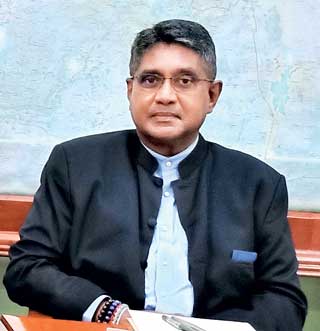

By Jeevan Thiyagaraja
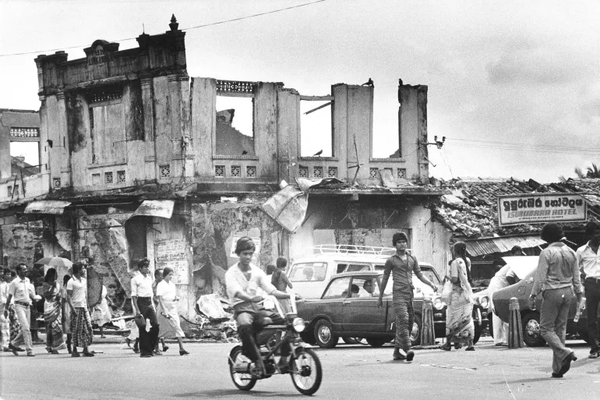
Black July was not a weather event. It means something more disquieting: a set of interlocking failures — constitutional, political, institutional, moral — had been accumulating since independence, so that by the time the Thinnavely ambush of 23 July supplied the occasion, the machinery of a violent, organized pogrom was already lying to hand (Jeyaraj 2021).
One caveat belongs at the front of this account. As in 1958, so in 1983: many officers in uniform attempted, at the ground level, to do their duty. What undid them was not will but authority: the absence, at the critical hour, of orders from the Commander-in-Chief. Inspector-General Rudra Rajasingham pressed for a curfew from the first night; his Senior DIG urged the same. The order did not come until the next day; by then the damage was done.
The same pattern held two days later inside Welikada Prison: an unidentified Sinhalese jail guard in C3 hid the cell keys in a toilet and barred the corridor with his own body, telling the men crowding toward him that they would have to kill him first — alone among seventeen jailors on duty, he held his wing. His courage could not substitute for the curfew order only a President had the authority to give. Commissioner C. T. Jansz's exhausting round of appeals across both massacre days, and Major Sunil Peiris's decision to move his commandos in within twenty minutes of a single call, were likewise courage well beyond duty — neither man's conduct is cited here as anything but that. This is not an exculpation of the state — it is, if anything, a sharper indictment, because the failure was not one of capacity but of will at the very top.
A childhood memory of the fire
I did not read about 23 July 1983. I lived inside it, as a schoolchild, and the memory has never required footnotes.
That morning, a mob of close to four hundred persons set about breaking down the wooden gates of a house owned by the Sir P. Ramanathan Trust. Six of us inside — I was one of them — faced the real prospect of death by burning. We were saved, if the word can be used for something so arbitrary, because the children of the family that owned the Mount Lavinia Hotel next door came out and persuaded the mob not to attack. That same morning, a howling crowd ran across our garden chasing a school van driver, having already set the van on fire. The nights that followed were spent listening for noises in the dark, in case mobs returned. The Parakrama family in the lane beside ours sheltered scores of frightened people, while someone stood guard at the top of the lane through the night. Seeds of hate had already crept into the minds of schoolgoers; one small consequence, years earlier , was my own quiet boycott of an elite group whose culture I would no longer stomach.
The country we knew failed us that week. I say this having served briefly in positions of authority in government myself — which makes the judgment harder to write, not easier. A state does not get to plead extenuating circumstances to a six-year-old, or a nineteen-year-old, cowering behind a wooden gate while four hundred ruffians try to break it down.
The slow unbuilding of a shared state
Sri Lanka did not inherit an ethnic civil war from the British; it constructed one, statute by statute. The Official Language Act of 1956 reversed a cross-party consensus on dual-language policy within two years, making language "a permanent and thus far irreconcilable issue" (Perera 2001, citing Kearney 1967). The 1972 republican constitution deleted the clause barring parliament from legislating to the prejudice of minorities; a joint Tamil reform submission that year was rejected outright (Perera 2001). University admissions, "standardized" from 1971, cut Tamil representation in science faculties from 35.3 to 19 percent by 1975 (Perera 2001) — reversed in 1977, but not before a generation learned the doors were closing by design.
Two negotiated paths existed and were both abandoned: the Bandaranaike–Chelvanayakam Pact of 1957 and the Dudley–Chelvanayakam Pact of 1965, each torn up under pressure from whichever party was, at that moment, in nationalist opposition (Perera 2001). Perera writes it is "generally accepted" that had either survived, the conflict would not have escalated as it did — twice negotiated, twice discarded, because generosity toward a minority can always be outbid at the next election. The Vaddukoddai Resolution of 1976 and the Tamil United Liberation Front's near-clean sweep of northern seats in 1977 on a separatist platform (Perera 2001) read as the electorate's verdict on thirty years of broken pacts.
Post-1977: a government with everything, and still not enough
The build-up after 1977 is its own chapter. Jayewardene's government won five-sixths of parliamentary seats — enough that no opposition arithmetic could threaten it — and used it to rewrite the constitution, instituting an executive presidency while abandoning a pledge to first convene an all-party conference (Perera 2001). In 1981 the Jaffna Public Library was burned by organized UNP "thuggery and terror," destroying some 95,000 books; no one, not even the implicated MPs, was ever prosecuted (Perera 2001). In 1982 the government postponed the next election through a referendum "acknowledged to be full of corruption" (Perera 2001), and made the Prevention of Terrorism Act, introduced in 1979 as temporary, permanent (Perera 2001) — alongside emergency regulations tied to arbitrary arrest, torture and extrajudicial killing (Perera 2001). A government that did not need to cheat, cheated anyway.
The week itself
The ambush that supplied the occasion is documented down to individual names. On 23 July 1983, a fifteen-man Army patrol out of Mathagal was destroyed at Thinnavely by an LTTE unit of nineteen cadres — of a total force then of perhaps thirty full-time members — under Sathasivam Selvanayagam, with Velupillai Prabhakaran among them. Thirteen soldiers were killed; only two survived (Jeyaraj 2021). Reprisal killings by the same battalion in Jaffna took fifty-one civilian lives, including a lecturer and a human rights editor pulled from a van and shot; the battalion's commanding officer proved "either unwilling or unable" to stop them (Jeyaraj 2021).
What happened next is best told in the words of the man who watched it happen from inside the Police hierarchy. Ramachandra Sundaralingam, then Senior DIG of Police in charge of Ranges, sent the following account to journalist D.B.S. Jeyaraj in July 2017 (excerpted below):
"1) Thinnavely LTTE ambush killed 13 soldiers on July 23, 1983. Army HQ informed, President JR via Gen Attygalle ordered Army Commander Weeratunge get to Jaffna immediately.
[…]
4) Gen. Attygalle in hourly discussion with Army Chief Weeratunge. In Jaffna the situation was deteriorating, with Army revolt, damage to property and injury to several persons; Weeratunge was unable to exercise control. Gen Attygalle informs JR, who in turn instructs that the soldiers be buried in Jaffna, as happens in war. When conveyed to Gen. Weeratunge, his prompt reply: 'Sir I will also be buried here, make arrangements to shift the bodies to their native places early.'
[…]
6) Direction received at Police HQ: the ambulance plan is cancelled, bodies to be brought to Ratmalana for common burial at Kanatte. Tension was mounting in Colombo, with large crowds heading there.
7) IGP Rudra Rajasingham, DIG Ernest Perera and I visited Kanatte; the situation looked tense. We strongly advised the IGP to meet the President immediately to impose curfew, otherwise it would get out of control. He left to meet JR at Ward Place. Curfew was never declared until the next evening, by which time it was the worst damage in the country's history. JR could have averted this, but failed to declare curfew. Who decided to bring the bodies to Kanatte for a common burial? Minister Thondaman told me it was Cyril Mathew. All this is history."
— Ramachandra Sundaralingam, email to D.B.S. Jeyaraj, July 2017 (reproduced in Jeyaraj 2021)
Note what this account shows: a President whose first instinct was to bury the soldiers where they fell, overridden only by his Army Commander's refusal; a second, humane plan — separate burials, approved and quietly cancelled; and a common funeral at Kanatte, insisted upon by a named minister, from which the mobs marched. From there the violence organized itself with a precision no spontaneous crowd achieves: Householder Lists targeting Tamil homes street by street, government vehicles ferrying gangs, police ordered not to arrest, detained rioters released on ministerial orders (Jeyaraj 2021). The International Commission of Jurists, investigating independently, reached the same verdict: this had been a coordinated operation rather than a spontaneous outburst of communal anger (ICJ 1984). The killing peaked on 27 July and subsided only on the 28th, the day India's Prime Minister dispatched an emissary — after which "the law enforcement machinery got re-activated miraculously" (Jeyaraj 2021). It was not a miracle. It was proof the machinery had worked all along, when someone with authority wanted it to.
The Welikada Prison massacres
Two days after the Thinnavely ambush, while its aftermath was still being negotiated in a Colombo boardroom, the same violence broke out inside Welikada Prison, under the Commissioner of Prisons and a platoon of the 4th Artillery. Over three days it killed 53 of the 72 Tamil detainees held under the Prevention of Terrorism Act — a 74 percent death rate among men already in the state's own custody. The reconstruction that follows draws throughout on Sameer's 2008 Sunday Times account (Sameer 2008).
The prison's chapel section was built as a cross — four wings, A3 through D3, each behind a locked iron door off a central lobby watched by sixteen guards. In July 1983 it held six TELO and PTA detainees in the front section of B3 — including leaders Kuttimani, Thangathurai and Jegan, appealing death sentences for the 1981 Neervely bank robbery; 28 more Tamils under the PTA in C3; 29 Tamil youths arrested on suspicion, already cleared for release, in D3. Nearby, the Youthful Offenders Building held nine Tamil professionals — two doctors, three priests, a lecturer, an editor, an architect — none convicted of anything.
At 2 p.m. on 25 July, curfew was declared across Colombo. Inside Welikada, some 400 convicts broke out into the lobby; about 25, armed with poles, axes, crowbars and a saw from the woodshed, went to work in B3 and D3. Commissioner Jansz and his staff tried to intervene and failed. By the time seven soldiers under Lieutenant Mahinda Hathurusinghe arrived — the mob, he said, dropped its weapons and fled upstairs the moment it saw armed troops — all 35 men in B3 and D3 were dead or dying; Kuttimani's eyes had reportedly been gouged out. In C3, a single unidentified Sinhalese guard held the wing alone, hiding the cell keys in a toilet and blocking the corridor with his own body, telling the attackers they would have to kill him first. It was the only wing that afternoon in which nobody died.
What followed says as much about the state as the killing. Lieutenant Hathurusinghe would not release the truck of bodies without authorization "from the top" — the Secretary to the Ministry of Defence, inside the same Security Council meeting chaired by Jayewardene. Jansz spent the next hours in a circuit echoing Sundaralingam's account of the same week: Borella police, short-staffed; Senior DIG Sundaralingam, leaving for that meeting; Army Commander Weeratunga, verbal "no objection" but nothing in writing; IGP Rajasingham, nothing more to offer. By the time Jansz returned, the bodies had been beaten again in the lobby, dragged into the compound, beaten again, loaded into the truck — witnesses recalled the sound continuing even once inside it. The prison doctor did not examine them for another hour, pronouncing all 35 dead at the gate.
The inquest opened the next afternoon. No lawyer applied to represent the dead, and none appeared. Of seventeen jailors on duty, only the guard locked inside C3 ever testified to what he had seen. Under Emergency Regulation 15A, issued a week earlier, the bodies could be released for disposal on the Ministry of Defence's authority alone, bypassing the ordinary requirement that they be returned to their families. Wrapped in white sheets, the 35 dead were driven to Kanatte Cemetery before dawn, dumped into a pit, and burned.
The survivors asked to be housed together and were refused: transferred out of C3 overnight, they were placed three and four to a cell in the Youthful Offenders Building instead. That morning, Chief Jailor W. M. Karunaratne told Jansz the prison's own intelligence had picked up word of a second attack. Jansz raised it with the Ministry of Justice, and that afternoon, at a second Security Council meeting, with Jayewardene himself — who wanted the detainees moved to Jaffna, talked out of it only when two Ministers warned it would further inflame Sinhalese opinion. A compromise, Negombo, was rejected as inviting "a repeat performance." Nobody transferred them to the one place a former Deputy Commissioner of Prisons later said would have been genuinely safe — the Magazine Prison, which had held the 1962 coup defendants without incident — because that required instructions from the Deputy Minister of Defence, whom Jansz could not reach.
At around 4 p.m. on 27 July, the moment curfew began, prisoners in A3 overpowered the overseer bringing their evening meal and, joined by roughly 300 others armed with tools from the same woodshed, stormed the Youthful Offenders Building. Dr. S. Rajasundaram was killed trying to reason with the mob; Dr. S. A. Tharmalingam, in his seventies, urged the others to fight back. Eighteen of the 28 men transferred from C3 died with him — 53 of 72 PTA detainees dead in three days. No prison officer ever identified a rioter, and no identification parade was held after either massacre.
The remaining detainees survived only because Major Sunil Peiris and a twelve-man commando team reached the prison within twenty minutes of a call to Army Headquarters, fired into the air and at the attackers, and moved the survivors out that night to Batticaloa prison, from which nearly all escaped that September. Only Father Singarayer, who chose to stand trial, and Dr. Tharmalingam, too old to travel, remained behind (Sameer 2008). Peiris went on to found and command the Army's Commando Regiment, and, by one widely circulated but unverified account, resigned in 1988 rather than send twenty-six detainees at the Ganemulla Commando base to their deaths during the JVP insurrection (unverified account, n.d.; cf. Fernando 2021, who confirms only that he resigned “to protect his honour, conscience and manhood”). The officer who moved fastest to end one massacre would, five years later, give up his career rather than start another.
The ledger
What did the country actually spend that week, and in the years it opened? Jeyaraj's retrospective puts the toll at over 4,000 Tamils and Muslims killed, close to 300,000 displaced, more than 2,500 businesses destroyed (Jeyaraj 2021); other estimates run as low as 300 to 2,000 killed nationally (Pavey 2008, cited in Jayawardane 2013: 16). No government ever cared enough to settle the number.
The soldiers killed at Thinnavely and the 35 men murdered in Welikada's B3 and D3 wings were burned at the same cemetery, Kanatte, days apart — one common grave ordered from above to spare the state thirteen separate funerals, the other a pit because no next of kin was ever permitted to claim the dead. Both were decisions, not accidents, made by the same apparatus in the same week.
But the ledger the country has not closed is larger than any single death toll. How many young men, in the twenty-six years of war that followed, paid with their lives serving the state's forces, and how many serving the LTTE and other groups Black July helped recruit and finance — a militancy that grew from thirty full-time cadres in 1983 to a force generating an estimated $100–200 million a year at its height (ICG 2010, cited in Jayawardane 2013: 6, 22)? How many youth of other groups were killed, by whom, and how many remain missing, conscripted, or simply disappeared from the record, uncounted by either side, or fled the island altogether? What was the cumulative cost to a country that might, with different choices in 1957, 1965, or the last week of July 1983, have spent that generation building instead of burying? And there is a harder question, one that cuts against the grain of grievance: what did the attacked communities choose *not* to do in return? Ordinary Sinhalese and Muslim neighbors sheltered Tamil families at real personal risk that week — the Parakramas in my own lane were one small instance of a pattern repeated across the island — a fact worth insisting on precisely because it complicates the "spontaneous mass uprising" the government wanted told (Jeyaraj 2021). That restraint, when the state itself showed none, is as much a part of this history as the violence is.
By the late 1980s the reckoning came again, from the south: the JVP's second insurrection of 1987–89, whose seeds trace in part to the same moment — a state that had just shown its willingness to clothe extrajudicial violence in the language of national security, and a banned movement that concluded the parliamentary road was closed to it too (Perera 2001). The cost, atop the war already burning in the north and east, was immense. Something was structurally wrong with Sri Lanka's state — not one government, one minister, or one mob, but the machinery itself.
What 1983 might hear from 2026
In 2026, Sri Lanka is still working through a different reckoning: court proceedings connected to the 2019 Easter Sunday bombings, testing not who planted the explosives but who knew, who was warned, who failed to act, and who may have had reason to let the attack proceed. The angles explored — command responsibility, the gap between operational knowledge and political will, whether inaction was negligence or complicity, the long delay before accountability was pursued — are not new to Sri Lankan public life. They are almost exactly the angles 1983 has never been made to answer.
Substitute 1983 for 2019 and ask the same questions a court would ask. Was the Inspector-General's request for an immediate curfew a "warning" unheeded, as pre-Easter intelligence warnings went unheeded? Was the delay negligence, or does Sundaralingam's sequence — a countermanded plan, a minister's insistence on an alternative funeral, a president reachable but not reached in time — meet a higher standard? Was releasing detained rioters on ministerial orders command interference of the kind now alleged in the Easter Sunday cases? Would a court in 2026 find that the eighteen-year delay before the Presidential Truth Commission was appointed in 2001 — a Commission that then reached no findings of individual culpability at all (PTC Report 2002; ICJ 2010: 106) — was itself obstruction rather than administrative slowness?
No one will ever bring such a case for 1983; the distance of four decades, the deaths of every principal actor, and the absence of any surviving investigative file make that certain. But asking the question is not idle. It exposes how much more forgiving Sri Lankan public life has been toward July 1983 than toward April 2019 — and suggests the difference has less to do with the gravity of what happened than with which victims a court, or a country, has finally decided are owed an answer.
What the history actually teaches
The lesson of Black July is not that ethnic hatred is ineradicable in Sri Lankan society. It is structural: a majoritarian democracy that repeatedly discards negotiated settlements, normalizes emergency law over ordinary law, lets one act of impunity go unpunished and then another, and eventually governs through extra-legal violence rather than against it, cannot contain that violence to the target it first had in mind. The instruments built to manage a minority end up managing — or failing to manage — the whole society. Sri Lanka spent thirty years building the conditions for July 1983, then twenty-six more years paying for the week itself. A formal apology did not come until 2004 (Jayawardane 2013: 20); there is still no state memorial, and schoolchildren still do not learn what happened that week (Jayawardane 2013: 22). The guard who held C3, the commissioner who would not stop calling, the major who reached the prison in twenty minutes — none of it was enough, because individual courage cannot substitute for a decision only the top of a state can make. A state testing, in open court, how far accountability reaches for 2019 has not finished the reckoning it owes for 1983 — and until it does, every new reckoning will carry the same unanswered question underneath it.
---
References
Fernando, Lalin (Major General). 2021. “Bravery and Betrayal: Stirring and Thrilling Story of a Commando Unit.” Review of The Commando Regiment, by Lt Col Sunil Peiris. The Sunday Times (Sri Lanka), September 5, 2021. https://www.sundaytimes.lk/210905/sunday-times-2/bravery-and-betrayal-stirring-and-thrilling-story-of-a-commando-unit-454427.html.
International Commission of Jurists (ICJ). 1984. Findings on the July 1983 violence in Sri Lanka, cited in Jayawardane 2013: 16.
International Commission of Jurists (ICJ). 2010. Report on accountability mechanisms in Sri Lanka, cited in Jayawardane 2013: 106.
International Crisis Group (ICG). 2010. Estimates on LTTE diaspora financing, cited in Jayawardane 2013: 6, 22.
Jayawardane, Sash. 2013. "A Study of Impunity in Postcolonial Sri Lanka." Impunity Watch Research Report, January 2013.
Jeyaraj, D.B.S. 2021. "Black July 1983 And The Foul Deeds Of 'Weeraya' Weeratunga And 'Yodaya' Athulathmudali." dbsjeyaraj.com, July 24, 2021, including the reproduced July 2017 email of Ramachandra Sundaralingam, former Senior DIG of Police.
Kearney, Robert N. 1967. Cited in Perera 2001, on the entrenchment of the language issue.
Pavey, Eleanor. 2008. Cited in Jayawardane 2013: 16, on academic death-toll estimates.
Perera, Sasanka. 2001. "The Ethnic Conflict in Sri Lanka: A Historical and Sociopolitical Outline." World Bank, February 2001.
Presidential Truth Commission on Ethnic Violence (PTC Report). 2002. Government of Sri Lanka, cited in Jayawardane 2013.
Sameer, Firoze. 2008. “That massacre upon massacre.” The Sunday Times (Sri Lanka), Plus section, July 27, 2008. https://www.sundaytimes.lk/080727/Plus/sundaytimesplus_08.html.
Sundaralingam, Ramachandra. Email to D.B.S. Jeyaraj, July 2017, reproduced in Jeyaraj 2021.
Unverified account. n.d. “Lieutenant Colonel Sunil Peiris: A Commander of Justice.” Social media post, publication venue and author not identified; specific claims (the 1988 Ganemulla order and the figure of twenty-six detainees) could not be independently corroborated for this piece and are presented as an unverified account only.
*Personal testimony: eyewitness account of the events of 23 July 1983 at Mount Lavinia, related by the author.*
*Note on the 2019 Easter Sunday comparison: the accountability proceedings referenced are ongoing as of 2026; specific case outcomes were not independently verified for this piece and readers should treat the comparison as an analytical framework rather than a report on any particular verdict.*