
By Asela Kuruluwansa
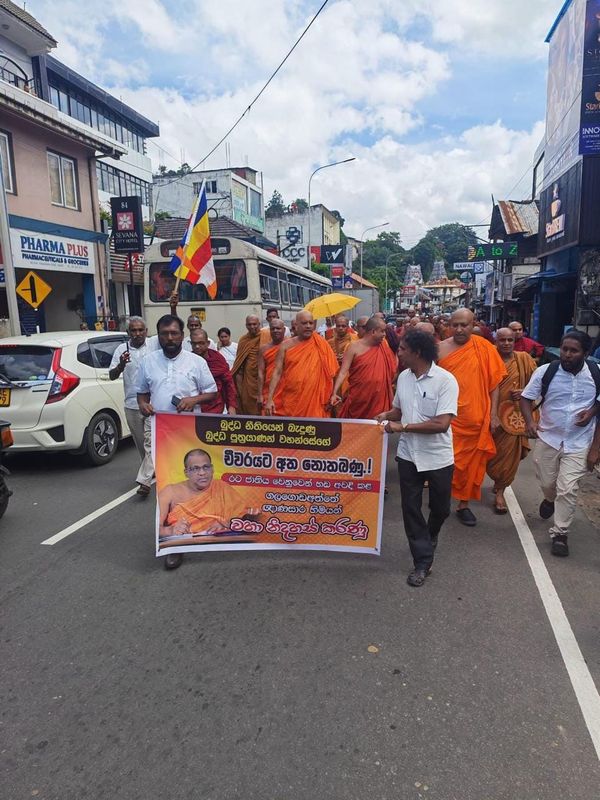
KANDY, Sri Lanka — More than 100 Buddhist monks set out from Kandy on Saturday on a six-day march to Colombo, the capital, to demand the release of Galagoda Aththe Gnanasara Thero, a hard-line Sinhala Buddhist nationalist cleric who was returned to prison this week to serve the rest of a sentence for contempt of court.
The march has exposed a division within Sri Lanka’s Buddhist clergy. On Thursday, the leaders of the country’s main monastic orders met President Anura Kumara Dissanayake and welcomed his promise to review, within two weeks, the rules governing how imprisoned monks are treated. The monks who gathered in Kandy on Saturday are demanding that Gnanasara Thero be freed.
“Even if we ourselves are imprisoned, even if punishments are imposed upon us, we pledge that we will not abandon this struggle,” Ulapane Sumangala Thero, one of the march’s two leaders, told the crowd.
Organizers said 105 monks, accompanied by lay supporters, had gathered at the Temple of the Sacred Tooth Relic, which houses what Buddhists believe is a tooth of the Buddha. The march is scheduled to end on Thursday at Magazine Prison in Colombo, where Gnanasara Thero is being held. Its other leader is Walawahengunawewe Dhammarathana Thero, the chief incumbent of the historic temple at Mihintale.
No senior representative of the Malwatta or Asgiriya chapters, whose prelates took part in the talks with Mr. Dissanayake, joined the march.
Gnanasara Thero is the general secretary of Bodu Bala Sena, a Sinhala Buddhist nationalist organization, and has been one of the most divisive public figures in Sri Lanka for more than a decade. Rights groups have accused him and his organization of inciting hostility toward Muslims, including in the period before deadly anti-Muslim riots in Aluthgama in 2014. He has denied encouraging violence.
In 2018, the Court of Appeal convicted him of contempt of court for disrupting proceedings at the Homagama Magistrate’s Court and threatening Sandya Ekneligoda, whose husband, the cartoonist and journalist Prageeth Ekneligoda, disappeared in 2010. He was sentenced to six years of rigorous imprisonment. President Maithripala Sirisena pardoned him the following year.
After that pardon was revoked, the attorney general asked the Court of Appeal to enforce the remainder of the sentence. The court issued an open warrant for his arrest on Oct. 1. He was arrested days later, and on Oct. 5 the court directed the commissioner general of prisons to carry out the rest of the term.
A prison spokesman, Senaka Palletenna, said at the time that the monk’s robes had been removed, that he had been issued standard prison clothing and that he was being held in a ward for ordinary prisoners. Senior monks objected, arguing that the state had no authority to alter a monk’s religious status.
Before setting off on Saturday, the marchers offered flowers at the temple and assembled before a statue of Wariyapola Sumangala Thero, a monk revered for his resistance to British colonial rule in the early 19th century.
Ulapane Sumangala Thero described the Dissanayake administration as a secular government that treated Gnanasara Thero like the British treated the colonial-era monk.
“The very same fate that befell Ven. Wariyapola Sumangala Thero has now been inflicted by this secular government upon our Gnanasara Thero, who raised his voice on behalf of the nation,” he said.
He argued that Gnanasara Thero had been jailed for defending Buddhism and the country. “His freedom is the freedom of the country. It is our freedom,” he said. He called on monks, nuns and lay Buddhists to unite behind the campaign, and urged marchers to remain nonviolent. The crowd answered with chants of “Sadhu,” a traditional Buddhist expression of approval.
Dhammarathana Thero delivered the harsher speech. “It is not Gnanasara Thero they have laid their hands on,” he said. “It is the banner of the Arahants that these people have attacked!” The phrase refers to the saffron robe, which he described as the symbol of a monastic tradition more than 2,000 years old.
He accused the government of removing Gnanasara Thero’s robes as a show for the Tamil diaspora and nongovernmental organizations, and he used derogatory Sinhala expressions to describe those in power. He said the government was targeting Sinhala Buddhists in particular.
Twice he invoked Anagarika Dharmapala, the Buddhist revivalist whose Sinhala nationalist ideas continue to shape strands of the country’s politics. “Wasn’t Dharmapala right in what he said?” he asked.
He also said that British officials had shown more respect for the robe than the current government. “Ven. Wariyapola Sumangala Thero was imprisoned in Jaffna. He died wearing his robes,” he said. Historical accounts say the monk was held in Jaffna after the 1818 rebellion against British rule and died there; whether he was permitted to keep his robes could not be independently verified.
He closed by shouting three times, “We will not allow it!”
The dispute places Mr. Dissanayake in a difficult position. Sri Lanka’s Constitution gives Buddhism “the foremost place” and obliges the state to protect it, while guaranteeing freedom of religion to all. Under the Vinaya, the code governing monastic life, whether a monk has lost his standing is a matter for the clergy, separate from any sentence imposed by a secular court. The government is responsible for carrying out court sentences and applying prison rules.
At Thursday’s meeting with the senior monks, Mr. Dissanayake said he would not issue special orders for individual prisoners while existing laws remained in force, and that laws found unsuitable should be amended through the proper process. He promised a mechanism to examine the rules on how monks are held in prison and transported outside it, with proposals within two weeks. The senior monks later issued a written statement welcoming that approach.
A change to prison regulations could settle the question of the robe without touching the court’s sentence. The marchers’ demand for release would require the government to set aside a judicial order, a step Mr. Dissanayake has so far declined to take.
The marchers planned to reach Kadugannawa on Saturday night, then continue through Kegalle, Warakapola, Nittambuwa and Kadawatha before arriving in Colombo on Thursday, Oct. 15.
Dhammarathana Thero told the gathering that the campaign was being waged for the entire Sinhala nation and its Buddhist people.