By M.R. Narayan Swamy
Six political parties representing Tamils and Muslims in Sri Lanka have come together for the first time in years to pressure the government on issues concerning the minorities ahead of Provincial Council elections expected next year.
But even as commoners voice scepticism about the grouping’s viability, one of its key leaders asserts that the front will “advance the historical responsibilities” towards the Tamil-speaking people that transcend elections.
Political pundits admit that the opposition in general is troubled by the aggression of the JVP-led coalition government and its visible attempts to ride roughshod over rivals on the strength of its brute majority in parliament.
Amid widespread assessments that the center-left National People’s Power is likely to lose support among the Sinhalese electorate in any future election, the government is expected to focus on wooing indigenous Tamils, Indian Tamils and Tamil-speaking Muslims.
This is why it worries the Tamil and Muslim parties that President Anura Dissanyake continues to be popular as an individual among their own constituents despite the many minuses that have plagued his government since taking office in 2024.
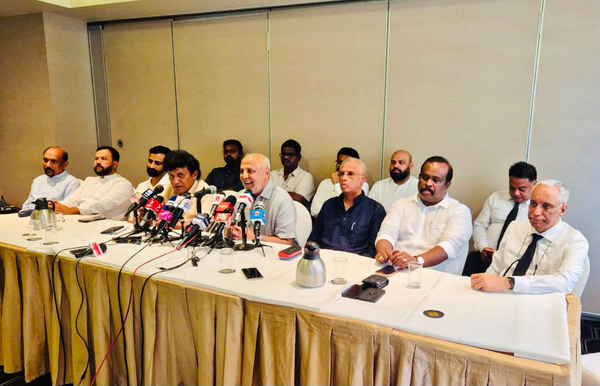
On July 17, the six parties announced in Colombo a common platform for coordination on issues of shared concern, including constitutional reforms, provincial council elections, and land issues affecting the minorities.
The initiative brought together the Sri Lanka People’s Congress (SLPC), the Sri Lanka Muslim Congress (SLMC), the Ceylon Workers Congress (CWC), the Tamil Progressive Alliance (TPA), the Ilankai Tamil Arasu Katchi (ITAK), and the Democratic Tamil National Alliance (DTNA).
Critics wonder how long leaders of the six parties can stick together, considering that each party is engaged in portraying itself as the dominant political force in its respective regional spheres of influence.
The CWC and TPA are long-time foes in the areas populated by the 1.5-million-strong ‘Indian Tamil community,’ while the ITAK, the country’s main Tamil party, has many reservations vis-à-vis the DTNA and other Tamil outfits in the country’s north and east.
Similarly, the SLMC and SLPC are in competition for the same Muslim votes spread across the island nation. In any case, there are major issues on which these parties do not see eye to eye.
TPA leader and multi-time MP Mano Ganesan says this is a wrong way of viewing the front, which he prefers to call “a national political platform” and which he says stands on a common minimum programme or CMP.
The platform’s first major demand is the early conduct of the much-delayed elections to Provincial Councils in all nine provinces. Dissanayake and the NPP had promised that these would be held within a year of their taking power.
The front wants the government to hurry up with its stated commitment to draft a new constitution that guarantees the full rights of the Tamil-speaking minorities, before Sinhalese-Buddhist nationalism, weakened by the mass protests that followed the 2022 economic collapse, creeps back.
Ganesan, 66, says the government must also give back all the private land taken from Tamils in the north and east during the war against the Tamil Tigers and distribute unused plantation land to workers employed in tea estates – one of the most economically depressed sections in Sri Lanka.
According to him, other long-established parties such as Gajendrakumar Ponnambalam’s Tamil National People’s Front are welcome to join the front, but underlined that “both internal and external disputes between (various) parties should not be brought onto this platform”.
Tamil sources say one major reason the six parties have come together is a growing sense that the JVP-led government is unlikely to yield even on minimum demands, even as it takes steps to undercut the influence of other political forces — including Muslim and Tamil parties — at the grassroots level.
Not everyone in the country is enthused by the new formation.
Some Tamils spoken to at random in Jaffna, Mullaitivu, and Kandy dismissed the six-party grouping as an opportunistic coming together of political forces that were stunned by the JVP/NPP in the parliamentary battle of 2024.
One man in Jaffna who has traditionally voted for the ITAK said, “I don’t see much hope in these people. When Tamil parties (in the north and east) cannot unite on issues affecting the Tamil community, how can they expect bonding with Muslims and plantation (Indian) Tamils?”
Others argue that such scepticism is the result of seeing the new formation as an electoral alliance and not as a way of putting pressure on the government on major issues on which there is a broad agreement among the minorities.
The fact is that when the JVP swept the elections two years ago, including in almost all Tamil and Muslim areas, there was anticipation that at least some of the historical wrongs in the country would be set right. But that hope has given way to despondency, though the JVP remains an attraction.
Instead, the Marxist Janatha Vimukthi Peramuna (JVP), for long an outsider vis-à-vis the political system, is seen to be increasingly aggressive and haughty.
For example, Dissanayake had vowed to repeal the draconian Prevention of Terrorism Act (PTA). He also pledged to return the vast tracts of land taken from ordinary Tamils during the war against the Liberation Tigers of Tamil Eelam (LTTE). Neither promise has been kept.
The JVP government says it is committed to repealing the PTA. But it promises to unveil a new law which critics warn will be harsher.
ITAK acting general secretary M.A. Sumanthiran pointed out that it was the first time in a long time that political representatives of the northern, eastern, Indian-Tamil and Muslim communities had shaken hands on agreed issues.
He added that each party would keep its independent existence and views.
“This is a platform where Tamil-speaking parties can raise a common voice on issues that affect us all. It is not an alliance. Each party remains free to hold its political views. Where there is a common ground, we will work together because a united voice carries greater strength.”
Tamil sources admit that a united front may not necessarily lead to a joint electoral front, although this cannot be ruled out. The latter could happen because the JVP-led government has made almost everyone its political foe.
The government’s Praja Shakthi programme, while aimed at banishing rural poverty through community empowerment, allegedly seeks to impose JVP cadres on official bodies, bypassing elected leaders of other parties. This has caused great resentment among Tamil and Muslim parties.
“The president tours Tamil areas and walks freely among the people,” one Tamil leader pointed out. “This is good. It means the law and order is under control. But when it comes to Tamil land, the military cites security concerns as a reason for not returning it. This amounts to speaking with a forked tongue.”
Pro-JVP social media accounts are already accusing the six Tamil and Muslim parties of whipping up ethnicity to score political points. But Tamil and Muslim leaders say they are firmly opposed to racism and fundamentalism of any kind.