
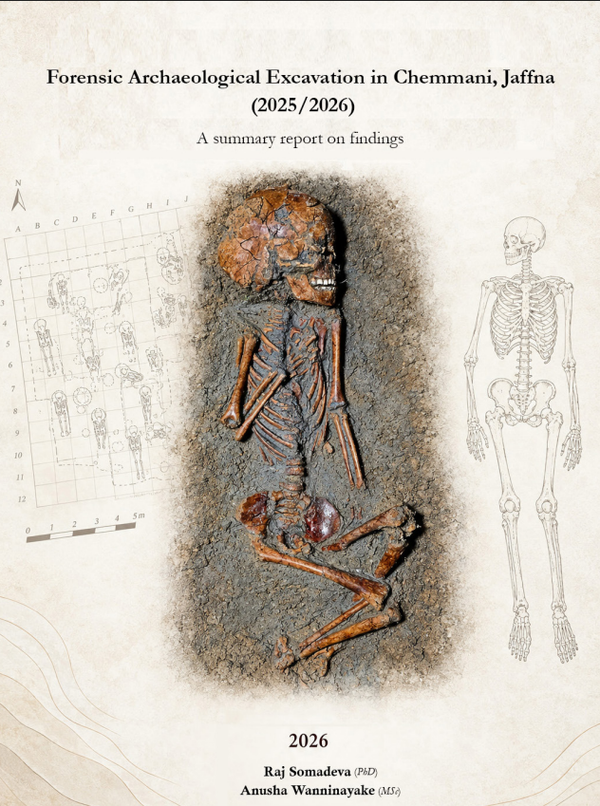
JAFFNA, Sri Lanka, Oct. 21, 2026 — Nearly two-thirds of the 574 people exhumed from the Sittupatti Hindu cemetery at Chemmani, on the outskirts of Jaffna, were infants or children, according to the third interim report of the archaeologists directing the excavation. The report concludes that the site bears greater similarity to formal burial practices than to clandestine burial sites documented elsewhere in the world. Its authors also say their evidence cannot establish how the dead came to be there.
“The assemblage of material evidence documented in this report is insufficient, in isolation, to support a definitive conclusion regarding the nature and character of the burials investigated,” write Professor Raj Somadeva, who led the archaeological excavation, and Anusha Wanninayake, a fellow member of the archaeological team. The report contains no scientific dating of the remains and no analysis of the bones for injury or disease. It does not establish when the people buried at the site died, what killed them or who buried them.
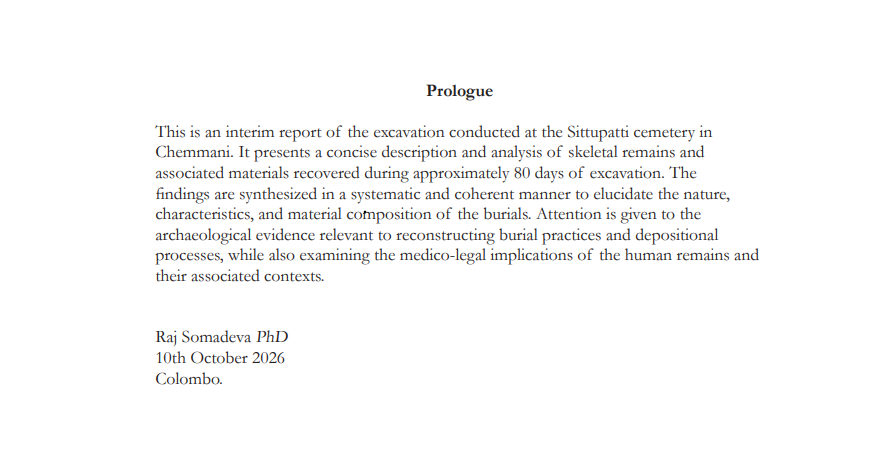
The report, seen by Jaffna Monitor, was prepared for the medico-legal investigation ordered by the Jaffna Magistrate’s Court. According to its preamble, the excavation was carried out under the observation of the magistrate and the chief judicial medical officer of Jaffna Hospital. Professor Somadeva signed the prologue in Colombo on 10 October. On 15 October, he sent the document to Dr. S. Pranavan at Jaffna’s Base Hospital with a cover letter calling it “the third interim report on the forensic archaeological excavation.”
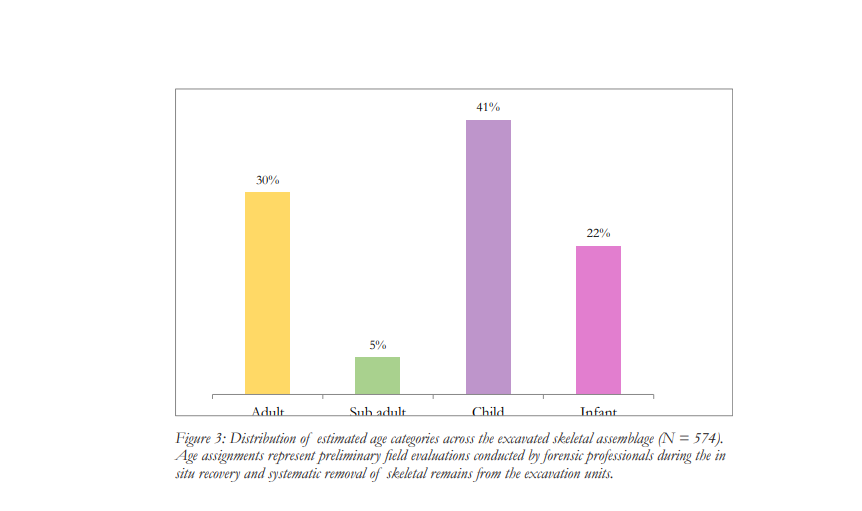
The report places 41 percent of the individuals in its child category and 22 percent among infants, about 360 people in all. Adults account for 30 percent and sub-adults for 5 percent. The four figures total 98 percent, and the report does not explain the remainder. It describes the age assignments as “preliminary field evaluations” made by forensic professionals while the skeletons were being recovered. It does not define the age range of each category or offer any explanation for the high proportion of children.
The epidemic passage
The report’s conclusion runs to two paragraphs. The sentence in it that has drawn most attention reads: “If the concentration of burials resulted from an epidemic or another form of natural catastrophe, a limited assemblage of associated material culture would not necessarily be unexpected.” In those circumstances, the authors write, “the primary concern may have been the rapid disposal of the deceased” and not the placing of offerings or belongings with the dead.
The sentence is conditional. The authors use it to explain why few objects might be found in the graves. The following sentence says the scarcity of artefacts “should not be regarded as conclusive evidence for any burial context.” The report names no epidemic or natural disaster, cites no record of one, and presents no evidence of disease from the skeletons. It does not examine whether any of the dead were killed.
Why the authors see formal burial
The comparison with formal burial rests mainly on how the bodies were laid out. Among skeletons left undisturbed after burial, many had the hands placed over the abdomen or along the sides of the body. The authors contrast this “notable degree of consistency” with the irregular limb positions they say are common in clandestine or irregular burials documented in forensic cases. They illustrate the point with a drawing of the Phaleron Captives, an Archaic-period mass grave found near Athens in 2016.
Seventy-two per cent of the skulls lay to the north-west, 11 percent to the south-east and 7 percent to the south-west, with the rest spread among other directions. The report nonetheless describes cranial orientation at Chemmani as lacking a uniform pattern. It says the variation may reflect the circumstances of burial or the practices of the people who buried the dead, and adds that it does not show cultural or religious considerations were absent.
Two skeletons, numbered 227 and 429, were found seated. The report notes that seated burial is associated in Hindu tradition with samadhi and jiva samadhi, in which the body of a spiritually accomplished person may be interred upright. It says the posture alone does not establish that link and treats the two burials as exceptional cases needing further study.
Objects in the graves
The excavation registered 170 artefact entries, which the report sorts into six provisional categories. Finger rings and bangles were found mainly with adults, and most beads with children. Amulets were found with several skeletons. Some coins carried traces the authors interpret as cloth, suggesting the coins had been wrapped and tied to the body. The report says this practice is documented among Hindu and Buddhist communities in Sri Lanka as protection against malevolent forces, and is “particularly noteworthy in relation to individuals who experienced prolonged illnesses.” It describes that reading as provisional.
Iron nails and irregular iron fragments were found with some skeletons. Iron nails and iron plates also turned up in some of the 51 heaps of loose, disarticulated bone. The authors identify part of this metalwork as probable coffin fittings and note that the nails vary widely in size.
The report’s artefact table lists objects against 39 skeletons. Iron nails appear against 19 of them and coins against 10. Smaller numbers are listed with beads, amulets, glass, rings, a bangle, clothing items, a hair ornament or pieces of rubber. The caption says the association of artefacts with some of the skeletons “suggests the intentional motive of the burials.”
Skeleton 25 had more objects with it than any other burial described in the report. They were a plastic bag, pieces of cloth cut and prepared for sewing, socks, shoes and a metal anklet chain known in Tamil as kāl changili. A cluster of small nails nearby may be what remains of a coffin. The report says these finds support the possibility that the person was buried in a coffin and received “a relatively formal burial.” Photographs in the report show a blue bag printed with letters of the alphabet and a sandal decorated with a cartoon bear. The report does not give the age of the person buried with them.
Across the site as a whole, such objects are few. The report describes clothing-related items as “relatively scarce.” It calls objects associated with final rites “extremely rare,” the only recorded example being two polythene garlands found with one skeleton. That section also cites two skeleton numbers, 56 and 48, without explanation.
Burials over time
In several places one skeleton lies over another or was cut through by a later grave. The report says these relationships, together with the possible coffin material, suggest the burials “may represent successive episodes of interment rather than a single, simultaneous depositional event.” It suggests that some of the heaps of loose bone may have formed when later gravediggers disturbed earlier burials. The authors caution that overlapping graves show only the order of particular burials, not how much time passed between them.
The skeletons lay between 0.24 and 1.52 metres below the present surface. Many of the children were buried close to the surface, although several adults and sub-adults in the western part of the trench also lay less than a metre down. The report finds no discernible pattern in how the bodies were arranged across the trench.
The authors also write that some burials “may have involved relatively deliberate and orderly procedures, whereas others may have resulted from more rapid or expedient acts of deposition.” Depth alone, they add, cannot establish the intentions of those who buried the dead.
Rubbish, carcasses and hospital waste
The report describes ground that was repeatedly disturbed. It records garbage dumping, pits dug for waste disposal and the burial of animal carcasses, which it says caused “substantial vertical and horizontal dislocation of human skeletal remains.” Its photographs show a dead cow buried at the site and hospital waste scattered on the surface. In the middle of three soil layers, the excavators found fragments of human bone alongside cow and goat bone. The report attributes these to later livestock burials and, in some instances, to “shallow human burials inserted into the mid-level of this stratum.”
The report concludes that the site was not used only as a human burial ground and served as “a dumping ground for various disposable items including human remains as well.” It does not say whether this means bodies were discarded there or that earlier burials were displaced by later digging. It draws no connection between the human remains and the hospital waste.
The area’s past is mentioned once. The preamble says Chemmani had been “locally identified as a potentially significant location, allegedly linked to illicit activities and suspected human rights violations in the recent past.” The remains first surfaced by accident during digging for construction on the cemetery grounds. The report does not return to the allegations.
Clothing
No skeleton was found with preserved garments. The authors argue that this does not show the dead were buried unclothed, because textiles break down through soil chemistry, moisture, microbial activity and time. The plastic buttons, eyelets and plastic studs recovered with several skeletons, they write, suggest that at least some of the dead were clothed. They call the absence of fabric “a taphonomic observation,” a term for changes that take place after burial. They concede that the extent to which soil conditions explain it cannot be determined without further study.
Some fabric did survive. The report records cut cloth and socks with skeleton 25 and traces of cloth on some coins. It does not say what this material was made of or why it lasted when garments elsewhere did not.
Coins and dates
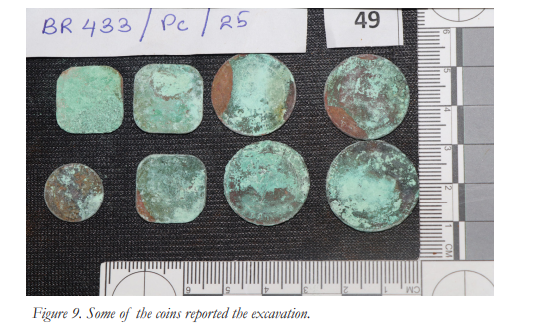
The report identifies coins as “the only datable material evidence recovered.” Most of those found with skeletons were too corroded to read. After conservation, one coin found with skeleton 367 showed the date 1870. The authors write that a minting date “does not establish the date of the burial,” since a coin may stay in circulation or be kept for many years. Coins placed with the dead, they add, may have had a ritual purpose and say little about chronology.
A second set of coins came from a thick layer of ash found when the trench was extended to the east and south-east, about five to six metres from the cemetery’s cremation platform. According to the report, an older cremation area “appears to have been cleared and levelled” to build the platform’s retaining wall, and the ash is what was left. These coins were better preserved. They bore the dates 1920, 1944, 1963, 1975, 1978, 1982, 1991 and 1994. The authors say the range of dates shows the material built up over a long period, but that the coins cannot date the ash or the wall. The report lists the 1920 coin against skeleton 172 without explaining how a coin from the ash layer is connected to a burial.
The finds also include plastic buttons and studs, a plastic bag, polythene garlands and pieces of rubber. The report does not discuss what these materials indicate about the age of the graves in which they were found.
How the site was chosen and how far it may extend
The archaeologists chose where to dig by studying satellite imagery, in which two patches of ground showed up as white rectangles suggesting disturbance below the surface. The main trench measured 28.5 by 18 metres, or 513 square metres. Where remains were found, it was dug to as much as 1.6 metres below the highest point of the surrounding ground. A second site, about 40 metres to the east, was tested with three narrow trial trenches dug to 0.8 metres. The report gives no findings from it.
A ground-penetrating radar survey of the land around the trench detected numerous anomalies below the surface. The authors say some of these may be consistent with additional burials and conclude that the site “may be considerably more extensive than the area investigated through archaeological excavation.”