
By: Aruliniyan Mahalingam
JAFFNA, Sri Lanka — Makkal Seyal, a civil society group in Jaffna, told reporters at the Jaffna Press Club on Sunday that it rejected “completely” the archaeologists’ latest report on the human remains found at Chemmani. In a Tamil statement, the group called the report one-sided and based on guesswork. It accused the authors of serving a state that has long suppressed minorities.
Two days earlier, at the same place, groups representing families of the disappeared rejected the report in similar terms and called a protest for Nov. 16.
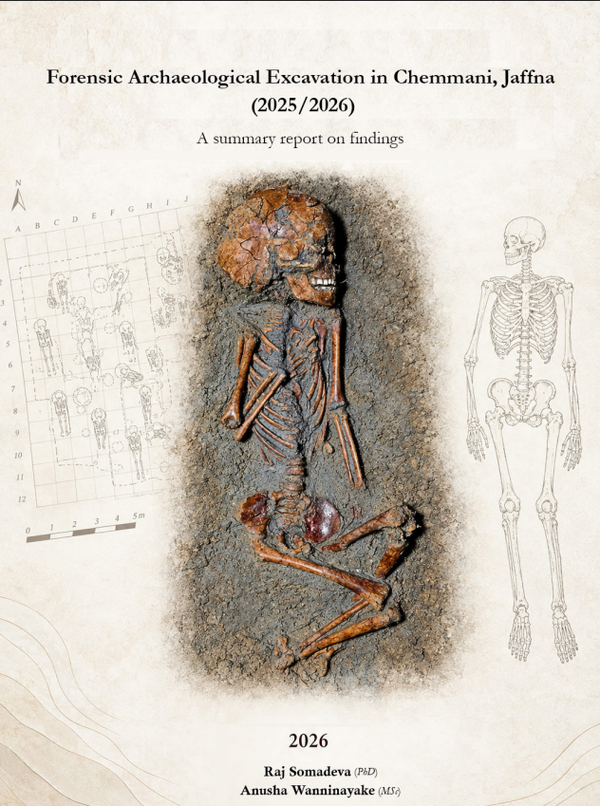
The report was written by Professor Raj Somadeva of the University of Kelaniya and Anusha Wanninayake, and it is the third interim report on the excavation. It records at least 574 people recovered from the Sinthupathi Hindu cemetery at Chemmani. It describes 41 percent of them as children and 22 percent as infants. The authors say the site looks more like a place of normal, formal burial than the secret graves found in other parts of the world. They also admit that their evidence is not enough to reach a firm conclusion.
Makkal Seyal’s statement runs to several pages and lists its objections one by one. Some get the report wrong. Some misunderstand how archaeology works. A few point to real failures in the report.
What the archaeologists were asked to do
The families complained that the report has no DNA results. Makkal Seyal complained that it ignores injuries, signs of torture, and causes of death.
Neither was the archaeologists’ job. In a court-ordered dig in Sri Lanka, the archaeologist finds the remains, lifts them out without damaging evidence, and records where each body lay, how deep it was, and what was buried with it. Working out a person’s age, sex, injuries and cause of death is the job of forensic doctors and bone specialists. At Chemmani, that work is led by the judicial medical officer, Dr. S. Pranavan, whose report has not yet been released. Identifying the dead requires DNA to be compared with samples from relatives. Sri Lanka has no laboratory that can do this with remains like these, and the government said it will send samples abroad.
The report itself says this. It leaves injuries and other details of the bones to the forensic experts.
The missing words
Makkal Seyal said Professor Somadeva had called the site a “mass grave” in three earlier reports and had now dropped the term on purpose. Lawyers for the families made the same accusation in a court motion on Thursday.
Professor Somadeva’s covering letter to Dr. Pranavan, dated Oct. 15, calls this the third interim report, so there were two before it, not three. Makkal Seyal did not say which three reports it meant.
The change in wording is real. In June 2025, Professor Somadeva told Al Jazeera that his first report had said the site “can be identified as a mass grave and further investigation is needed.” His second report, a month later, pointed to signs of crime. In the third report, the phrase is never used to describe Chemmani. It appears only in a caption about an ancient grave in Greece and as a place name printed on a satellite map.
He should explain why he changed his language. But the term itself proves nothing.
International law has no single agreed meaning for “mass grave.” Forensic archaeologists usually use the term for any grave with two or more bodies in it, regardless of how those people died. A pit dug for victims of a plague counts. A United Nations definition, used by investigators looking into illegal killings, describes a mass grave as a place where three or more victims of such killings are buried. That definition was written for cases where killings were already suspected. It does not turn every grave with several bodies into a crime scene.
Another set of international guidelines, the Bournemouth Protocol, was written with the International Commission on Missing Persons. It calls a site a mass grave when it holds the remains of several people, and there is reason to check whether their deaths, or the way they were buried, were legal. In other words, the term means a site should be investigated. It does not mean a crime happened.
Sri Lankan law does not define the term at all. When the Jaffna Magistrate’s Court recognised the site as a mass grave in 2025, it put the dig under the court’s supervision. It did not rule that anyone had been murdered. To prove a killing in court, investigators still have to show who died, how and when, and who was responsible. Using the term, or dropping it, does not change a single bone in the ground.
The epidemic
The part of the report that caused the most anger is one sentence. It says that if the burials were caused by an epidemic or a natural disaster, it would not be surprising that so few objects were found with the dead. The very next sentence warns that the small number of objects should not be treated as proof of any kind of burial.
Makkal Seyal read this as an attempt to blame the deaths on disease or disaster. The report does not say an epidemic happened.
The group also argued that history rules out an epidemic. It said the Jaffna Kachcheri files, kept since 1829, and the British colonial government records after 1833 contain no record of any epidemic or disaster requiring quick burials.
The records show the opposite. Jaffna’s epidemics are among the best recorded in Sri Lanka’s colonial history, as this newspaper reported on Oct. 22. Cholera reached the American mission at Uduvil in 1825 and killed two small girls on the same day. It came back in 1838, when as many as 35 people a day died at Point Pedro. The historian S. A. Meegama counted 6,125 cholera deaths in Jaffna in 1855. In 1871, the colony’s chief medical officer wrote that the Northern Province was the one part of the island where cholera kept returning. Smallpox struck repeatedly, and an 1884 outbreak emptied parts of Mandaitivu and Velanai. In the last three months of 1918, the influenza pandemic killed 2,558 people in the Jaffna district, and another 1,453 died in 1919. Across the island, researchers found that the biggest rise in deaths during that pandemic was among babies and children under five.
None of those records says where the dead were buried, and none mentions Sinthupathi. An 1897 law gave the colonial government the power to decide whether people who died of infectious diseases should be buried or cremated, and how. No one knows if that power was used in Jaffna, or if the dead from an outbreak were sent to particular cemeteries. The answer would be in provincial government files, which no one has checked. After decades of war, it is doubtful those files still exist.
Looking for signs of disease in the bones is the medical officer’s job, not the archaeologists’. But once the report raised the idea of an epidemic, it should have given some reason for it, and it gives none. It names no outbreak and cites no record, even though archaeologists working on recent sites often use such documents. The bones may never answer the question. Cholera can kill within hours, and neither cholera nor influenza usually leaves marks on bone. Only dating and old records could show whether an epidemic filled these graves.
The report’s own findings point away from an epidemic. The authors say newer graves were dug through older ones, that some dead were buried in coffins, and that people were buried there at different times. That describes a cemetery used over many years. An epidemic would leave many burials in a short time, which should show up as a separate layer or group of graves. If dating shows the burials are spread over decades, the epidemic idea fails. If a group of children from one layer turns out to date from 1918, or another outbreak year, it becomes more likely.
The large number of children needs no epidemic to explain it. In Jaffna, Hindus cremate most adults but bury young children. Malaria and ordinary childhood illnesses killed babies on the peninsula every year of the colonial period. A cemetery used this way for generations will fill up with small graves. The report never says this.
Depth, dates and shared graves
Makkal Seyal said Hindu graves are usually about five feet deep, while remains at Sinthupathi were found less than three-quarters of a metre down.
The group gave no source for its five-foot figure. The report records skeletons between 0.24 and 1.52 metres below today’s ground level, and in a working cemetery the ground level changes. The report describes rubbish pits, buried cattle, dumped waste and the levelling of an old cremation area when a wall was built for the cremation platform. All of these raise or lower the ground. A grave that looks shallow today may have been dug much deeper from a ground level that no longer exists.
Children’s graves are often shallow anyway. Adults are a different question. The report records several adults and older children less than a metre down in the western part of the trench, and it does not explain why. In 2025, the Human Rights Commission of Sri Lanka named shallow burial as one reason to suspect unlawful killings. Archaeologists can work out where the old ground level was by studying the soil layers. This report does not try.
The question of several bodies in one pit matters more. Makkal Seyal pointed to remains of different ages, lying in different positions, found with unrelated objects in the same pit.
Two very different things can produce that picture. In one, a single pit is dug and filled with bodies at once, as happens in most mass executions. In the other, new graves are dug through old ones over many years, as happens in any crowded cemetery. To tell them apart, archaeologists record the outline of each grave pit in the soil and which pit cuts through which. The report says the burials happened at different times, but it does not publish the grave-by-grave record that would let others check. In June 2026, six bodies were reported found together in one group. The report does not discuss that group, or any other, on its own.
On coins, Makkal Seyal has the report backwards. The group said the archaeologists relied on the dates stamped on coins and ignored the fact that old coins stayed in use in Jaffna during the wartime economic blockade. In fact, the report says clearly that a coin’s date “does not establish the date of the burial,” because a coin can be used or kept for many years. Archaeologists treat a coin’s date as the earliest a grave could be. A coin from 1870 means the grave was dug in 1870 or later, but it says nothing about how much later. Makkal Seyal’s point about the blockade is correct, and it supports the report’s caution. It also means the coins cannot prove the burials are recent.
The group also said the archaeologists should have used coins and other objects to identify the dead. Coins are made in huge numbers and cannot identify anyone. Personal belongings can help a family recognise a relative, which is why the Office on Missing Persons put 54 recovered items on display in Jaffna in August 2025. The coin dated 1994 was found in a layer of ash near the cremation platform, not in a grave.
The report uses this “earliest possible date” reasoning for coins only. Some graves contained a plastic bag, plastic buttons, plastic garlands, or bits of rubber. Those objects mean those particular graves can be no older than the second half of the 20th century. The report lists the objects but does not say what they mean.
Makkal Seyal also demanded that every set of remains be carbon-dated under international supervision, and said Tamils around the world would pay if needed.
Carbon dating measures how much of a natural form of carbon is left in a bone. For people who died a few hundred years ago, it gives only a rough range. For example, the bones from the Mannar grave dated to somewhere between 1499 and 1719.
For people who died after about 1955, a more precise method exists, known as bomb-pulse dating. Nuclear bomb tests in the 1950s and 1960s released extra carbon that spread through the air across the whole world and entered the bodies of everyone alive at the time, through the food they ate. Scientists can measure it in bones and teeth to show whether a person died before or after the mid-1950s, and often to narrow the date to a span of years.
Each test destroys a piece of bone, and testing every skeleton at a site this large is not normal practice. It is also not necessary. Testing samples from every soil layer and every group of graves, from adults and children, and from each skeleton reported as bound or injured would show whether anyone was buried there after 1995.
Clothes and seated bodies
In 2025, the Human Rights Commission found that more than 90 percent of the remains had no clothing and said this ruled out normal Hindu burial. Makkal Seyal said the dead had been stripped. The report says the clothes rotted away.
Cotton rots quickly in warm, wet soil like Jaffna’s lagoon clay. Polyester and nylon, which were common in Jaffna by the 1980s, last much longer. People buried in 1990s clothing would probably leave some synthetic fabric behind, and almost none has been reported. That fits older burials in cotton clothes or in the white cotton cloth Hindus usually wrap their dead in. It fits just as well with bodies buried naked.
Here the report’s own evidence weakens its argument. Socks and pieces of cloth survived with Skeleton 25, so fabric can last in this ground. Plastic buttons and studs, which last longer than any cloth, were found with only a handful of the 574. Testing the surviving fibres and the soil could help settle the question, and the report admits neither has been done.
Makkal Seyal said the report presents the seated skeletons as jeeva samadhi burials, in which a holy person is buried sitting upright. The report’s text is more careful. It says a seated position alone does not prove such a link, and it calls the two seated skeletons, numbered 227 and 429, unusual cases that need more study. But the caption under the photograph of Skeleton 227 reads: “A skeleton buried in meditation posture.”
When Skeleton 227 was dug up in September 2025, Tamil media reported that its hands were bound and that its skull and jaw were broken. The report does not mention any of this.
In August 2026, a skeleton without a head was reportedly found in a test pit outside the main trench, with its hands bound across its chest. The report does not mention it either, though the test pits fall outside what the report covers.
No official account has confirmed that either skeleton was bound. The judicial medical officer has not said whether any rope, cord or other binding was found with them. Of everything Makkal Seyal raised, these two skeletons are the most urgent questions still unanswered.
The report also missed an explanation from Jaffna’s own religious life. Veerasaiva families in Jaffna still bury their dead instead of cremating them, and their tradition places the dead in a seated position.
Two more questions belong to Dr. Pranavan. When Hindus prepare a body for a funeral, they commonly tie the big toes together, and often the thumbs. An expert can tell this apart from hands tied behind the back by looking at where any cord was and what it was made of. A bone broken at the time of death also looks different from a bone broken years later by the weight of soil, a gravedigger’s spade or a digging machine. Every skeleton reported as bound or injured needs this check.
The site’s past and the archaeologist’s record
Makkal Seyal said the archaeologists “conveniently forgot and concealed” that Sinthupathi lies near the army checkpoint that stood at the entrance to Jaffna town for about ten years after 1995, close to army camps and guard posts. It also said the site is very close to where Krishanthi Kumaraswamy and her family were found in 1996.
That history is real. In 2003, an inquiry set up by the Human Rights Commission described the area as a place where people were rounded up, arrested, and made to disappear. The report mentions these allegations in one sentence of its introduction and never returns to them.
If soldiers used this cemetery to hide bodies, dating will show burials after 1995, and the medical examination will find violent deaths among adults of the same age and sex as the disappeared. People familiar with both excavations say the sites that the soldier Somaratne Rajapakse pointed out in 1999 lie about a kilometre from the present trench.
The families’ groups went further. They accused Professor Somadeva of shutting down earlier investigations at Kokkuthoduvai in Mullaitivu and at the Sathosa site in Mannar. His record at both sites shows otherwise. At Kokkuthoduvai, his team found remains in clothing that looked like LTTE uniforms. At Mannar, a laboratory in Florida dated the bones to between 1499 and 1719, which would have placed the grave centuries before the war. Professor Somadeva rejected that result, saying it did not match the objects found in the grave. In other words, he argued against the finding that would have ruled out a wartime grave at Mannar.
There are fair criticisms of his role at Chemmani. His research has been on ancient history and early towns, not on forensic archaeology. In 2025, the Human Rights Commission said his team worked under “immense pressure” with an “unrealistic” deadline, though it also praised the team for “a considerable service.” Those are good reasons for independent experts to review his work. They are not evidence that he is serving a political agenda.
Both Makkal Seyal and the families called Chemmani proof of genocide. Under the 1948 Genocide Convention, genocide means acts committed with the intent to destroy a national, ethnic, racial, or religious group, in whole or in part. Killings can be evidence of that intent. But before anyone can show that killings happened at Sinthupathi, investigators must establish who the dead were, when they died, and how. None of that has been established for this trench.
Mistakes in the report
Some of the report’s mistakes are careless. Where it should say how far the main trench is from the cremation platform, it says “[insert number] meters.” Someone left a blank in a draft and never filled it in, and the report went to court that way. Its map coordinates are impossible, with minutes and seconds above 59. It says the dig lasted about 80 days in one place and about three months in another, when it actually ran for 110 days. Its age groups add up to 98 percent. Its drawing of the soil layers carries the same caption as its site map.
Other mistakes weaken its argument. It says the skulls point in no regular direction, but its own chart shows 72 percent pointing northwest. It names Skeletons 56 and 48 as examples of objects linked to funeral rites, then says a single pair of garlands is the only example. It describes the site as a dumping ground for rubbish “including human remains,” but then concludes that the site looks like a place of formal burial, without explaining how both can be true.
The only secret grave the report uses for comparison is the Phaleron Captives, a burial near Athens about 2,600 years old. It says nothing about modern mass graves in Bosnia, Iraq or Spain, where tied hands, blindfolds and pits filled in a single event have been studied in detail.
On Nov. 19, the Jaffna Magistrate’s Court will consider the Criminal Investigation Department’s request to send samples abroad for dating. The archaeologists’ report still does not say whether the hands of Skeleton 227 were bound.