
JAFFNA, Sri Lanka — They came carrying photographs of sons, husbands and other relatives who disappeared years ago, some dressed in black, some holding burning torches, many still asking the question that has defined years of protests across Sri Lanka’s north and east: Where are they?
Relatives of the forcibly disappeared marched through Jaffna on Sunday as part of a gathering that brought United Nations officials, international diplomats and human rights advocates together with families who say successive Sri Lankan governments have failed to tell them what happened to their loved ones.
The march began around 9:15 a.m. near the memorial to those killed during the 1974 World Tamil Research Conference in Jaffna and moved along Hospital Road to the Thanthai Chelva Auditorium, where an international conference titled “The Long Journey for Justice” was held.
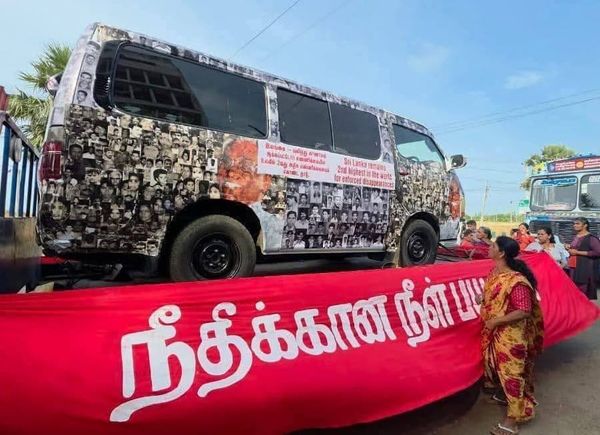
At the front of the procession was a vehicle made to resemble the “white vans” that became synonymous with abductions in Sri Lanka. Photographs of missing people covered its sides. A mother whose relative had disappeared lit a ceremonial flame before the march began.
Along the route, families held portraits of the missing above their heads. Some cried as they walked.
“Where are our disappeared relatives?” marchers chanted. “Where are those we handed over to the military?”
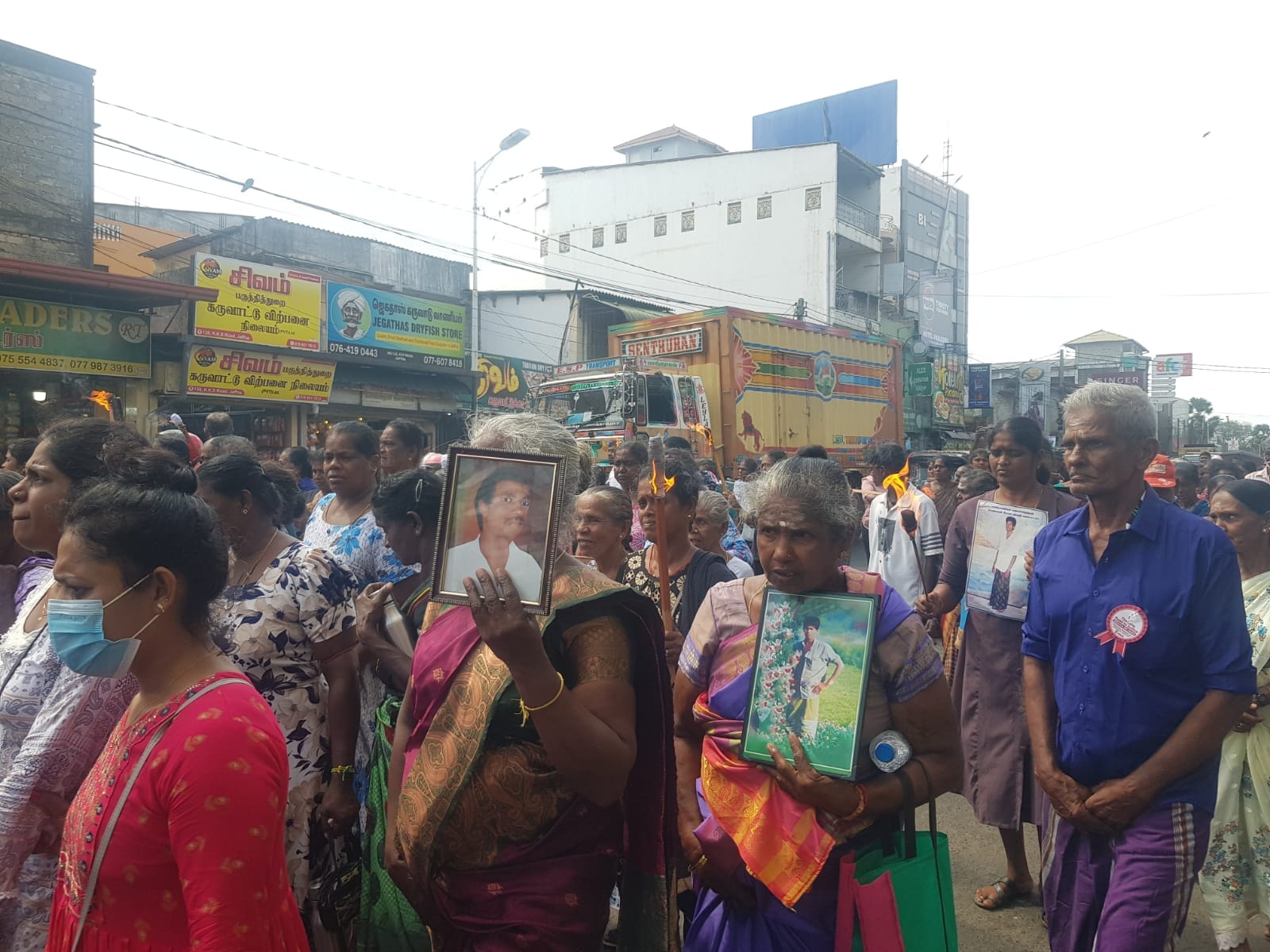
Others rejected the Office on Missing Persons and the Office for Reparations, saying they wanted answers rather than compensation. “We will neither forget nor forgive,” they chanted. There were also calls for an international investigation and for international scrutiny of the mass grave being excavated at Chemmani in Jaffna.
The event was organized by the Association of Relatives of the Enforced Disappeared of the North and East to mark the International Day of the Victims of Enforced Disappearances, observed each year on Aug. 30.
Among those attending were Ana Lorena Delgadillo Pérez, a member of the United Nations Working Group on Enforced or Involuntary Disappearances; Smriti Singh, Amnesty International’s South Asia regional director; international diplomats; lawmakers Sivagnanam Shritharan, Thurairajah Raviharan and Gnanamuttu Sirinesan; and civil society figures including Velan Swamigal, Ruki Fernando and Thyagi Ruwanpathirana.
But much of the day was about the families — and the diminishing time many of them have left to get an answer.
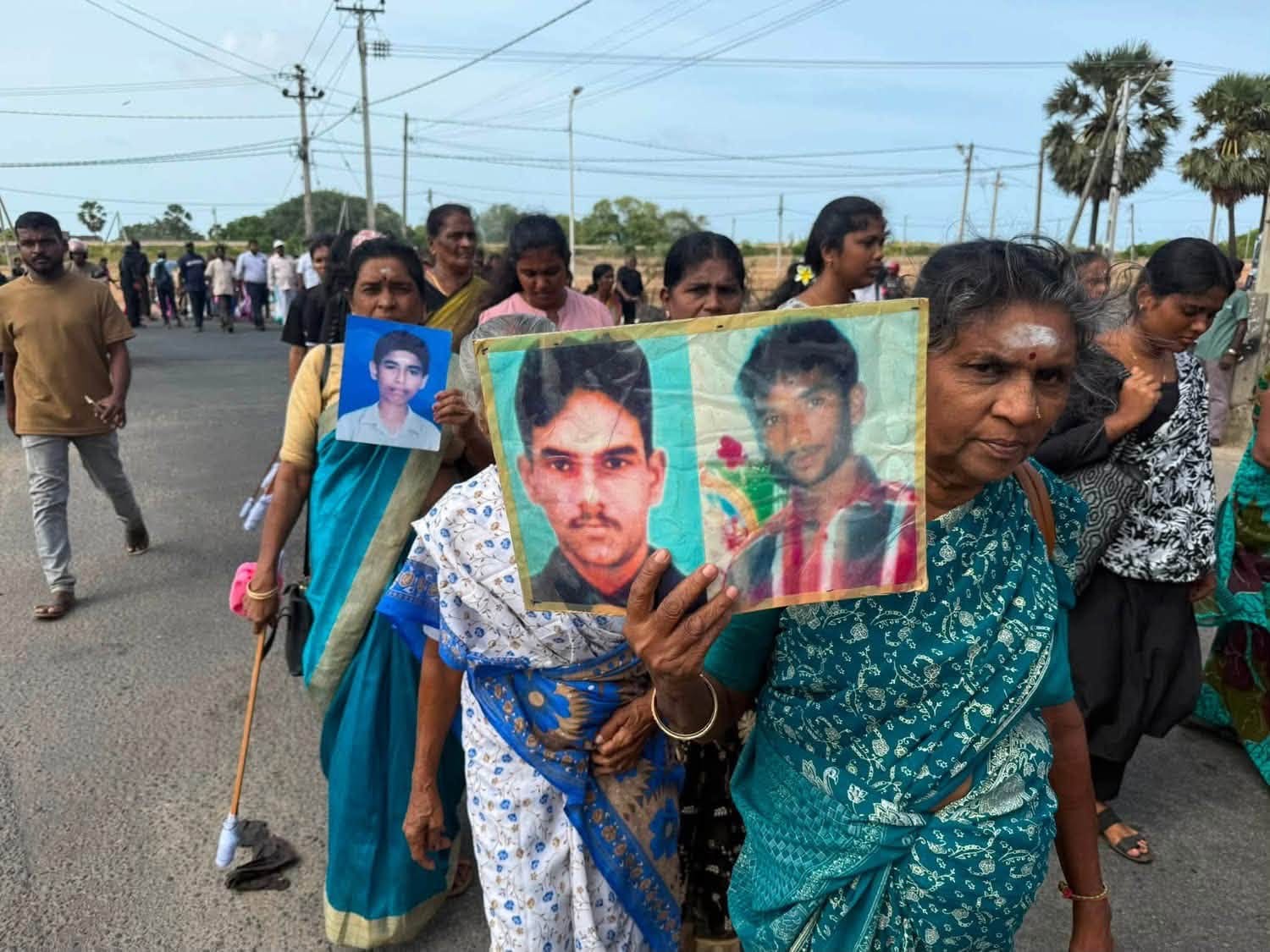
A number of the mothers who began campaigning for their missing children have died during the years of protest. Those who remain have continued to demonstrate, carrying the same photographs and returning to the same question.
Yogeswari, a mother from Chunnakam whose son disappeared in 2006, told Jaffna Monitor that nearly 20 years had passed, but she was still waiting for him.
“For almost 20 years, there has not been a single day when I have stopped waiting for my son,” she said. “I have not had a peaceful night’s sleep in all these years. Whenever I hear someone coming to my house, for a moment I think it might be him. I still look toward the door hoping to see my son standing there.”
“People tell us to move on, but how can a mother move on when she does not know whether her child is alive or dead?” she said. “If they tell me what happened to him, at least I will know. But this waiting, every day, without an answer — this is a living death.”
‘No Victim Should Have to Die Without an Answer’
Speaking inside the Thanthai Chelva Auditorium, Ms. Delgadillo Pérez said it was unacceptable for state authorities to deny enforced disappearances when credible and reliable evidence existed.
She said the excavation of mass graves must not end with the recovery of human remains. The sites must be properly investigated and the evidence used to establish what happened and, where possible, who was responsible.
“The ongoing excavations of mass graves must be followed by proper investigations,” she said. “The victims must receive the justice they are entitled to.”
The U.N. Working Group was established in 1980 and has transmitted information concerning 66,626 cases to about 115 countries, Ms. Delgadillo Pérez said.
Sri Lanka alone has generated more than 12,000 complaints to the Working Group over the years, she said, though there is still no comprehensive official count of the disappeared.
The cases span different chapters of Sri Lanka’s violent recent history. Many complaints received by the Working Group concern disappearances during the state’s suppression of the Janatha Vimukthi Peramuna, or J.V.P., insurrection in the late 1980s and early 1990s. Others arose from the long war between the Sri Lankan government and the Liberation Tigers of Tamil Eelam.
Ms. Delgadillo Pérez said civil society activists, journalists, political critics and members of ethnic and religious minorities had been among those subjected to disappearance.
For the families, she said, the consequences do not end with the disappearance itself. Many of those who vanished were men who supported their households, leaving families to cope with both the uncertainty over their fate and the loss of an income.
And as the years pass, some parents are dying without ever learning what happened.
“Many mothers who struggled for justice for a long time have died without receiving answers,” Ms. Delgadillo Pérez said. “In the future, no victim should have to die without receiving an answer.”
She said the Working Group was prepared to provide technical assistance for investigations and urged the families to keep making themselves heard.
“The voices of these mothers must continue to be heard by the international community,” she said.
A Gap Between Words and Action
Ms. Singh, Amnesty International’s South Asia regional director, turned her attention more directly to the Sri Lankan government.
“The government speaks about reconciliation,” she said. “But there is a gap between the government’s intentions and its actions.”
She said the current administration had both an opportunity and an obligation to take a different approach from its predecessors.
Ms. Singh recalled attending the Mullivaikkal commemoration for the first time in 2023 and being struck by how long families had been asking the same basic questions.
“Where are our loved ones?” she said. “Who is responsible?”
No government had adequately answered them, she said, calling that failure evidence of a deeper problem of accountability in Sri Lanka.
Finding out what happened to the disappeared and determining responsibility for their disappearance could not be separated, she said. Families were entitled to both truth and justice.
“Accountability for Chemmani must not end merely with the excavation of the mass grave,” she said.
She called for domestic criminal investigations and judicial proceedings to move forward alongside international scrutiny. She also said participants in a recent protest by families of the disappeared in Jaffna had faced repression.
“The international community must continue to exert pressure until justice and accountability are ensured,” she said.
A Question That Outlives Those Asking It
Kanagaranjani Yogarasa, president of the Association of Relatives of the Enforced Disappeared of the North and East, said Sunday’s gathering was not simply another conference.
Its purpose, she said, was to make the international community hear families whose voices had gone unanswered for years.
Some of the mothers who began the search are no longer alive. But the question they asked has survived them.
What happened to our loved ones?
The gathering also included the launch of a book documenting the families’ long campaign for truth and justice and an exhibition of material relating to enforced disappearances.
Jaffna was not the only place where families gathered on Sunday.
In Kilinochchi, a separate commemoration was held with the participation of Sandya Ekneligoda, the wife of Prageeth Ekneligoda, the journalist and cartoonist who disappeared in 2010.
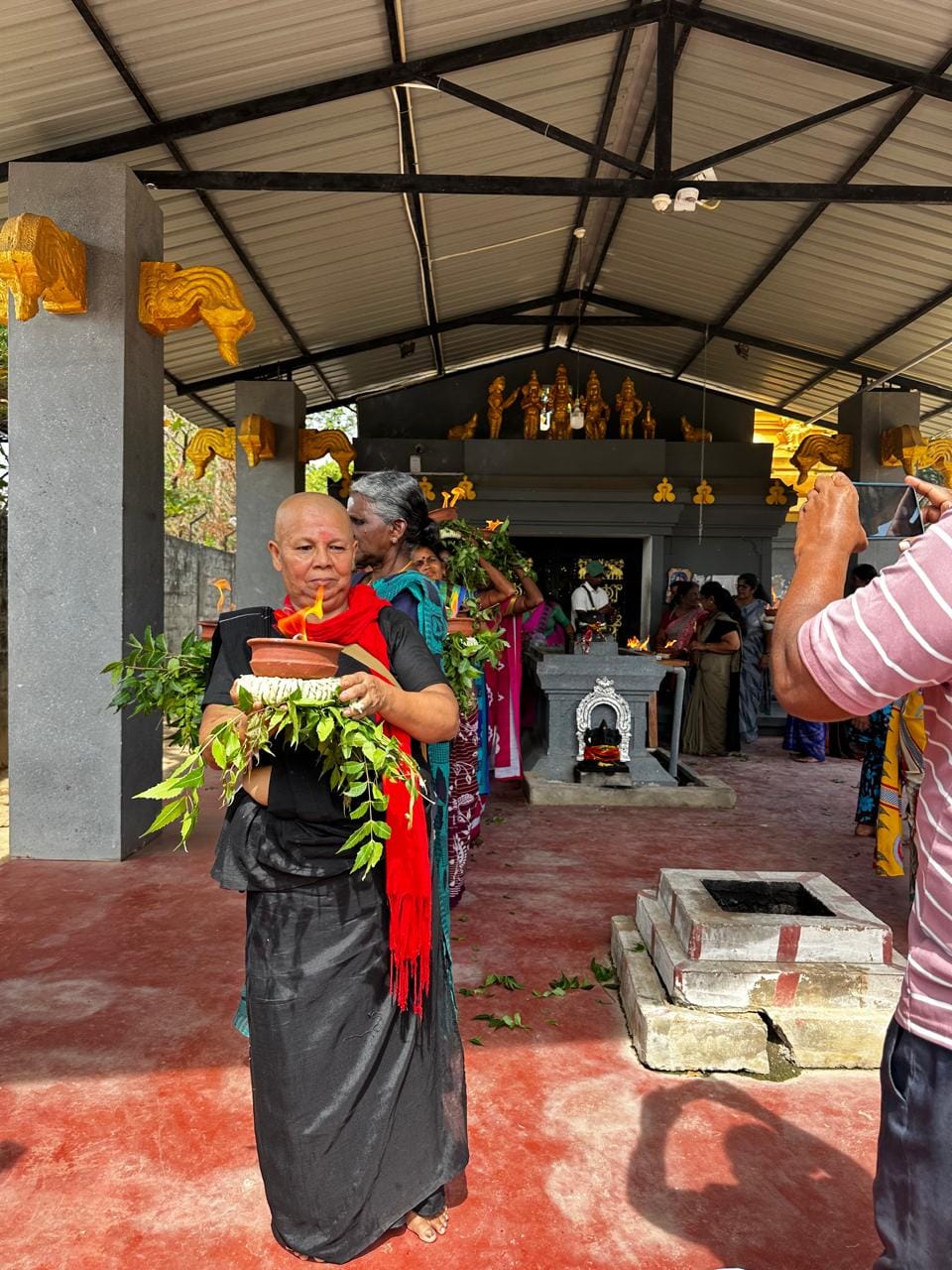
Mothers there carried theechatti, traditional clay pots holding fire, as part of a ritual invocation to the gods during the commemoration.
Back in Jaffna, the march eventually ended, and the torches were put out. Families left the auditorium carrying home the photographs of their loved ones, along with the weight of their memories, years of unanswered questions and a deep sense of betrayal by a government they had hoped would be different.
But the question they had carried for years remained.
Where are they?