

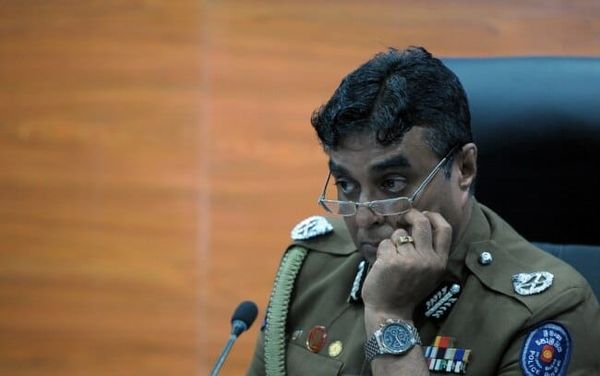
COLOMBO, Sri Lanka — Sri Lanka’s former police chief was sentenced to death on Friday for failing to stop the 2019 Easter Sunday bombings, after a court found he had sat on a run of intelligence warnings that named the bombers and, at the end, the day they would strike.
The three judges of the Colombo Permanent High Court Trial-at-Bar, Priyantha Liyanage, Viraj Weerasuriya, and Thilakaratne Bandara, convicted Pujith Jayasundara, who was Inspector General of Police at the time of the attacks, of abetting the killings through what prosecutors called an illegal omission. He had the warnings. He did not act on them.
No head of the Sri Lanka Police had ever before been convicted, let alone condemned to death, over a failure to prevent an attack. It is one of the gravest rulings to come out of a case that has moved through the courts and through the country’s politics for seven years.
The bombers struck three churches and three Colombo hotels on the morning of April 21, 2019, during Easter services. St. Anthony’s Shrine in Kochchikade, St. Sebastian’s Church in Negombo, and Zion Church in Batticaloa were packed with worshippers. The hotels were the Shangri-La, the Cinnamon Grand, and the Kingsbury. A seventh attacker blew himself up at a guesthouse in Dehiwala. Court records put the toll at 268 dead and 586 wounded; many of the dead were foreign tourists. The attackers belonged to a local group, National Thowheeth Jama’ath, that had pledged loyalty to the Islamic State.
Eight warnings
The case was about what did not happen. Between April 9 and the morning of the bombings, Mr. Jayasundara’s office took in at least eight intelligence reports, most routed through the State Intelligence Service and several traced to a foreign agency. Each warned that Zahran Hashim and his followers were preparing suicide attacks on churches and on hotels used by foreigners.
The reports sharpened by the day. One named Zahran and his lieutenants pointed to Catholic churches and the Indian High Commission. Another, dated April 20, said the group had already rehearsed, detonating a motorcycle near Kattankudy on April 16, and was likely to strike on or before April 21, with eight sites chosen, among them a church and a hotel. A message on the morning of the 21st tightened it again: the attackers were expected to move between 6 and 10 a.m.
What the Inspector General did with all that, by the court’s account, was very little. On one intelligence letter, he wrote three initials, “F.N.A.,” understood to mean “for necessary action,” and passed it down the line. On another, he told the intelligence chief to hand the matter to a subordinate. On a report about the Kattankudy rehearsal, he asked for a progress update by May 5 — more than a fortnight away.
Nilantha Jayawardena, then head of the State Intelligence Service, testified that when he pushed for instructions, he was told to inform other officers, and not much more.
In the ruling that revived the prosecution, the Supreme Court said the country’s most senior policeman had appeared content to write those three letters and move the threat along, with a mass-casualty attack all but announced. Whether that met his duty under the Police Ordinance, which requires every officer to do his utmost to prevent crime, was a question only Mr. Jayasundara could answer, the court held. On Friday, made at last to answer it, he was found to have failed.
Acquitted, then retried
The case turned twice on a point of procedure. In February 2022, an earlier Trial-at-Bar acquitted Mr. Jayasundara and the former defence secretary, Hemasiri Fernando, without even calling on them to defend themselves, ruling that the prosecution had not made its case.
The Attorney General appealed. On Nov. 5, 2024, five Supreme Court judges--Preethi Padman Surasena, Yasantha Kodagoda, Kumudini Wickremasinghe, Mahinda Samayawardhena, and Arjuna Obeyesekere --set that acquittal aside, with none of them dissenting. Justice Surasena, writing for the court, found that the trial judges had misread the law, holding the prosecution to a standard the charges never required and denying it the chance to put the accused to his defence. A case of this weight, the court said, should not have closed with the two men freed unheard. It sent the trial back.
That retrial ended on Friday.
A death sentence in Sri Lanka is close to notional. The country keeps capital punishment on the books but has executed no one since 1976, and successive governments have held to the moratorium. Condemned prisoners remain in jail, and sentences are frequently commuted. Mr. Jayasundara is expected to appeal.
The men now running the inquiry
The conviction comes as President Anura Kumara Dissanayake’s government pushes a broader reopening of the Easter case, promising to go after both the plot’s backers and whoever obscured the truth afterward. In February, investigators arrested Maj. Gen. Suresh Sallay, a former military and intelligence chief, under the Prevention of Terrorism Act — a measure of how high the new inquiry is prepared to go.
There is an awkwardness in it, and Mr. Jayasundara’s defenders and parts of the opposition have worked it hard. The two officials now steering the investigation both held senior police rank in 2019. Ravi Seneviratne, now Secretary to the Ministry of Public Security, was then the Senior Deputy Inspector General over the Criminal Investigation Department. Shani Abeysekara, brought back into service and now the C.I.D.'s director, headed the department at the time.
Hence, the question doing the rounds in Colombo: should officers who held senior security posts when the system broke down be the ones now sitting in judgment on that breakdown? Their critics, nationalist commentators, and government opponents, who have long resented the pair’s return, call it a conflict of interest and note that both belonged to a retired police group aligned with the governing party before they were rehired.
The two men, and the campaigners who want the case pursued read it another way. The C.I.D. investigates crime; it was not part of the intelligence and prevention chain - the State Intelligence Service, the Inspector General, the defence secretary - that received the warnings and failed to move. Mr. Abeysekara has testified that his detectives were already on Zahran’s trail before the bombings, that intelligence officers loyal to the Rajapaksa camp obstructed them, and that his team was broken up once Gotabaya Rajapaksa became president. Mr. Abeysekara was later arrested and jailed.
The Catholic Church, the most insistent voice for accountability, says it asked only that the investigators pushed aside under Mr. Rajapaksa be returned to the work, though a cabinet minister’s claim that the two were appointed at the Cardinal’s request is now itself in dispute.
None of that fixes how it looks, and the argument will likely return on appeal, and in the wider fight over what the investigation finally concludes.