
By Aruliniyan Mahalingam
JAFFNA, Sri Lanka — It was around 4:15 in the afternoon of Aug. 4, 2006. The men who came through the gate asked in Sinhala what the aid workers were doing there when everyone else in the town had fled, according to an account assembled by the University Teachers for Human Rights (Jaffna) from police sources in Muttur. The staff answered that their office in Trincomalee had told them to stay and wait to be collected. A home guard interrupted and said they were Tamil Tigers.
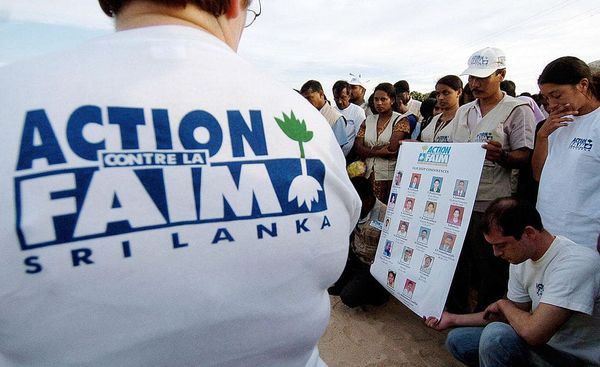
Seventeen employees of the French humanitarian organization Action contre la Faim, 16 of them Tamil and one Muslim, were made to kneel. They were shot at close range as they begged. Two who ran were killed away from the others. Their bodies were found separately, behind a vehicle. It was over within five minutes of the party's arrival, the group’s reconstruction found.
All 17 were wearing white T-shirts and vests bearing their organization’s logo. They were inside a compound whose GPS coordinates had been provided to the Sri Lankan Army, Navy, and Police so that it would not be shelled.
Twenty years later, no one has been arrested or indicted. A magisterial inquest, a criminal investigation, a human rights commission inquiry, and a presidential commission of inquiry all examined the killings. None identified a perpetrator. None produced a charge.
This month, as the anniversary passed, United Nations human rights experts, Amnesty International, Human Rights Watch, the French Embassy in Colombo, and the aid organization itself all called on Sri Lanka to reopen the investigation. The government has not responded.
Independent investigators concluded that at least four types of ammunition were fired inside the compound. One type entered the official record. It was the 7.62 round carried by both sides in the war.
A Jaffna Monitor review of reports by the International Commission of Jurists, the University Teachers for Human Rights, the Office of the United Nations High Commissioner for Human Rights, and the aid organization’s own investigations, together with interviews with former combatants, sets out what happened to the other three.
The town
Muttur sits on the southern shore of Trincomalee harbor. Fabrice Carbonne, who ran the organization’s Trincomalee base from March 2005 to June 2006 and had left before the killings, described it as the entry gate to its operations across the south of the district.
The organization arrived in Sri Lanka as a tsunami response after December 2004 and remained as the cease-fire broke down. In the year before the killings, it delivered water and sanitation services to more than 116,000 people across Sri Lanka. By August 2006, the U.N. experts said this month, it was the only international aid group still working in and around Muttur.
Fighting for the town began Aug. 1, and the Liberation Tigers of Tamil Eelam captured Muttur on Aug. 2. The organization’s new anniversary report says more than 150 people were killed in the surrounding area as civilians fled. The University Teachers for Human Rights, a group founded by academics at the University of Jaffna and critical of both the government and the LTTE, put the figure at about 50, most of them Muslim civilians killed by government shelling.
The 17 staff members did not leave.
“We believed that displaying our humanitarian identity would provide a form of protection,” said François Danel, the organization’s deputy director general in 2006. “Realizing that we were wrong, and that the military paid no attention to it whatsoever, was devastating.”
Between Aug. 1 and Aug. 4, the organization and the International Committee of the Red Cross attempted evacuation by road and by boat. Neither side in the fighting would guarantee safe passage.
An army major, a colonel, and a senior superintendent of police were each personally asked by staff in Trincomalee to secure the safety of the trapped team. The Presidential Commission of Inquiry that later examined the case scrutinized the aid organization’s internal decisions in detail. It never examined the conduct of those three officers.
The clock
Radio contact with the team was lost at about 7:45 on the morning of Aug. 4, according to Andrew Mitchell, the organization’s desk officer at the time. A convoy sent to reach the compound after the team went silent was stopped at an army checkpoint six miles away.
The LTTE withdrew from Muttur around midday. Government forces then moved in.
If the killings occurred in the early morning, the rebels were plausibly in control of the ground. If they occurred in the afternoon, the security forces were.
The commission of inquiry, chaired by Justice Nissanka Udalagama, placed the deaths in the early hours of the morning, relying on the judicial medical officer of Anuradhapura, who recorded the time of death as most likely early on Aug. 4. The commission also concluded that no evidence placed army commandos anywhere near the compound at any point that day. A police witness told the same commission that commandos had been seen at a school nearby on Aug. 3 and 4.
The University Teachers for Human Rights rejected the commission’s finding and assembled a competing chronology, set out in its Special Report No. 30, published on April 1, 2008.
A religious leader in Muttur told the group that he had gone to the compound between 8 and 8:30 a.m. and urged the staff to leave on foot with the departing residents. They refused, he said, telling him their superiors had instructed them to remain in the office and wait to be collected. In a later report, Special Report No. 33 of August 2009, the group recorded testimony from the Rev. Albert Sornarajah, who saw the aid workers alive after 8:30 that morning.
A staff member who was not lodging at the office and who left Muttur on foot with most of the town’s residents around 10 a.m. told the group that he believed his colleagues were still alive when he went. He had not seen them himself. His account rested on a woman who cooked for the team and who had met them after 9 a.m.
The group cited, as corroboration, a report in the Tamil-language Sunday Virakesari of Aug. 13, 2006, quoting a neighbor who had fed the aid workers and warned them that everyone else was packing to leave.
Later that day, sources the group reached in 2007 said, some of the staff walked to a grocery on the main road near the hospital to buy tea and biscuits. That would place them alive after the rebel withdrawal, which residents generally put at around noon. The group was not able to trace those sources again.
The same report states that the Anuradhapura medical officer gave a different account privately. The group wrote that it had later learned he told Peter Apps, then a Reuters correspondent, that the probable time of death was the afternoon of Aug. 4. The medical officer said this after examining some of the bodies at Trincomalee Hospital on Aug. 8, 2006, four days after the killings and well before he prepared his post-mortem reports.
What he entered in the inquest reports was that death had occurred most likely in the early morning of Aug. 4.
Apps was separately told by Sri Lankan commanders in Muttur on Aug. 5 that most rebel fighters had already withdrawn early on the 4th.
The police obtained the cellphone numbers of all 17 victims and their call records from the operators within days. Those records have never been made public.
The Sri Lanka Monitoring Mission, the Nordic body overseeing the 2002 cease-fire, issued its assessment in late August 2006. Given that government forces controlled the town, it said, no armed group other than the security forces could have been responsible. Ulf Henricsson, its head, called the killings a clear war crime and said an independent international commission was needed because the mission trusted neither side to investigate.
What the rebels say
Former Tamil Tiger fighters interviewed by Jaffna Monitor said the movement had never intended to capture Muttur. The offensive, they said, was commanded by its Trincomalee commander, Sornam, and was aimed at overrunning the Kaddaparichchan army camp. When the assault failed, the cadres moved into the adjoining town.
They rejected any role in the killings, arguing from opportunity. Most of the aid workers were Tamils from areas the movement controlled. Had the Tigers wanted to kill civilians and blame the military, the former fighters said, the withdrawal offered far better opportunities, and the cadres passed large numbers of Muslim and Sinhalese civilians without harming them.
“Sornam was no saint,” a senior former rebel leader said. “He was a ruthless commander who was responsible for the deaths of many innocent civilians.”
The same man said Sornam had killed members of a Rupavahini television crew shortly after fighting broke out between the Tigers and the Indian Peacekeeping Force in October 1987. Sornam was killed in the final phase of the war in 2009 and cannot answer the allegation.
The compound
Aid agencies did not reach the compound until Aug. 7, when the Consortium of Humanitarian Agencies gained access and found the bodies. Some accounts, including one published by the organization’s British office, date the first entry to Aug. 6.
Local police did not secure the scene, preserve evidence, or collect the dead. The bodies had lain where they fell for days. Action contre la Faim staff loaded their colleagues onto trucks themselves.
The guns
Two calibers of ammunition were in circulation in Muttur that week, and they were not equally revealing.
The police at the Muttur station were generally issued the T-56, a Chinese-made copy of the Kalashnikov that fires a 7.62-by-39-millimeter round. So did the Tamil Tigers. It was the standard rifle on both sides. A recovered 7.62 projectile is consistent with the police, with the Muslim home guards attached to them, and with the rebels.
The Naval Special Forces commandos deployed to Muttur on Aug. 3 were seen carrying M16 rifles and FN Minimi light machine guns, the University Teachers for Human Rights found. Both fire a 5.56-by-45-millimeter round. In 2006, that caliber was neither standard police issue nor standard rebel armament. It was a special forces caliber. Witnesses stated separately that government Special Forces carrying M16S were in Muttur at the height of the battle, a point acknowledged even in The Muttur Massacre: A Quest for the Whole Truth, an account written from within the government and published in July 2008.
The same report identifies two further weapons carried by police constables in the party that went to the compound: an Uzi submachine gun, firing a 9-millimeter round, belonging to the station commander’s bodyguard, and a belt-fed light machine gun carried by a second constable. The group concluded that a minimum of four types of ammunition were fired inside the compound.
A missing photograph
Eleven of the 17 bodies were exhumed after burial. Second post-mortem examinations were conducted on Oct. 24 and 25, 2006, with an Australian forensic pathologist, Dr. Malcolm J. Dodd, observing. Seven bullets and three bullet fragments were recovered.
The government analyst identified every one of them as 7.62.
There was one exception, briefly. At the second autopsy, Dr. Dodd identified a projectile taken from the head of one of the women, Romila Sivapragasam, as 5.56. The International Commission of Jurists reported the identification in April 2007 and set out what it implied about who had fired.
In June 2007 the Attorney General’s Department moved to establish that the object was not a bullet at all, but the core of a 7.62 round. Dr. Dodd withdrew his identification. He did so, the University Teachers for Human Rights found, after being sent a photograph of the projectile that was not the original. The original certified photograph taken at the autopsy is missing.
A fired 5.56 projectile carries rifling marks visible to the naked eye. The core of a 7.62 round is smooth. It is also the wrong color: cores are gray-black, jacketed bullets are copper. A police sub-inspector had earlier submitted actual cores to the court among productions from the scene, so both he and Dr. Dodd had handled the difference.
Michael Birnbaum, the senior British barrister sent by the International Commission of Jurists to observe the inquest, examined the documentation of the ballistic exhibits and found numerous inconsistencies in how items were recorded, described, and transmitted. The commission’s published summary of his conclusions states that there was serious concern that a bullet of the type used by Sri Lankan military and special forces units was removed from the evidence and replaced with a bullet of a different caliber.
The second magistrate to hear the inquest had ordered that the ballistic exhibits be opened only in the presence of the Australian expert. Birnbaum found that the police disobeyed that order.
One of the earliest accounts obtained by the University Teachers for Human Rights came from an elderly Muttur resident who lived near the compound. He said he saw an army patrol enter the office at about 4:15 p.m. and leave shortly afterward. About 45 minutes later, he said, masked men in commando uniforms arrived on a convoy of motorcycles, followed by a senior officer in a vehicle accompanied by guards. They entered the compound and remained there for about half an hour.
The group described that second visit as an attempt to remove ammunition that would not fit the official account. The witness later became untraceable.
Removing the magistrate
The Muttur magistrate, M. Ganesharajah, a Tamil, had conducted three hearings and was about to deliver his verdict on the post-mortems. That undelivered verdict described the killings as a crime against humanity and ordered a rigorous investigation, the University Teachers for Human Rights found.
On Sept. 4, 2006, the Judicial Service Commission, acting through the Secretary to the Ministry of Justice, ordered the inquest transferred to the magistrate of Anuradhapura. Ganesharajah was replaced by a Sinhalese magistrate.
Birnbaum found that no provision in Sri Lankan law justified replacing one magistrate with another at such an advanced stage of the proceedings. He described the move as unwarranted interference contrary to international standards, while concluding that both magistrates had nevertheless conducted the inquest with sensitivity and fairness.
One of the three members of the Judicial Service Commission that removed Ganesharajah was Justice Udalagama. Three months later he was appointed chairman of the presidential commission that would examine the same case.
The inquiry
Birnbaum’s report, published in April 2007, identified two failures in the police investigation.
Official police reports showed that from the outset, before any investigation had been conducted, the police had settled on the Tamil Tigers as the perpetrators.
And the Criminal Investigation Department had not interviewed a single member of the Sri Lankan security forces. Nor had it interviewed any Tamil, apart from the families of the dead.
President Mahinda Rajapaksa announced the commission of inquiry in September 2006, with a mandate covering about 15 alleged violations, including the Muttur killings. Foreign donors, skeptical of earlier Sri Lankan commissions, negotiated the creation of an International Independent Group of Eminent Persons to observe its work, chaired by P.N. Bhagwati, a former chief justice of India. The group could not investigate independently and had no access to witnesses of its own. Its reports went to the president, who could veto publication.
In March 2008 it quit. Its final report concluded that the proceedings had fallen far short of transparency and of basic international standards, and identified conflicts of interest compromising the commission’s independence, the absence of witness protection, and the conduct of the Attorney General’s Department. The government, it concluded, was unwilling to investigate cases with vigor where the conduct of its own forces was in question.
One commissioner had already been forced out by the president over a perceived conflict of interest, at the urging of counsel for the army.
The commission exonerated the army and navy in 2009, attributing the killings instead to the LTTE or a Muslim militia group. Its full report was never published.
The witnesses
The University Teachers for Human Rights documented threats delivered by telephone and in person, forced reporting to police stations, abduction and assault, bribery and threats from the commission’s own police investigation unit, surveillance, illegal detention, house searches and threatening letters. Witnesses were intimidated inside the commission’s own witness protection room.
Witnesses who had fled abroad were to testify by video link. A presidential directive stopped it.
A key witness whom the police had themselves identified, Haji Abdul Rahuman, has been missing since late September 2006.
Two people connected to the victims’ families died. The guardian of one of the dead drivers died after being beaten by a naval officer in an unrelated incident. The wife of another victim died of a brain hemorrhage a day after receiving a summons to appear before the commission, following months of harassment.
Several families left the country. The 2015 U.N. investigation separately documented allegations that witnesses and officials connected with the case faced intimidation and harassment.
The letters
The commission wound up in mid-2009 without identifying anyone. Udalagama told the BBC that the culprits had not been identified because the commission had run out of funds. He said that video conferencing had been essential for hearing witnesses abroad and had been stopped by a presidential directive. Journalists who approached individual commissioners for copies of the report were referred to the president's office.
On July 14, 2009, news organizations reported that the commission had cleared the army.
Four days later, plainclothes police officers went to the homes of the victims’ families in Trincomalee and summoned them to Fort Frederick, then the army’s headquarters and the government’s administrative center in the town. A man who introduced himself as a private attorney from Colombo presented them with two letters in English and told them to sign, the University Teachers for Human Rights found. Others present filmed them.
The letter addressed to the president thanked him for appointing the commission, said the families agreed with its finding that the deaths were caused by the Tamil Tigers, and said compensation should be paid by the aid organization for gross negligence. The second thanked the Attorney General’s counsel for their impartiality.
“I do not know English, but I gathered from others that the truth had been turned on its head and we were to give our assent,” one parent said. “Some of us gave excuses, trying to wriggle out of it. The attorney was firm that we must sign.”
The letters were collected on July 25. After the BBC reported that the families had signed under duress, they came back by post on Aug. 1, 2009, stamped at Thampalakamam.
Still no justice
In 2011, the government’s own Lessons Learnt and Reconciliation Commission recommended further investigation and prosecution. Nothing followed.
In 2015, the U.N. human rights office concluded that there were reasonable grounds to believe members of the Sri Lankan security forces committed the extrajudicial executions. It recorded the government’s rejection of the allegation and its position that rebel involvement could not be ruled out. Its recommendation for a hybrid court was never acted on. In 2021, the U.N. human rights office said Sri Lanka remained in a state of denial about the past.
Action contre la Faim left Sri Lanka in 2008.
On May 15 this year, Dr. Robert Sebbag, the president of Action contre la Faim, wrote to President Anura Kumara Dissanayake requesting an account of what Sri Lanka’s governmental and judicial authorities had done to investigate the massacre and bring those responsible to justice, in accordance with what the letter called Sri Lanka’s international obligations. He asked to meet the president to discuss progress toward an impartial, transparent, and effective investigation.
The letter said the organization was deeply concerned that twenty years on, there had been no justice for its colleagues, and that the families continued to endure the trauma of a decades-long wait. An open case file, it warned, sent a dangerous signal that attacks on humanitarian workers could be carried out without consequence. It noted that Sri Lanka has signed the Declaration for the Protection of Humanitarian Personnel, which affirms its determination to end impunity for such attacks.
In an accompanying statement on June 15, the organization called on the international community to support the request. It says it has received no reply from the president.
Amuthan Sivajnanam, whose sister Kovarthani, 27, was among the dead, told The Guardian that years of fear had silenced many relatives.
“I refuse to remain anonymous because fear has already taken too much from us,” he said. “I want the world to know my name, my sister’s name, and the names of the 16 others who died with her.”