


KALMUNAI, Sri Lanka — Sivarasa Anojan was serving a five-year prison sentence in Saudi Arabia over a Facebook comment about the Prophet Muhammad. His family was told that an appeal could result in a reduced sentence, and they agreed to pursue one. But when the appeal was decided on Thursday, the court instead sentenced him to death, according to the lawyer who attended the hearing.
Documents reviewed by Jaffna Monitor show that Sri Lanka’s Foreign Ministry helped facilitate the appeal even after its embassy obtained legal advice describing the chances of success as “extremely low.” None of the documents reviewed by Jaffna Monitor records a warning to the family that an appeal could produce a harsher sentence, and the ministry sent the family a copy of the appeal filed in Anojan’s name only one day before it was decided.
The documents are the memorandum of appeal lodged on Mr. Anojan’s behalf, a letter from the ministry’s Consular Division to his father dated Sept. 16, and a Bank of Ceylon slip recording the money the family paid.
Two crimes, not one
The Criminal Court in Al-Ahsa convicted Mr. Anojan of two separate offences on July 28. The first was producing and publishing material through an information network likely to undermine religious values and public morals, by posting a comment on a social media platform. That offence has a written penalty attached to it. The second was verbally insulting and verbally assaulting the Prophet Muhammad, which the judgment describes as prohibited under Sharia. That offence has no written penalty attached to it at all.
For both convictions together, the court gave him five years in prison, counting time already spent in detention, and a fine of three million Saudi riyals, roughly $800,000. It ordered the confiscation of the digital device used and the closure of the account.
The public prosecutor had asked for more. He wanted a summary of the judgment published, and he wanted a severe discretionary punishment imposed for the verbal assault against the Prophet, to deter Mr. Anojan and others. The court refused both requests.
That refusal became significant once the case went to appeal. A heavier punishment had already been sought at trial, and the trial judges had declined to impose it.
Why an appeal could make things worse
Saudi Arabia has no complete written criminal code. Where scripture fixes no penalty, the judge decides the penalty himself, applying his own reading of Islamic law. This discretionary power is called ta’zir. It has no ceiling written anywhere, and for insulting the Prophet it can extend to death. The Hanbali school of jurisprudence followed by Saudi courts treats that offence as among the gravest there is, and some jurists place it alongside apostasy.
The cybercrime conviction was different. It fell under Article 6 of the Anti-Cyber Crime Law, issued by royal decree in 2007, which sets a ceiling of five years’ imprisonment and a fine of three million riyals, or one of the two. Mr. Anojan received the maximum on both.
The appeal filed for Mr. Anojan was built entirely on that ceiling. It argued that imposing the maximum prison term and the maximum fine together was excessive, and that the court should weigh the circumstances of the incident and his personal situation. It did not dispute his guilt. “My client does not dispute the prohibition or seriousness of the act,” the English translation reads, “nor is his appeal intended to diminish the status of the Prophet.”
The ceiling the appeal relied on governed only one of the two convictions. The other had no ceiling. By asking the appellate judges to look again at whether the punishment was too severe, the appeal put the whole sentence back in play, including the part the trial judges had declined to impose.
In many legal systems, including Sri Lanka’s, a convict who appeals cannot end up worse off than before. Saudi Arabia offers no such protection. The United States State Department’s annual human rights report on Saudi Arabia records that appellate courts there may increase a sentence, including raising a lesser sentence to the death penalty. Saudi Arabia’s Law of Criminal Procedure gives the prosecutor the same right of appeal as the convict. The precedent is well documented: in the Qatif case in 2007, an appellate court doubled the sentence of a rape victim after her lawyer appealed, and the punishment was undone only when King Abdullah pardoned her.
Whether the prosecutor filed his own appeal here, and what reasoning the appellate judges gave, cannot be established until the written judgment is released. The Sri Lankan government says it still does not have it.
The Remaining Routes
The judgment records that Mr. Anojan was sentenced in respect of what Saudi law calls the public right. The state prosecuted him on its own behalf. There is no victim.
In Saudi murder and assault cases, the victim’s family can forgive the convict or accept compensation, and the execution is called off. Those cases end in pardons regularly, and Sri Lankan governments have used that route before to save citizens facing execution in the Gulf.
That route does not exist here. Nobody has standing to forgive Mr. Anojan except the Saudi state. A death sentence is carried out only after the king ratifies it by royal order, which makes the king the only person who can stop it.
Two judicial safeguards remain before that point. A death sentence must be affirmed by a five-judge appellate panel, and then unanimously by a five-judge panel of the Supreme Court. The lawyer who attended the hearing told the Sri Lankan Embassy the judgment may be challenged before the Supreme Court within one month.
August
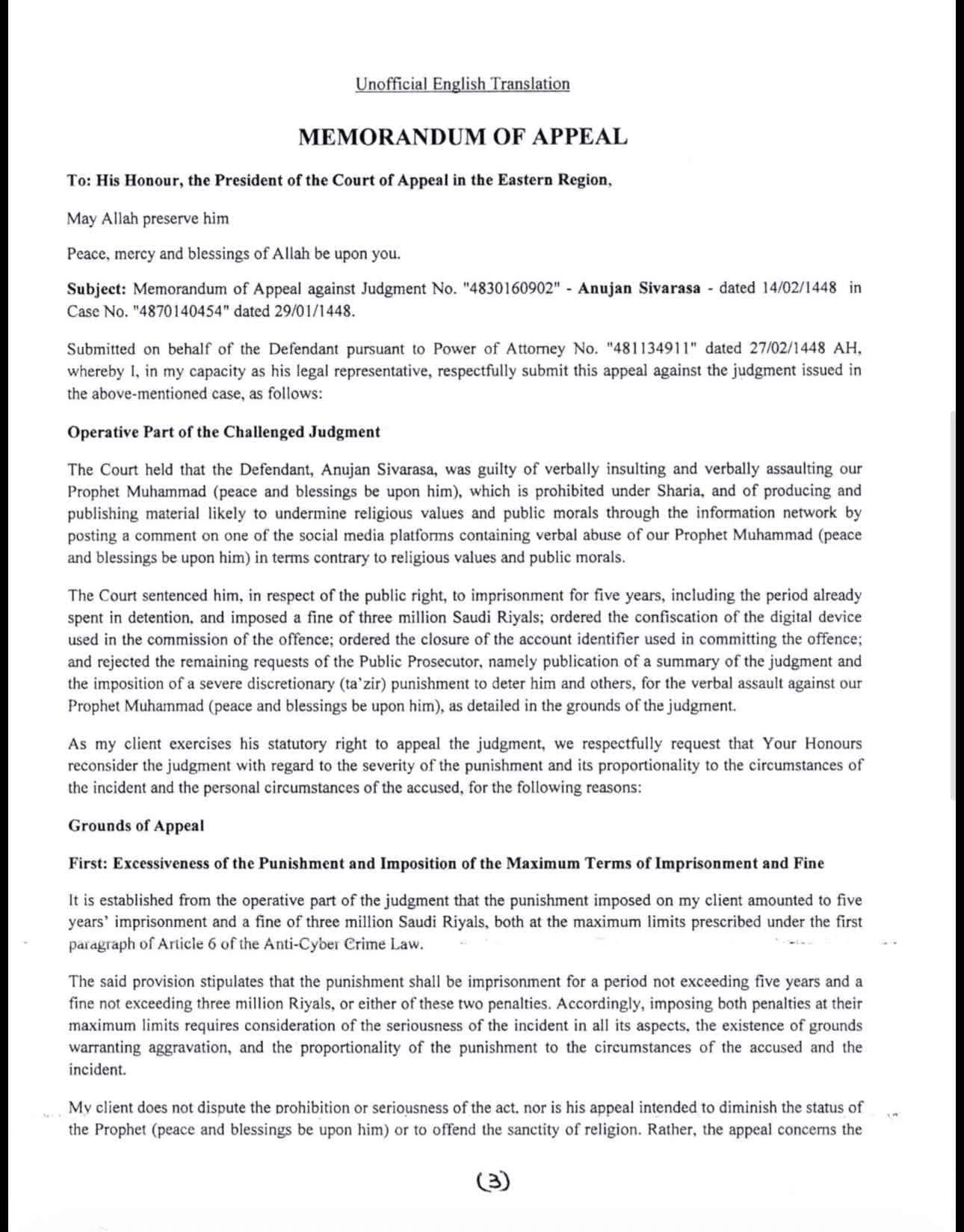
The trial judgment is dated July 28. The Sri Lankan Embassy in Riyadh obtained advice from a Saudi lawyer after receiving it. A Foreign Ministry notification issued in early August recorded that advice: the likelihood of the appellate court accepting an appeal or reducing the sentence was “extremely low.” The same notification recorded that an appeal had to be filed within 30 days of receipt of the judgment.
On Aug. 4, Cabinet spokesman Nalinda Jayatissa said the government was consulting the family about an appeal while separately exploring a royal pardon or a reduced sentence, and that the family’s consent was required before any appeal could proceed.
The power of attorney authorising the appeal is dated Aug. 10. The memorandum was filed on Aug. 24.
Shanakiyan Rasamanickam, parliamentary group leader of the Ilankai Tamil Arasu Kadchi, says the family agreed to appeal after meeting Deputy Foreign Minister Arun Hemachandra and being advised to proceed. According to Mr. Rasamanickam, religious leaders had at the same time been pursuing clemency on humanitarian grounds without disturbing the judgment.
It has not been established whether the family was ever shown the “extremely low” assessment, or whether anyone explained to them that an appeal in Saudi Arabia can produce a heavier sentence. Nothing in the documents reviewed by Jaffna Monitor records such a warning.
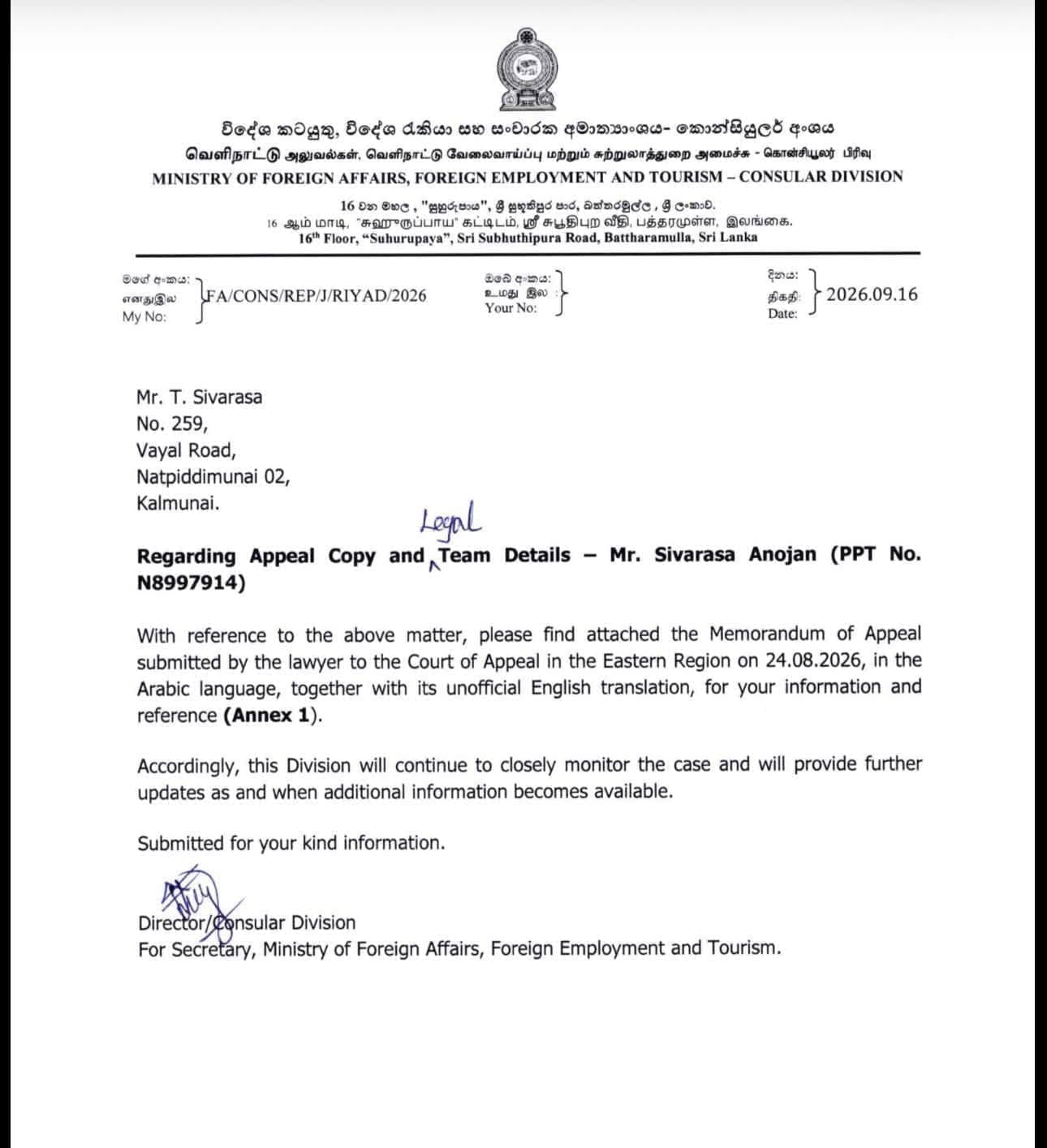
The ministry’s letter to Mr. Anojan’s father, T. Sivarasa, at Vayal Road, Natpiddimunai, is dated Sept. 16. It enclosed the Arabic memorandum and its unofficial English translation. That was more than three weeks after the appeal was filed and one day before it was decided. By then, nothing in it could be changed. It names no lawyer. It says only that the Consular Division will continue to monitor the case and provide updates as information becomes available.
Mr. Rasamanickam says the memorandum identifies an attorney named Adlan Abdullah Al-Subaie as counsel, but that a different lawyer appeared at the hearing, and that the family was never given his name or contact details.
The family also did not learn the outcome from the government. Mr. Anojan was allowed to telephone home after the hearing and told his relatives himself, according to Rajkumar Rajeevkanth, an activist who has been in contact with them and who first made the death sentence public. The embassy was informed afterwards, verbally, by the lawyer who had been in the courtroom.
1,890,766 rupees
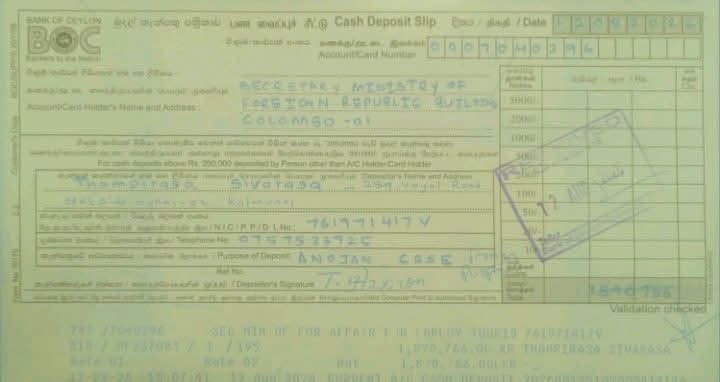
A Bank of Ceylon cash deposit slip reviewed by Jaffna Monitor records a payment of 1,890,766 rupees, about $6,300, by Thampirasa Sivarasa of Vayal Road, Natpiddimunai. The account is held in the name of the Secretary, Ministry of Foreign Affairs, Republic Building, Colombo 01. In the box asking the purpose of the deposit, the depositor wrote “Anojan case.”
The account is an official government account rather than a private one. What is unanswered is who selected the lawyer the money paid for, how the fee was set, when and how it was remitted to Saudi Arabia, and what record exists of how it was spent. The ministry has not addressed any of this publicly.
The Foreign Ministry says it has conveyed its concern to the Saudi Embassy in Colombo, that it is providing consular assistance to Mr. Anojan and his family, and that the embassy in Riyadh is preparing a further appeal to the Supreme Court within the one-month window. It says it is still awaiting the written judgment, which will set out the official basis of the decision.
The politics
Mr. Rasamanickam says he will raise the case in Parliament this week, and that any inquiry into the handling of the first appeal must not slow efforts to save Mr. Anojan. He has called for experienced legal representation in Saudi Arabia, for every remaining avenue of judicial review, and for a clemency campaign at the highest diplomatic level.
Rishad Bathiudeen, leader of the All Ceylon Makkal Congress and a former cabinet minister, visited the family at Natpiddimunai on Friday night. He said he would bring Muslim members of Parliament together to petition President Anura Kumara Dissanayake and the Saudi king, and would ask the All Ceylon Jamiyyathul Ulama to appeal to Saudi authorities. He said Mr. Rasamanickam, Gajendrakumar Ponnambalam and Mano Ganesan had agreed to work with him.
Ali Sabry, the former foreign minister, has urged clemency. “Respect for Saudi Arabia’s sovereignty and legal system does not require silence in the face of disproportionate punishment,” he said. He called five years excessive for an offensive social media comment and said taking Mr. Anojan’s life for it would be “grossly disproportionate, inhumane and unacceptable.” Reports that the comment was removed within minutes and followed by a video apology deserved weight, he said. “An offensive remark should not extinguish a person’s opportunity to repent, learn and rebuild his life.”
Mr. Anojan’s mother has appealed to President Dissanayake to bring her son home.
The window for a Supreme Court challenge runs for one month from the appellate ruling. Neither Mr. Anojan’s family nor the Sri Lankan government has seen the judgment they would have to challenge.
A dog named Subramani
The case began thousands of kilometres from Saudi Arabia. During this year’s Pada Yatra, the Hindu pilgrimage to Kataragama, a stray dog that pilgrims named Subramani walked hundreds of kilometres with them and became known across the island. A video then circulated showing a young Muslim man kicking the dog in Kalmunai. He was arrested and released on bail, and the incident set off weeks of angry exchanges online between members of different religious communities.
A Facebook comment Mr. Anojan posted during those exchanges was brought to the attention of Saudi authorities in the country where he was working. That comment became the basis of the prosecution.