
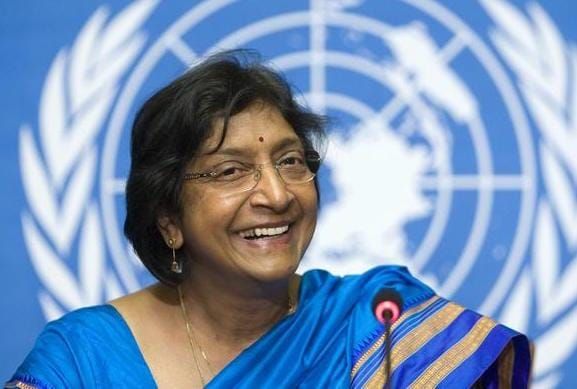
OSLO — Navanethem Pillay, the South African jurist whose demands for an international investigation into the final months of Sri Lanka’s civil war made her a defining figure for war-affected Tamils and a target of the Rajapaksa government, was awarded the Nobel Peace Prize on Friday.
The Norwegian Nobel Committee said it was honoring Ms. Pillay, 85, known as Navi, for her work to advance “a more comprehensive global legal order” and to ensure that war crimes, crimes against humanity and genocide are prosecuted. The committee framed the award as a defense of international courts at a time when, it said, judges “are sanctioned, and their institutions are attacked.”
Ms. Pillay is believed to be the first person of Tamil origin to win the Peace Prize. Three earlier Nobel laureates of Tamil descent, the physicists C.V. Raman and Subrahmanyan Chandrasekhar and the chemist Venkatraman Ramakrishnan, were honored in the sciences.
A Durban childhood
Ms. Pillay was born on Sept. 23, 1941, in Clairwood, a predominantly Indian neighborhood of Durban, then part of South Africa’s Natal Province. Her parents, Narrainsamy Naidoo and Santhama Naidoo, were a Tamil couple of modest means. Their names appear to correspond to the Tamil Narayanasamy Naidu (நாராயணசாமி நாயுடு) and Santhamma Naidu (சாந்தம்மா நாயுடு).
Her grandparents had migrated from the Madras Presidency in British India, which encompassed much of present-day Tamil Nadu, to work as indentured laborers on Natal’s sugar plantations in the late 19th century. According to Ms. Pillay, one of her grandfathers lost both arms in an accident at a sugar mill, forcing her father to leave school at the age of 8 and begin working to support the family. Her given name, Navanethem, is a variant of the Tamil Navaneetham (நவநீதம்).
Her father drove a bus and took other work, including fishing, to support eight children, of whom she was the fifth. Her parents raised the family with Hindu values and insisted that their daughters attend school alongside their sons at a time when many girls in her community were married young. She has described facing discrimination on three counts: as a woman, as a South African of Indian heritage and as the child of a working-class family.
In 1967 she became the first non-white woman to open a law practice in Natal. In 1973 she won the right of political prisoners on Robben Island, including Nelson Mandela, to have access to lawyers. Her husband, Gaby Pillay, a lawyer of Indian descent, was among the detainees she defended. After the end of apartheid, President Mandela appointed her to the High Court.
International courts
Ms. Pillay joined the International Criminal Tribunal for Rwanda in 1995 and later served as its president. In the 1998 judgment against Jean-Paul Akayesu, a former town mayor, the tribunal held for the first time that rape and sexual violence could constitute genocide. The committee credited her influence as a significant factor in that finding. She later presided over the tribunal’s “media case,” which convicted the founders of a radio station and a newspaper of inciting genocide.
She went on to serve as a judge of the International Criminal Court, as U.N. High Commissioner for Human Rights from 2008 to 2014, and as chair of the U.N. Independent International Commission of Inquiry on the Occupied Palestinian Territory and Israel. She now sits as a judge on the International Court of Justice in the case brought by The Gambia accusing Myanmar of genocide against the Rohingya.
Sri Lanka
Ms. Pillay took office as high commissioner months before the war between the Sri Lankan government and the Liberation Tigers of Tamil Eelam ended in May 2009.
Within days of the government’s victory, she told a special session of the U.N. Human Rights Council that there were strong reasons to believe both sides had grossly disregarded the principle that civilians must be protected. She called for an independent and credible international investigation and cited allegations against both parties. The LTTE, she said, was accused of preventing civilians from leaving the conflict zone, forcibly conscripting people and using civilians as human shields, and there were alleged cases of rebels firing on civilians as they fled. The government, she noted, reportedly used heavy weapons on the small, densely populated conflict zone in the north despite assurances that it would protect civilians.
In 2011, a panel of experts appointed by Secretary-General Ban Ki-moon reported credible allegations that both the Sri Lankan military and the LTTE had committed serious violations, some of which could amount to war crimes and crimes against humanity. Ms. Pillay endorsed its call for further investigation. She said the eyewitness accounts in the report demanded a full, impartial, independent and transparent investigation.
In August 2013 she spent a week in Sri Lanka, traveling to Jaffna, Kilinochchi, Mullaitivu and Trincomalee as well as Colombo. At a news conference at the end of the visit, she said the country was “showing signs of heading in an increasingly authoritarian direction.” She said people who met her had been harassed and intimidated by security forces.
‘The Tamil Tigress at the U.N.’
Ms. Pillay’s Tamil ancestry was a recurring theme in attacks on her by Sri Lankan government ministers and their allies.
The attacks began during the war. In March 2009, she cited an estimate of 2,800 civilian deaths in the Vanni and warned that actions by both the military and the LTTE might violate international law. The government rejected the figure. Its human rights minister, Mahinda Samarasinghe, objected that her numbers matched those published on TamilNet, a website the government said the LTTE ran. The same month, according to a U.S. Embassy cable later released by WikiLeaks, the defense spokesman, Keheliya Rambukwella, said international organizations had been “infiltrated by the LTTE” and that pro-LTTE elements held high-ranking posts in them. In its report to Washington, the embassy noted that Ms. Pillay was an ethnic Tamil but, to its knowledge, had never visited Sri Lanka.
The campaign intensified around her 2013 visit. Pro-government demonstrators protested outside U.N. offices in Colombo and called her a stooge of the United States. Midway through the trip, Housing Minister Wimal Weerawansa told reporters she would write an unjust report because of her ethnicity. He said she had come “as a Tamil woman, to satisfy the wishes of Tamil separatists,” and accused her of meeting activists secretly and accepting forged documents and faked photographs.
At a public meeting in Colombo the same week, Mervyn Silva, the public relations minister, offered to marry her. He said he would teach her Sri Lankan history and take her on a tour of the country. Udaya Gammanpila, a leader of the Jathika Hela Urumaya, a Sinhala nationalist party allied with the government, called her husband a terrorist. When President Mahinda Rajapaksa met Ms. Pillay near the end of her visit, he apologized for remarks by Mr. Silva, Mr. Weerawansa, and Mr. Gammanpila. Days later, a cabinet minister, Dullas Alahapperuma, publicly apologized for Mr. Silva’s proposal, calling it wrong and uncivilized.
Government officials and state media also questioned her motives in the north. The state-run Sunday Observer, citing unnamed sources, reported that she had sought to pay a floral tribute to the LTTE leader Velupillai Prabhakaran. Mr. Rambukwella, by then media minister, said her criticism gave reason to believe she had “a different agenda.”
Ms. Pillay addressed the attacks at her closing news conference in Colombo. She said that some ministers, media outlets and propagandists in Sri Lanka had for years described her as a tool of the LTTE on the basis of her Indian Tamil heritage. “They claim I am in the LTTE’s pay, that I am the Tamil Tigress at the UN,” she said. She noted that her only previous visit to the country had been to attend a commemoration of Neelan Tiruchelvam, the Tamil legislator and scholar killed by an LTTE suicide bomber in July 1999. She described the LTTE as a “murderous organisation” and said members of the diaspora who honor the group should understand there is no place for glorifying it.
The government said she had exceeded her mandate. Defense Secretary Gotabaya Rajapaksa said her visit had been influenced by propaganda from remnants of the Tamil Tigers. Weeks later, her office filed a formal complaint with the government. Its spokesman, Rupert Colville, accused senior officials of “a coordinated campaign of disinformation” to discredit her.
An international inquiry
In February 2014, Ms. Pillay’s office issued a report concluding that Colombo’s failure to establish a credible national accountability process was “fundamentally a question of political will” and recommended an international inquiry. President Rajapaksa called the recommendations “arbitrary, intrusive and of a political nature.” On March 27, 2014, the Human Rights Council adopted a resolution mandating an investigation by her office, by a vote of 23 to 12 with 12 abstentions. The investigation's findings were published in 2015, after her term ended.
Nobel
In its citation, the committee called Ms. Pillay “one of the most respected international jurists of our time” and credited her independence, expertise and steadfastness. It said she had held states and national leaders accountable and brought hope to victims of violence and conflict. She will receive the prize, which carries an award of 11 million Swedish kronor, at a ceremony in Oslo on Dec. 10.