
By Aruliniyan Mahalingam
The president told senior clergy that the drafters of Sri Lanka’s prison regulations may not have expected monks to be imprisoned. Colonial records show monks tried for treason, jailed in Jaffna and Kandy, and executed in their robes before the law was written. A court ruled on a monk stripped of his robes in prison more than a century ago.
JAFFNA, Sri Lanka — More than 120 years ago, a Buddhist monk walked out of a colonial prison in Ceylon without his robes. The prison had taken them. He wore lay clothes for some time before robing again, and the island’s Supreme Court was asked whether he was still a monk. The court ruled that he was. A monk forcibly deprived of his robes, the judges held, had not renounced the order.
On Thursday, President Anura Kumara Dissanayake met senior Buddhist clergy in Colombo about the removal of a jailed monk’s robes. He told them that Sri Lanka’s prison regulations say little about monks and offered a possible reason.
“Perhaps that is because those who drafted the regulations did not anticipate Buddhist monks being imprisoned,” he said. “That may have been how our society was, with a bond between our monks, society and lawmakers.”
The historical record does not support that explanation, and some of the evidence against it came from the president himself. In the same meeting, he said that Regulation 216 refers specifically to Buddhist monks and that about 69 monks are now serving sentences.
The older record goes further. Jaffna Monitor reviewed colonial correspondence held by the National Archives, published histories, contemporary British newspapers and the island’s law reports. Under British rule, the British arrested and tried monks for treason from 1816 onward. A senior prelate was imprisoned in Jaffna. A monk was shot by firing squad in his robes in 1848, and the British press argued over whether he should have been stripped of them first. All of this happened before the Prisons Ordinance was enacted in 1877. Within about 25 years of the ordinance, the courts were deciding what it meant for a monk to lose his robes in prison.
A monk in prison clothing
The dispute concerns Galagoda Aththe Gnanasara Thero, general secretary of the Buddhist nationalist group Bodu Bala Sena. On Oct. 5, the Court of Appeal ordered prison authorities to enforce the remainder of his sentence for contempt of court. The Attorney General had sought the order after the presidential pardon that freed him was revoked. That afternoon, officials removed his robes, issued him prison clothing and placed him in a ward for ordinary prisoners. His appearance in court in that clothing drew protests from the Mahanayake Theros, the chief prelates of the main monastic orders.
Under the regulations, a monk's attire depends on his status. A monk held on remand has not been convicted and keeps his robes. A monk sentenced to simple imprisonment may wear robes if the prison superintendent agrees. A monk serving rigorous imprisonment, as Gnanasara Thero is, must wear what the prison issues. He wore prison clothing during an earlier jail term in 2018.
Mr. Dissanayake said prison officials had followed the law. “My personal preference must not become the law,” he said.
Arrested, jailed, executed
The British took the Kandyan kingdom in 1815. The next year, Ihagama Rathanapala Thero, a monk of the Malwatte chapter, organized a plan to remove them and place a Siamese prince on the throne. The plan was exposed, and he was arrested with two other monks. After the rebellion of 1818, he was sentenced to death. He was instead exiled to Mauritius, and was exiled there a second time after a failed conspiracy in 1834.
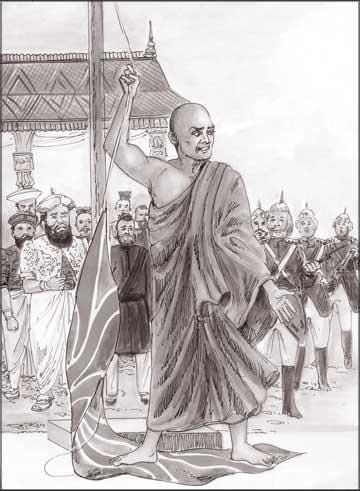
In 1818, during the Uva-Wellassa rebellion, Wariyapola Sri Sumangala Thero, a deputy chief prelate of the Asgiriya chapter, took the Tooth Relic from the Temple of the Tooth in Kandy and went into hiding. Possession of the relic had long been tied to the right to rule the island. A letter from Governor Robert Brownrigg to the Colonial Office, now in the National Archives, describes soldiers finding the monk in the forest with the relic. He was convicted of treason and imprisoned in Jaffna.
In the early 1840s, a monk known as Bentota Unnanse claimed royal status. He was held in the Kandy jail and released without trial in January 1843. He was later arrested again and indicted for treason before the Supreme Court in Badulla, listed first among 12 defendants under his monastic name.
The Matale rebellion of 1848 was put down under martial law imposed by Governor Viscount Torrington. Eighteen people were executed after courts-martial. One was Kadahapola Unnanse, a monk shot while wearing his robes on Aug. 24 or Aug. 26; accounts differ on the date. The killing was criticized in the British press and examined by the parliamentary inquiry that followed. Two other monks tried over the rebels’ coronation ceremony at Dambulla were acquitted.
The question of the robes was argued at the time. In November 1854, the London weekly The Leader defended Torrington against critics who had compared the execution to shooting the Pope in his vestments. The paper said a monk had no other clothing and that stripping him would have exposed him naked before his people. It said he was executed in the dress he wore when arrested.
The Prisons Ordinance was passed 29 years after the executions.
The court and the robes
The case described at the top of this article is Gooneratne Terunanse v. Ratnapala Terunanse. It was decided by Chief Justice John Bonser, who led the court from 1893 to 1902, and Justice Withers. The court held that disrobing ended a monk’s status only if it was voluntary and intended as renunciation. It found that this monk’s disrobing was neither.
In 1941, the Supreme Court applied the ruling again in a dispute over a temple in the Galle District and restated the same test.
After independence
On Sept. 25, 1959, a monk, Talduwe Somarama, shot Prime Minister S.W.R.D. Bandaranaike at his residence. A jury found that the killing had been arranged by Mapitigama Buddharakkitha, chief incumbent of the Kelaniya Raja Maha Viharaya. Somarama had worn his robes when he fired the shots but stopped wearing them in court during the trial, and in sentencing him to death in May 1961, Justice T.S. Fernando remarked on it. Somarama gave up his robes two weeks before he was hanged at Welikada Prison on July 6, 1962, and was baptized by an Anglican priest in his cell. Buddharakkitha’s death sentence was reduced on appeal to rigorous imprisonment for life, later commuted to 20 years. He died of a heart ailment in early 1967 after about seven and a half years at Welikada. No published account reviewed by Jaffna Monitor records whether he wore robes in prison. His sentence was rigorous imprisonment, the category that today requires prison clothing.
After the Janatha Vimukthi Peramuna’s insurrection in 1971, about 16,000 people were detained under emergency powers. A retired police officer has written that young monks travelling in civilian clothes were among the activists behind a failed attempt that year to free the JVP leader, Rohana Wijeweera, from Jaffna prison. The JVP now leads Mr. Dissanayake’s National People’s Power coalition.
What the committee faces
The president said the committee would be appointed the same day. It will draw on the Attorney General’s Department, the ministries of justice, public administration and Buddhist affairs, and senior prison officials. He said its proposals would be put to the senior clergy before they take effect.
Mr. Dissanayake told the prelates that their main objection seemed to be how imprisoned monks appear when taken out of prison, to court or anywhere else the public and press can see them, more than what they wear inside. He did not say whether the new rules would treat the two situations differently.