By Aruliniyan Mahalingam
COLOMBO, Sri Lanka — Sri Lanka's government on Tuesday introduced legislation to repeal the Prevention of Terrorism Act, the 47-year-old security law that Tamils, Muslims and critics of successive governments have long associated with arbitrary detention and torture.
Human rights groups, lawyers and the country's own Human Rights Commission say the replacement keeps many of the old law's worst features and adds new ones. The bill sets out a broad definition of terrorism, allows the armed forces to search and arrest civilians without a warrant, and lets the president ban organisations without judicial review.
Harshana Nanayakkara, the Minister of Justice and National Integration, presented the Protection of the State from Terrorism Bill for its first reading. It would repeal the Prevention of Terrorism (Temporary Provisions) Act, No. 48 of 1979, known as the PTA.
The bill says its purpose is to protect Sri Lanka and its people from terrorism committed inside or outside the country, and to stop Sri Lankan territory from being used to plan attacks abroad. It gives the authorities powers to arrest, detain, investigate, prosecute and punish people suspected of terrorism and related offences.
Years of Pledges
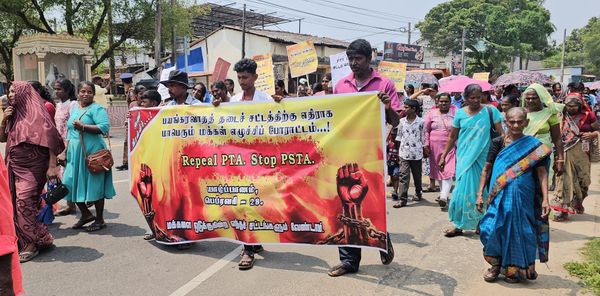
Tamil political parties, civil society groups, the United Nations and foreign governments have called for the PTA's repeal for decades. President Anura Kumara Dissanayake's National People's Power coalition promised in its 2024 election manifesto to abolish it.
Earlier governments made the same promise. In 2017, Sri Lanka agreed to repeal the PTA as a condition for the European Union restoring its GSP+ trade concessions. Every attempt to replace the law since 2018 has failed, including the Anti-Terrorism Bill that President Ranil Wickremesinghe's government put forward in 2023.
This is the current government's second try. It introduced an earlier version in late 2025, withdrew it after objections from rights groups and the media, and redrafted it. The cabinet approved the revised bill in August after the Attorney General cleared it.
The PTA is still being used. In June, police arrested Sangeethan Ganeshkumar, a 24-year-old Tamil hip-hop artist, under the law over a music video. The Human Rights Commission of Sri Lanka told the United Nations there were 46 PTA-related detention cases in 2025 and 12 in the first three months of this year.
Objections
Human Rights Watch said in a statement issued hours before the bill was tabled that it retained many of the provisions that had enabled serious abuses under the PTA. The group said the bill fell short of standards set by United Nations experts and of Sri Lanka's commitments to the European Union. Elaine Pearson, its Asia director, said the bill would do little to stop past abuses from happening again.
The Centre for Policy Alternatives, a Colombo-based research group, has asked the government to withdraw the bill and repeal the PTA outright. It said the bill does add procedural safeguards the PTA lacked, but that its definition of terrorism is too broad and that it still allows executive detention and gives policing powers to the military.
The World Organisation Against Torture said the law could be used arbitrarily against "political opponents, minority communities, human rights defenders, journalists and dissenting voices."
The Human Rights Commission sent its observations to Mr. Nanayakkara, with a copy to the president. It described the PTA as a "serious blight" on the statute book and said it was not convinced the new bill fixed the PTA's basic flaws. The commission asked for a narrower definition of terrorism, judicial control over detention, protection of judges' power to grant bail, and prompt access to lawyers for suspects. It also asked whether Sri Lanka needs a separate counterterrorism law at all, and recommended that terrorism cases be tried under ordinary criminal law.
What the Bill Changes
The PTA did not define terrorism. It listed offences and relied on the loose idea of "unlawful activity." The new bill does define terrorism, and most of the criticism is aimed at that definition.
It includes "unduly compelling a government or an international organization" to do or abstain from any act. It also covers acts involving property, infrastructure, electronic systems, essential services and the environment. United Nations experts say a terrorism offence should require both serious violence and an intent to intimidate the public or coerce a government. Critics say the Sri Lankan bill could be applied to nonviolent acts, such as a strike that disrupts an essential service, and expose those involved to the bill's special arrest and detention powers.
A lawyer who spoke to Jaffna Monitor about the earlier draft said someone urging the government to pull out of its agreement with the International Monetary Fund, or calling on a foreign government to cancel agreements with Sri Lanka, could be accused under the "compelling" clause.
The bill says protest, advocacy, dissent, industrial action and humanitarian or medical assistance do not, by themselves, amount to offences. Human Rights Watch said this did not remove the risks in other clauses. Lawyers point out that the words "by themselves" allow the authorities to claim that a particular protest crossed the line.
Detention has drawn the sharpest objections. Under the PTA, the Minister of Defence could order a suspect held for three months at a time, for up to 18 months. A 2022 amendment cut that to 12 months. Under the new bill, the Inspector General of Police or a Deputy Inspector General can get an order from the Defence Secretary to hold a suspect for two months, which can be extended to a year. A magistrate has no power to cancel it. Through other provisions, a person could be held without charge for as long as two years.
The decision to detain would therefore rest with a civil servant appointed by the president, not an elected minister who answers to Parliament. An Independent Review Committee would look at each order within 30 days. Its members, however, would be appointed by the Minister of Defence, and Human Rights Watch said that raised doubts about its independence.
The bill also puts into permanent law powers that governments used mostly under emergency regulations, which lapse unless Parliament renews them every month. Police, the armed forces and the coast guard could stop, search and question people, enter premises and take suspects into custody without a warrant if they have "reasonable suspicion." The president could ban organisations without a court's involvement. The Defence Secretary could declare any place a "prohibited place." A Deputy Inspector General could seek a court order restricting a person's movement and communications for up to three months.
On speech, the bill makes it an offence to encourage terrorism, directly or indirectly, by distributing or circulating a "terrorist publication," or by providing a service that lets others obtain, read, listen to or view one. The withdrawn draft also made it a crime to gather or pass on "confidential information," which it defined to include information about the official conduct of the police and armed forces. Unlike the 2023 bill, it offered no defence for journalists or researchers.
Some changes have been welcomed. The Centre for Policy Alternatives said the bill does not keep, in the same form, the PTA rule that let confessions made to police officers be used as evidence, a provision lawyers have long linked to torture in custody. Magistrates would be able to visit detention sites without notice, speak to detainees, order an examination by a Judicial Medical Officer if torture is suspected, and move a detainee to another facility.
The Human Rights Commission said a new law would not replace the need to reform the security agencies that enforce it, and noted that laws with safeguards on paper can still be applied selectively.
Background
The PTA was passed in 1979 under President J.R. Jayewardene as a temporary law meant to last three years, at a time of growing Tamil militancy in the North and East. It was made permanent in 1982, a year before the civil war began in earnest. Security forces used it widely against Tamils suspected of links to the Liberation Tigers of Tamil Eelam, among them students, labourers and young men picked up in cordon-and-search operations. Rights groups recorded cases of people held for years without trial, and many detainees said they were tortured or forced to confess.
The law was also used outside the war. Tamil journalist J.S. Tissainayagam was sentenced in 2009 to 20 years of rigorous imprisonment for articles criticising the government's treatment of Tamil civilians. He was pardoned in 2010 after international pressure. Ahnaf Jazeem, a Muslim poet and teacher from Mannar, was held for 19 months from May 2020 over claims that his Tamil poetry promoted extremism. A court acquitted him in 2023 for lack of evidence. Wasantha Mudalige, a student leader arrested at a protest in Colombo in August 2022, was held for more than five months until a magistrate discharged him and found that police had misused the law. After the 2019 Easter Sunday bombings, Muslims were detained in large numbers under counterterrorism powers.
In the North and East, where the military still has a heavy presence 17 years after the war ended, Tamil politicians and activists say land disputes with the army, protests by families of the disappeared and commemorations of the war dead could all be treated as security matters under the new definitions.
The NPP's Past Position
The National People's Power is led by the Janatha Vimukthi Peramuna, or JVP. Thousands of its members were killed or disappeared when the government put down the party's 1987-89 insurrection under emergency rule.
When the Wickremesinghe government proposed its Anti-Terrorism Bill in 2023, Vijitha Herath, now the foreign minister, called it anti-democratic, demanded it be withdrawn and said its definition of terrorism went against United Nations standards. He and Harini Amarasuriya, now the prime minister, were among those who petitioned the Supreme Court to rule that the bill could only become law if approved at a referendum. Critics say the same objections apply to the bill their government tabled on Tuesday.
Next Steps
Any citizen can challenge the bill in the Supreme Court within 14 days of it being placed on Parliament's order paper. The court's ruling must reach the Speaker before the second-reading debate. The National People's Power won 159 of the 225 seats in Parliament in 2024, more than the two-thirds majority it would need if the court rules that any part of the bill requires one.
Human Rights Watch has asked the government to stop using the PTA while the bill is revised. Rights groups say they will push for changes to the definition of terrorism, judicial oversight of detention and the military's powers before the second reading.