
By: Sunanda Deshapriya
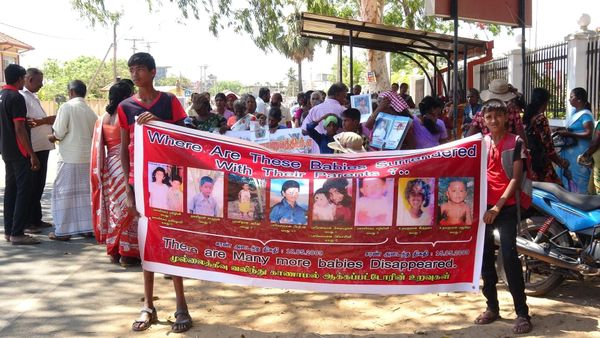
30 August is the International Day of the Victims of Enforced Disappearances. Across the world, tens of thousands of families continue to search for answers about loved ones who vanished during wars, dictatorships, political repression, and armed conflicts. For many, justice remains elusive.
Sri Lanka is one of the countries where enforced disappearances remain a deeply painful and unresolved issue. For decades, Sinhalese, Tamil, and Muslim families have experienced disappearances in different historical contexts.
Since the mid-1980s, I have witnessed and actively participated in both local and international efforts to seek truth, accountability, and justice for the disappeared in Sri Lanka. Since May 2009, while living in exile in Geneva, Switzerland, I have continued to support and advocate for international initiatives aimed at securing justice for wartime human rights violations in my country.
Over the years, the international human rights community has produced hundreds of reports documenting these violations. Numerous UN Human Rights Council resolutions have been adopted, and many comprehensive studies and recommendations on post-war accountability and transitional justice have been published, debated, and archived. Despite this extensive body of work, meaningful justice for victims and their families remains elusive.
Sixteen years on, we are still at square one. Mothers and fathers of the disappeared are still on the streets, in the North as well as in the South. Numbers are dwindling. Same slogans, same faces and same response from the state. Sometimes brutal repression, sometimes cold indifference.
In early post-war years, progressive Sinhalese and justice-seeking Tamil diaspora worked together at the Human Rights Council, in Geneva. Today there is no unity. Diaspora groups opposed the September 2015 consensus resolution on establishing transitional justice mechanisms. I stood by the resolution.
The 2015 change of government presented the most promising opportunity for constitutional reform, reconciliation, and transitional justice in Sri Lanka, generating significant domestic and international optimism. However, political resistance, personality clashes and infights, institutional weaknesses, and the absence of sustained public support caused these efforts to stall, allowing a historic opportunity for accountability to slip away.
At the same time, the ruling NPP/JVP has generally approached the national question through a class-based framework, emphasizing socioeconomic reform as the solution to ethnic grievances. This perspective overlooks the distinct political, historical, and identity-based dimensions of the Sri Lankan Tamil question, which require direct engagement with issues such as power-sharing, minority rights, recognition, and accountability. Expecting justice for the disappeared from a ruling party that has shown no willingness to investigate the killing of its own founding leader, Rohana Wijeweera, after his arrest on 13 November 1989, and that has elevated alleged perpetrators to positions of power, is akin to waiting for Godot.
At present, the strongest Tamil voices, both within Sri Lanka and in the diaspora, call for an international mechanism, whereas there is little discernible support among Sinhalese constituencies for international involvement.
Appeals to Tamil Nadu and India for support in securing an international investigation have largely fallen on deaf ears. Even recent political changes in Tamil Nadu have made little difference.
Resolutions passed by the UNHRC became diluted over time, and there is now no such enthusiasm among Council members as there was between 2012 and 2016. The Sri Lankan state learned to live with the resolutions to the extent that it no longer asks for a division when yet another hackneyed resolution comes up. On the last two occasions, the NPP government, led by President Dissanayake, simply made a statement opposing the resolutions and allowed them to pass unopposed.
The OHCHR Sri Lanka Accountability Project (OSLAP), established by the UN Human Rights Council, has been in operation for five years and has collected a substantial body of evidence relating to alleged human rights violations in Sri Lanka. However, no convictions resulting from the use of this evidence under universal jurisdiction have been publicly reported.
The Office on Missing Persons (OMP), established in line with Sri Lanka's commitments under the 2015 UNHRC resolution, has largely faded from public relevance. Under the leadership of Saliya Pieris, PC, a respected lawyer and human rights defender, the institution did some commendable work in its early years. Today, however, it is often viewed as little more than a nameboard institution. The same critique is frequently directed at the Office for Reparations, whose first Chairperson was Dhara Wijayatilake, Attorney-at-Law and a distinguished former senior public servant.
Unlike countries such as South Africa and Argentina, where transitional justice processes emerged from profound political transformations, Sri Lanka has experienced no comparable change in the character of the state.
At the same time, there is no shared understanding of justice across Sri Lanka's communities. For many Tamils, accountability for wartime abuses remains central to reconciliation, while Muslims continue to face grievances relating to discrimination and displacement. In contrast, many Sinhalese view the military primarily as the force that defeated terrorism and safeguarded the state. These competing narratives have made it difficult to build consensus around a common approach to justice and reconciliation.
No paradigm shift in any of these factors is on the horizon.
Within Sri Lanka, there is no significant civil or state initiative towards establishing a Truth and Reconciliation Commission that could pave the way for a realistic and tangible accountability and reconciliation process. When it comes to wartime accountability issues, the government and opposition are on the same page.
The international human rights landscape has changed dramatically. There is no longer a unipolar West advocating rights-based accountability. The multipolar world we are witnessing today places greater weight on state sovereignty than on international pressure. In the era of post-Gaza genocide, advocacy for human rights has become another term for selective hypocrisy.
The 63rd session of the UN Human Rights Council will once again consider the OHCHR's written update on Sri Lanka. As an individual who submitted a report on Sri Lanka's human rights situation to the Council's first session in June 2006, I continue to follow these proceedings with keen interest.
Most probably, a new resolution along the lines of Resolution 57/1, Promoting Reconciliation, Accountability and Human Rights in Sri Lanka, will be adopted without a vote.
But will it make any real difference? I am not convinced that it will.
This brings us to the million-rupee accountability question: Where do we go from here?
After nearly two decades of resolutions, reports, commitments and monitoring mechanisms, the fundamental challenge remains unchanged. How can meaningful accountability, reconciliation and institutional reform be achieved when international concern has not translated into substantial domestic action?
Are there any low-hanging fruits that can be pursued while keeping the larger issues on the agenda? Could the day-to-day lives of the families of the disappeared be improved through an accelerated programme? Is a collective apology from Sri Lanka’s political leadership possible? Can there be an investigation leading to a consensus on the number of missing and dead due to political violence since the 1971 insurrection, including those affected by ethnic riots? How do we create a common narrative on justice for the disappeared?
This leaves me with a troubling question: if even such steps remain beyond reach, where can victims of enforced disappearances realistically look for justice?