
By Sunanda Deshapriya
Sri Lanka's history demonstrates how laws enacted in the name of security and public order can evolve into instruments that extend far beyond their original purpose. The Prevention of Terrorism Act (PTA) became synonymous with arbitrary detention, torture allegations, and the suppression of political dissent. Today, a new generation of legislation is being introduced against a backdrop where accountability for past abuses remains limited and public confidence in law enforcement and security institutions continues to be fragile.
The National People's Power (NPP) government has presented a series of legislative initiatives it argues are necessary to address national security threats, organised crime, money laundering, and public safety. These measures include the proposed Protection of the State from Terrorism Act (PSTA), the Prevention of Organised Crime Bill, and the Non-Governmental Organisations (Registration and Supervision) Bill. However, critics argue that when examined together, these laws represent more than isolated policy initiatives. Instead, they appear to form part of a broader regulatory framework that expands state authority at the expense of civic freedoms and democratic safeguards.
Adding to these concerns are two additional developments: the continued implementation of the Online Safety Act and the proposed Chartered Institute of Media Professionals of Sri Lanka Bill. Together, these measures are seen as creating a legislative framework capable of increasing state oversight over civil society, journalism, digital expression, and political participation.
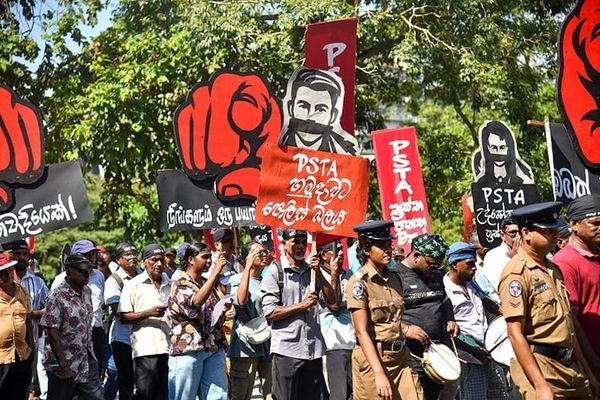
At the centre of the debate is the proposed Protection of the State from Terrorism Act (PSTA), introduced as a replacement for the widely criticised PTA. While presented as a modern counterterrorism framework, concerns have been raised over its broad and ambiguous definitions of terrorism. Critics argue that these definitions could potentially extend beyond genuine security threats and be used against forms of political dissent or public protest.
The bill also grants extensive executive powers relating to detention and provides mechanisms through which armed forces could be deployed in law-enforcement roles. Civil liberties advocates warn that such provisions pose significant risks to the freedoms of expression and assembly, while also raising concerns about the protection of personal liberty.
Similar concerns have emerged in relation to the proposed Prevention of Organised Crime Bill. Introduced as a tool to combat criminal networks and organised criminal activity, the legislation includes provisions allowing administrative detention by police for periods ranging from two months to twelve months with reduced judicial oversight. Human rights advocates contend that such measures undermine due process protections and the right to a fair trial while increasing the risk of arbitrary detention and ill-treatment.
The Draft NGO Act represents a different but equally significant expansion of regulatory authority. The government argues that the legislation is required to strengthen compliance with international anti-money laundering and counter-terrorist financing standards. However, the bill would require compulsory registration of civil society organisations and grant the state expanded supervisory powers over their activities.
Critics note that the legislation would require organisations to align with government policy objectives while introducing extensive monitoring powers. Particularly controversial are provisions that would permit officials to enter organisational premises without a judicial warrant. Civil society groups argue that such measures threaten freedom of association, freedom of expression, and the right to privacy, potentially discouraging independent civic engagement.
These legislative initiatives do not exist in isolation. The Online Safety Act has already established a legal framework through which online speech can be regulated. Authorities describe the law as necessary to combat harmful online activity, misinformation, and digital abuse. Critics, however, argue that its broadly framed provisions relating to false statements and harmful content can be used to restrict legitimate criticism and investigative reporting.
According to media freedom advocates, the law's greatest impact may not come through direct prosecutions but through its chilling effect on public debate. The possibility of legal consequences may encourage self-censorship among journalists, activists, and ordinary citizens engaging in political discussion online.
The proposed Chartered Institute of Journalists Bill has generated another layer of concern. Although the legislation has already undergone scrutiny by the Supreme Court and is expected to be amended, critics question whether a state-recognised professional regulatory body could undermine media independence.
While the bill is presented as a mechanism to improve professional standards within journalism, opponents fear it could create new avenues for professional control, disciplinary action, and indirect regulation of the media sector. In a context where other legislative measures already increase state oversight, they argue that such a framework could further weaken the autonomy of journalists and independent media institutions.
Viewed separately, each of these laws is justified on different grounds: national security, crime prevention, financial compliance, online safety, or professional regulation. However, concerns intensify when the measures are considered collectively. The PSTA, Prevention of Organised Crime Bill, Draft NGO Act, Online Safety Act, and Chartered Institute of Journalists Bill appear to form a mutually reinforcing legislative architecture.
Collectively, these measures expand executive and administrative powers while increasing state oversight of civil society organisations, media institutions, digital platforms, and individual citizens. The cumulative effect is a noticeable contraction of civic space and a corresponding reduction in opportunities for dissent, independent civic engagement, and democratic participation. The irony is that the JVP-NPP, now in government, was previously a sharp critic of many similar laws and initiatives, warning that they concentrated excessive power in the hands of the state and undermined democratic freedoms. These concerns are further amplified by the emergence of the JVP-led Praja Shakthi network, which has become an influential mechanism in the implementation and monitoring of local development activities, raising questions about whether unelected party-linked structures are increasingly eclipsing the role of constitutionally mandated local authorities.
The implications of this evolving legal framework are heightened by the current political climate. President Anura Kumara Dissanayake and the NPP government enjoy substantial public goodwill generated by anti-corruption initiatives, social justice campaigns, and the personal popularity of the president. This political legitimacy provides the government with considerable public support as it pursues legislative reforms.
Yet it is precisely this popularity that raises concerns among some observers. They argue that democratic decline is not always the result of a sudden authoritarian takeover. Instead, it can occur gradually through the concentration of power under governments that retain broad electoral support.
Within this context, Sri Lanka risks evolving into a "popular autocracy" - a system in which democratic legitimacy derived from elections coexists with the gradual erosion of civic freedoms and institutional restraints on executive power. Rather than emerging through an abrupt authoritarian rupture, such a transformation can occur incrementally, as successive legislative measures expand state authority over public discourse, civil society, political mobilisation, and independent scrutiny. The cumulative effect is not merely greater regulation, but a structural shift in the balance between state power and citizen freedom. Growing opposition from civil society organisations, journalists, lawyers, and concerned citizens suggests that awareness of, and resistance to, this trajectory is already taking shape.
Another concern relates to how these powers might be used in practice. Security legislation and laws governing public order or organisational activity often grant authorities significant discretion. There is a risk that such powers could be disproportionately deployed against opposition movements, independent activists, and Tamil nationalist political mobilisation. Such outcomes could deepen existing social and political divisions while undermining efforts to build a more inclusive democratic system.
Ultimately, the debate extends beyond questions of legal rights and governance. Sri Lanka's most pressing challenge remains economic transformation. The long-term success of the government's political project is likely to depend less on expanding regulatory powers than on delivering meaningful economic progress.
Reducing poverty, creating new economic opportunities, and enabling the middle class to experience tangible improvements in living standards will be central to sustaining public confidence. Equally important will be the pursuit of genuine ethnic reconciliation through the recognition and implementation of the political, cultural, and democratic rights of the Tamil people.
Without progress on these fronts, economic achievements alone may be insufficient to secure a stable, inclusive, and democratic future. The central question facing Sri Lanka is therefore whether democratic renewal will be achieved through accountable governance and inclusive development, or whether expanding state control over civic and political life will gradually constrict the very democratic space required for that renewal to succeed.