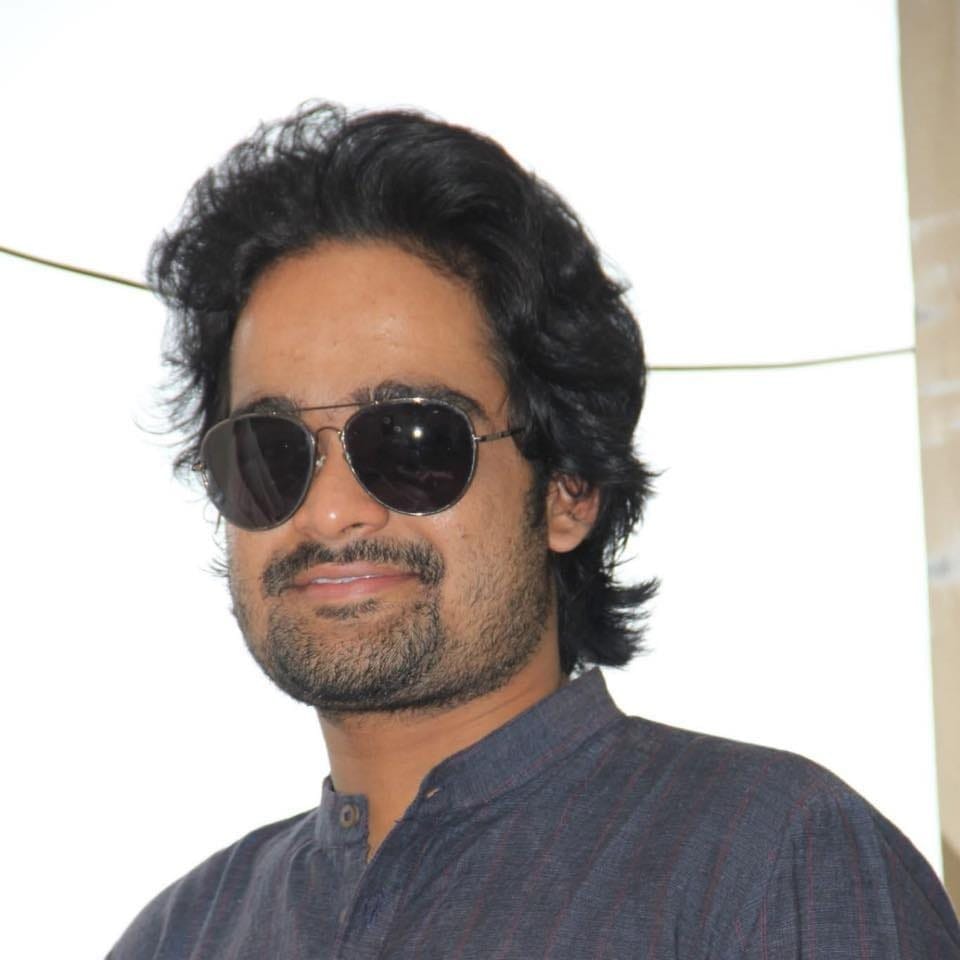

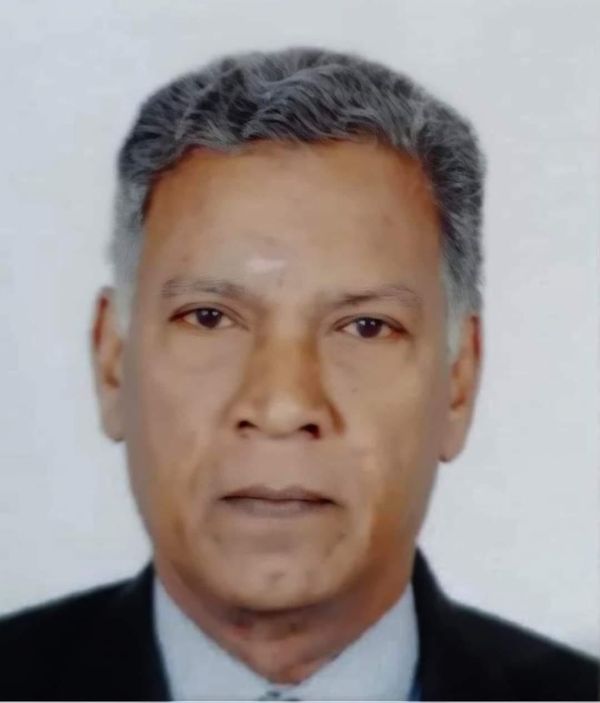
By: Aruliniyan Mahalingam
This profile first appeared in the Jaffna Monitor at the time of Maheswaran’s death. It is republished, lightly revised, to mark the second anniversary of his passing.
Thambapillai Maheswaran, one of the earliest figures in the armed Tamil struggle and the founder of the Tamil Eelam Army (TEA), died of a heart attack in Jaffna two years ago. He was among the first to bring a certain audacity to the movement — the raids, the jailbreaks, the vehicle bombs that preceded and, in some measure, inspired operations the Liberation Tigers of Tamil Eelam would later make infamous. Yet for all his early influence, Maheswaran remains one of the struggle’s most contested figures: to some a committed liberationist, to others an impulsive adventurer more drawn to the thrill of the attack than to the politics of freedom.
He came from an affluent family in Pungudutivu. His father, Thambippillai, was a prosperous restaurateur, one of many islanders who made their fortunes in the trade, and the owner of the well-known Dhawalagiri Hotel in Maradana, Colombo, which he sold, for reasons he never explained, before the 1980s. There is an irony written into the son’s very name. Thambippillai was routinely mispronounced as Thambapillai, and so the son became Thambapillai Maheswaran; his militant group, in turn, was first known as the ‘Thampa Group’.
His siblings prospered abroad — a sister who became a doctor, a brother who retired as an accountant, a younger brother in the United States, and an elder sister in the United Kingdom. At Jaffna Central College, Maheswaran had been a standout: a sharp memory, strong academics, and a genuine athlete who turned out at cricket and football for the school.
The family’s wealth, built largely on the hotel business, sent him to Queen’s College at the University of London in the mid-1970s, where he lived with his elder sister and her husband, an established accountant. He read civil engineering before switching to aeronautics, sources close to him said.
Unmarried all his life, he would in his final years be supported by the same siblings whose generosity he had once tested so sorely.
London
In London, he fell in with Anton Balasingham — later the LTTE’s chief theoretician — and with Ratnasabapathy, a founding member of the Eelam Revolutionary Organisation of Students (EROS). Balasingham had not yet attached himself to the Tigers or to their leader, Prabhakaran.
At Maheswaran’s funeral, PLOTE leader Dharmalingam Siddarthan claimed it was Maheswaran who first drew Balasingham toward the LTTE, introducing the theoretician to the movement he would come to define. It was also in London, friends told the Jaffna Monitor, that Maheswaran took his first drink, in Balasingham’s company — a habit that would shadow him for the rest of his life.
Who he really was depends on whom you ask. To some who knew him, Maheswaran was driven by a genuine, almost consuming desire for Tamil liberation, a man moved by the oppression of his people and the hope of social justice. To others, he was something more restless: impulsive, captivated by the sheer audacity of striking at the Sri Lankan state, and comparatively uninterested in the slower, harder work of political strategy.
True to that restlessness, Maheswaran abandoned his studies and returned to Sri Lanka in 1980 — and did so, characteristically, by taking his sister’s jewellery to fund the journey.
She lamented the decision for years: a promising education traded for a revolver. “With your jewellery I did nothing for myself,” he reportedly told her. “I just bought two revolvers.”
‘Panagoda’ Maheswaran
His legend was sealed in the early 1980s at Panagoda, one of the country’s high-security military detention centres. He sawed through the iron bars of his cell, disguised the cuts with chewing gum, and slipped out in early 1983 — celebrated afterwards as the first jailbreak in Sri Lankan history and the source of the nickname that followed him ever after: “Panagoda Maheswaran.” The escape thrilled a generation of Tamil youth. It also lasted barely a day. He was recaptured the following morning after a tip-off from a Muslim household in Peliyagoda.
That weakness haunted a friendship of decades. Over drinks, one close friend would needle him, recently as much as ever: “You were an impulsive youth with no ideology and no plan. If you’d had one, things might have been different.” The charge went further. Your family sent you to London, the friend would say; instead of finishing your studies and building or joining a movement from there, you ran home to start your own, proof, he insisted, of a bourgeois restlessness rather than a revolutionary’s discipline. Maheswaran, the friend recalled, never had an answer.
He was among the handful of Tamil prisoners who survived the massacre inside Welikada Prison during the July 1983 riots, when Sinhala mobs, with, of course, the state’s blessings, turned on Tamil political detainees. Alongside Douglas Devananda, then a young militant and today the EPDP general secretary, he knotted bedsheets and whatever else came to hand into makeshift barricades and weapons, jamming the cell doors against the attackers. Devananda would later credit Maheswaran’s quick thinking with saving his life.
The survivors were moved to Batticaloa Prison, and it was there, two months later, that Maheswaran engineered one of the boldest escapes in the country's history: the Batticaloa jailbreak of 23 September 1983.
Funding the fight, and a blueprint for what came after
In the years when the Tamil movements financed themselves at gunpoint, the TEA proved adept. Its most famous raid struck the People’s Bank at Kattankudy, Batticaloa, in 1984, netting cash and jewellery worth some 30 million rupees, an enormous sum at the time, along with a high-end 250cc police motorcycle. The bike, sources said, was later shipped to Chennai and turned up in an LTTE camp in Tamil Nadu.
On 23 September 1985, Maheswaran attempted something that would become a signature of Tamil militancy. Against the joint police-and-army camp at Kilinochchi, he rigged a lorry with explosives and staged a petrol tanker nearby, intending the first blast to ignite the second into a single devastating fireball. The lorry detonated at midnight, tearing into the police station and its surroundings; the tanker never caught. The Tamil Eelam Army claimed the attack, which Maheswaran oversaw himself — one of the earliest vehicle-borne bombings of the war, executed with the technical knowledge he had picked up in London.
The idea outlived the group. The LTTE, credible Tiger sources told the Jaffna Monitor, studied the Kilinochchi attack and asked a simple, terrible question: What if a fighter had been sent inside the lorry? The answer took shape on 5 July 1987, when Captain Miller- Vallipuram Vasanthan- drove an explosives-laden truck into the army base at Nelliady Madhya Maha Vidyalayam.
A Base Beyond India’s Reach
Maheswaran never quite trusted India. From his earliest militant days, associates said, he insisted the movement needed a base beyond Indian reach — “we can’t rely completely on India” — and he tried, without success, to establish one on a Maldivian island and later in an African country. Ahead of his time here, too, he pioneered arms procurement from abroad, though the weapons he managed to source were cruder than those the LTTE would later command.
Meenambakkam
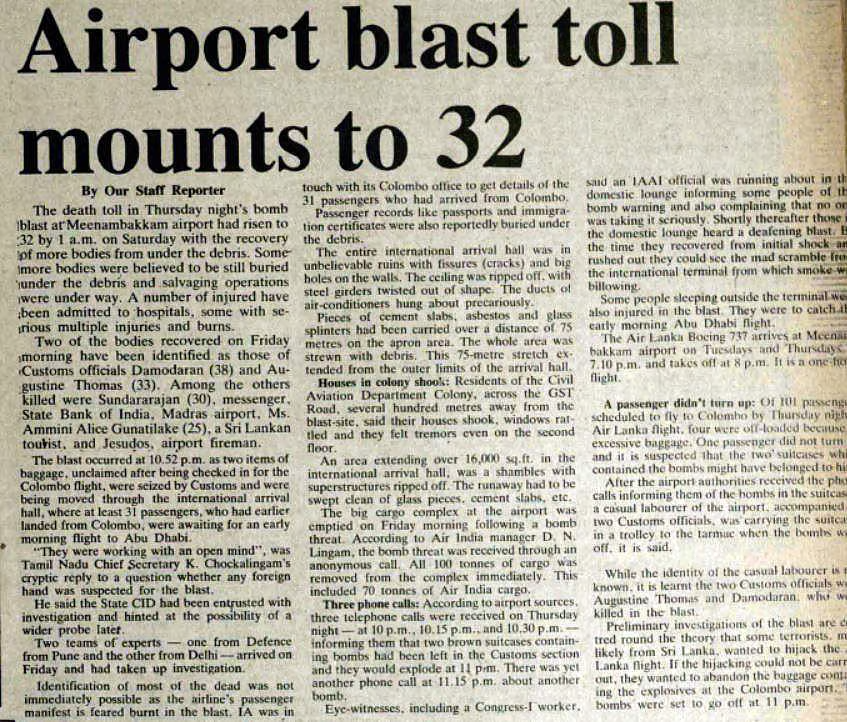
Then came Meenambakkam. On 2 August 1984, Maheswaran masterminded the bombing of Madras’s Meenambakkam airport (today Chennai International) in a plot aimed not at India at all, but at crippling Sri Lanka’s economy through its main airport at Katunayake. He packed explosives into two suitcases bound for Colombo on Air Lanka flight UL-122, the timer set for 10:52 p.m., the moment the aircraft was due to land. The charge was calibrated to detonate once the luggage had been offloaded into the cargo complex — powerful enough, by his design, to destroy half a dozen aircraft on the ground.
The plan failed in the worst possible way. Maheswaran bought a ticket but never boarded. The suitcases, meant for the Colombo flight, were misrouted into baggage for London. When staff realised the ticketed passenger had not boarded, customs impounded the bags, and the Air Lanka flight departed around 8:15 p.m. without them.
From inside the airport, Maheswaran watched it unravel and began phoning warnings about the explosives in the seized luggage. But a customs inspector, convinced the suitcases held contraband, apparently gold, and perhaps hoping to pocket it himself, refused to release them.
Only after a third anonymous call did he relent. By then, it was 10:52 p.m., and a baggage handler was lifting the luggage to move it. The blast tore through the international arrivals hall, killing more than thirty people, twenty-three of them Sri Lankans, including a woman from Kilinochchi, and wounding some thirty-eight others. The ceiling came down on passengers waiting for an early flight to Abu Dhabi; one victim was decapitated, the head thrown a hundred and fifty feet. Maheswaran was arrested with ten others, jumped bail, was rearrested, and would not walk free until 2010.
The bombing was immediately blamed on the LTTE, the best-known Tamil group in Tamil Nadu, where press and public alike tended to call every militant a “Tiger.” Stung, Prabhakaran ordered his men to find the real perpetrators, with proof. The task fell to Karuna Amman, later the LTTE’s military chief for Batticaloa-Ampara. Though Maheswaran himself was a northerner from Jaffna, most of his TEA fighters were Batticaloa men, and Karuna’s local networks led him to the truth. The Tigers passed their findings to the Indian and Tamil Nadu authorities, and, sources said, the authorities later presented the discovery as their own.
Meenambakkam sent Maheswaran underground and hardened the LTTE’s move to ban every rival organisation, the TEA among them. Rather than fight, Maheswaran told his men to lay down their arms and go quietly. Many did: fighters such as Thampirasa, Siththa, ‘Appuchi’ Varathan, and some twenty-five to thirty others crossed over to the LTTE and trained at its tenth camp in Kolathur. Siththa, now living quietly in Europe, was remembered by the Tigers as a fearsome fighter; ‘Appuchi’ Varathan became a trusted lieutenant of Pottu Amman and masterminded the bombing of the Joint Operations Command on Flower Road before taking cyanide and dying at the home of Up-Country People’s Front leader Periyasamy Chandrasekaran.
A former senior Tiger who worked closely with these ex-TEA men told the Jaffna Monitor that, although he never met Maheswaran, the calibre of his fighters left no doubt that their commander had been formidable.
The weight of conscience
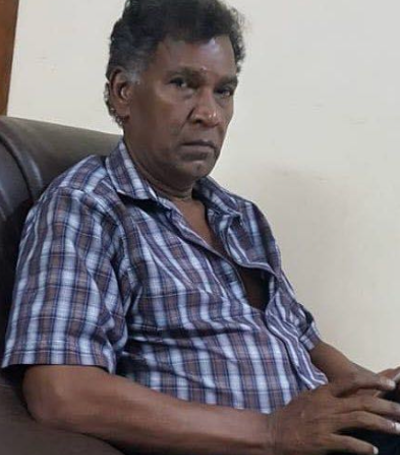
In his later years, friends said, Maheswaran became a prisoner of his own conscience. Meenambakkam weighed on him most, but so did the memory of quieter cruelties. Part of the gold seized at Kattankudy had been handed to three goldsmiths in Nelliady, Vadamarachchi, to be melted down. When they skimmed a few grams for themselves, an enraged Maheswaran summoned them to a hideout and had them executed.
In Batticaloa and Jaffna, too, he ordered the killing of a handful of people the TEA considered traitors. According to several friends who remained close to him, Maheswaran came to reflect deeply on the lives taken by his own hand or on his orders. The guilt he carried, they believed, was one reason he sank increasingly into alcohol. The commander who had once inspired fear and awe ended as a man tormented by his own record.
What became of the roughly three crores taken at Kattankudy remains murky. Some went to arms and operations; much of it, sources said, was simply pocketed by TEA men. It was an open secret that one of Maheswaran’s own deputies built a house in Jaffna with the proceeds.
Within the TEA he was never “leader” or “commander” or “comrade,” but simply Thamba, or Annaachi — the Batticaloa term of elder-brotherly affection. His group operated across the Sinhala border villages of Batticaloa, Ampara, and Polonnaruwa and in Muslim areas, yet largely spared local civilians, keeping a working understanding with Sinhala and Muslim communities and with other militant groups alike.
Later life, and the ironies of mourning
After Meenambakkam, Maheswaran spent years in Indian prisons, emerging in 2010. He tried to join his siblings in the West, travelling to Tanzania, only to be jailed again there for a visa violation. It was Douglas Devananda, his old jailmate from Welikada and Panagoda, and by then a minister, who arranged his passage home, cleared him personally at the airport, took him to his Colombo house, and gave him refuge. Maheswaran never formally joined the EPDP, but he aligned himself with the party and stayed close to Devananda to the end.
His death drew condolences from quarters that might have been expected to disown him. The Transnational Government of Tamil Eelam (TGTE) mourned, through its self-styled prime minister Visvanathan Rudrakumaran, the loss of a great man who had stood firm on the path of Tamil Eelam, this despite Maheswaran’s own well-attested contempt for the TGTE, an outfit he spoke of, associates said, as something he wanted to bite and be done with.
The Tamil National People’s Front (TNPF), forever adjudicating who is patriot and who is traitor, anointed him a patriot through its MP Kajendran and spokesman Sugash Kanagaratnam. Sivagnanam Shritharan offered condolences in Parliament. It may be the first time a figure so closely associated with the EPDP was mourned by the LTTE’s own proxies.
The irony would not have been lost on Maheswaran. At an EPDP meeting not long before his death, he is said to have snapped that “Prabhakaran’s foolishness led this struggle to failure.” Now the very people who once treated Prabhakaran as a god were calling Maheswaran a patriot and a pillar of Tamil Eelam.
One friend offered the shrewdest explanation for the sudden warmth. In the LTTE’s vocabulary, every rival was a traitor — so why the tributes now? Because he reasoned, Maheswaran never fought the Tigers when they banned his group; he told his men to comply, and compliance kept him off Prabhakaran’s list. And because he spent so many of his prime years in prison, he was never a functioning rival for long. Had he stayed free, the friend said, he would surely have been marked for death.
In the end, that friend argued, Maheswaran was less Prabhakaran’s opposite than his forerunner: daring, ruthless, more moved by the thrill of a spectacular operation and the impulse for revenge than by any fully formed design for liberation and, like Prabhakaran, careless of human life.
Of course, Maheswaran was no Prabhakaran, the former militant cautioned; Prabhakaran, in his view, was a military genius. “How Maheswaran would have built the organisation, I cannot say,” he told Jaffna Monitor. “But of one thing I am absolutely certain: put him in Prabhakaran’s place and, driven by the same appetites, he would ultimately have led the movement — and the people — to the same end at Mullivaikkal.”