

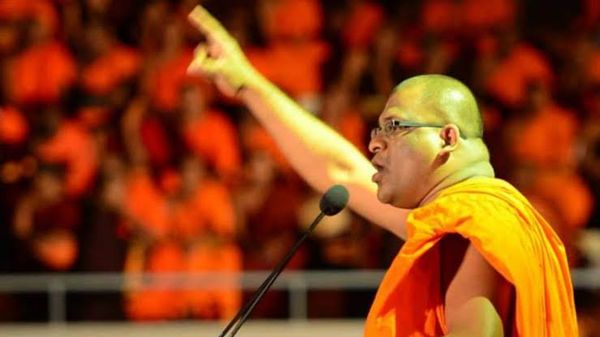
By Aruliniyan Mahalingam
The Supreme Court declared on 10 September that the presidential pardon granted to Galagoda Aththe Gnanasara Thero was null and void. The judgment runs to 58 pages, and its findings reach well beyond the monk who benefited from the pardon. Justice Janak De Silva wrote it. Justices Sobhitha Rajakaruna and Sampath B. Abayakoon agreed.
The two petitions were filed in 2019 by the Centre for Policy Alternatives and its executive director, Paikiasothy Saravanamuttu, and separately by Sandhya Ekneligoda. They were argued together on 26 August last year. Viran Corea, PC, appeared for the CPA, Asthika Devendra for Sandhya Ekneligoda, and Faizer Musthapha, PC, for former President Maithripala Sirisena.
The conviction
On 25 January 2016, Gnanasara Thero walked into the Homagama Magistrate’s Court while case B 7417/10, the investigation into the disappearance of the journalist Prageeth Ekneligoda, was being called. He was not a party to the proceedings and had no lawful connection to them.
The Court of Appeal convicted him on four counts of contempt. He addressed the court without permission and obstructed its proceedings. He said in open court that he would not accept the court’s orders and that the law of the country need not be followed. He directed the Magistrate to grant bail to the suspects, who were military intelligence personnel. He called the prosecuting Senior State Counsel, Dileepa Peiris, an impotent state official.
The sentences were four, four, six and five years of rigorous imprisonment, nineteen years in aggregate, ordered to run concurrently and so to be served in six. The judgment records that the Court of Appeal refused leave to appeal on 31 August 2016. The Supreme Court refused special leave, by majority, on 5 October 2018.
Justice De Silva notes at this point in the judgment that the Buddha instructed monks to comply with the law of the land. The reference is to the Vinaya Piṭaka, Mahāvagga III.4.3, where the Buddha laid down the rule Anujānāmi, bhikkhave, rājūnaṃ anuvattituṃ, rendered in the judgment as “I allow you, monks, to follow or obey kings.” The rule arose, the judgment records, after King Seniya Bimbisāra of Magadha sent a messenger asking that the start of the monks’ rainy-season residence be postponed.
The paper trail
The present Secretary to the President tendered both Presidential Secretariat files to the court: nine minute sheets and thirty documents in one, and a further minute sheet and ten documents in the other. The judgment goes through the sequence minute by minute.
The file was opened on 22 January 2019, after a telephone conversation between the then Additional Secretary (Legal), Lakshmi Jayawickrema, and a monk, held on the advice of the then Secretary to the President, Udaya Seneviratne. The Court of Appeal delivered its proceedings to the Secretariat that afternoon. Later that day, the Additional Secretary spoke to Sirisena in the presence of the Secretary to the President, and minuted that further action was to be taken in future, not at that stage.
Letters from the Mahanayake Theros of the Malwathu, Asgiri and Kotte Chapters of the Siyam Maha Nikaya, dated December 2018, were on the file. So was a letter from the Diyawadana Nilame of the Sri Dalada Maligawa, and a request from a Sri Lanka Freedom Party coordinating secretary in Muttur that the pardon be granted on Independence Day. The pardon was also being urged publicly at the time, including by parliamentarian Wijeyadasa Rajapakshe, who called for it before Vesak.
One document went the other way. An unsigned letter dated 1 February 2019, carrying several names, asked the President not to grant the pardon. The Additional Secretary put it up to the Secretary to the President on 1 March. On 15 March the Secretary minuted that it be submitted later, so as to be brought to the President’s attention. The file contains nothing to show that it ever was.
The rest of the process took a single day. On 21 May 2019 the Additional Secretary recorded that she had been advised to call for a detailed report from the prison, without recording who had advised her. The request went out by fax under the Secretary to the President’s signature. The report came back. She wrote her recommending minute. Sirisena signed it. The minute, which the judgment reproduces in full, ends with two printed options, approved and not approved, and a signature. Gnanasara Thero walked out of Welikada on 23 May, after roughly nine months of a six-year term.
The prison report attached to that minute stated that with all remissions his sentence was due to expire on 28 July 2022.
No reasons on record
Justice De Silva went through the English and Sri Lankan authorities on the duty to give reasons, from Doody and Stefan to Karunadasa v. Unique Gem Stones and Lankem Tea, and arrived at a holding with no precedent in Sri Lankan law.
The President, he held, is under a duty to make a contemporaneous record of the reasons for granting a pardon under Article 34(1), to make those reasons available to an aggrieved party on request, and to produce them to court when the decision is challenged.
Sovereignty is in the people. The President exercises the executive power of the people and holds it in trust for them. The Nineteenth Amendment removed presidential immunity and made those acts justiciable. A court cannot perform that check on a decision whose reasons were never written down. Where no reasons have been recorded, Justice De Silva held, quoting his own earlier judgment in Peduru Arachchige Janaka Pushpakumara, the only conclusion open to a court is that the decision was taken without any, and is therefore arbitrary.
Sirisena filed his affidavit after the Secretariat files were already before the court, and undertook to plead by reference to them. The judgment sets out what he left unanswered: what the further action contemplated on 22 January meant, whether he had already decided to grant the pardon and thought it premature to act, why the objections were never placed before him, and what accounted for the compression of the whole process into one day in May.
Abdication
The Additional Secretary’s minute explains why she believed no notice to any victim was required. It gives no reason why a pardon should be granted. Sirisena approved it.
Citing Wade and Forsyth, the court treated this as abdication rather than delegation. Where an authority allows another to dictate to it, or submits to another’s wishes or instructions, the discretion conferred by law is exercised by the wrong hands, and the decision is ultra vires and void. Sirisena, the court held, acted mechanically and abdicated the power and the responsibility vested in him.
The pardon was accordingly held to be arbitrary, in breach of the public trust and the rules of natural justice, ultra vires, and an infringement of the right to equality under Article 12(1).
The effect of a pardon
Article 4(c) vests judicial power in Parliament, to be exercised through the courts, with a narrow exception for matters of parliamentary privilege. The Constitution gives the executive no judicial power. From that premise, Justice De Silva held that Article 34(1) cannot be read as wiping out a conviction or sentence. A pardon relieves the offender from the execution of the sentence to the extent specified in the pardon, and does no more than that.
On that reasoning, Gnanasara Thero has remained a convicted contemnor since 2018. Once the pardon was declared void, it could no longer provide a legal basis for relieving him from execution of the sentence.
The court also reaffirmed, following the two earlier pardon cases, that a President’s decision to grant or refuse a pardon is reviewable under Articles 17 and 126, on substance as well as on procedure.
Section 3(q)
Section 3(q) of the Assistance to and Protection of Victims of Crime and Witnesses Act of 2015 gives a victim the right to be told when any authority is considering a pardon, and to describe to that authority how the offence has affected their life. Two earlier Supreme Court benches, in Hirunika Premachandra and Women & Media Collective, held that the section sits alongside Article 34 and applies to presidential pardons.
Justice De Silva disagreed. Article 34(1) prescribes a procedure in one situation only, where the offender has been sentenced to death, and prescribes none for any other offender. Reading a notice requirement into it would add a step the Constitution does not contain. Article 82(7) defines amendment to include addition. Article 82(6) provides that no provision of any law shall be interpreted or construed as amending the Constitution unless it was enacted as a constitutional amendment. The Victims and Witnesses Act does not mention Article 34, and its long title does not describe it as an amendment to the Constitution. Relying on Ranasinghe J’s reasoning in the Thirteenth Amendment determination, he held that section 3(q) cannot be read into Article 34 at all.
He added that this does not mean the two earlier cases were wrongly decided, since each rested on other grounds. The effect for now is that a victim of crime in Sri Lanka has no enforceable right to be heard before a pardon is granted, unless Parliament amends the Constitution or a larger bench revisits the question. Sandhya Ekneligoda won her case on other grounds.
The Additional Secretary had dealt with the section in her minute. She recorded that Sandhya Ekneligoda was neither a victim nor a witness in the contempt case, since all four charges concerned the court and the prosecuting counsel, and that although she was a victim and a witness in a separate Homagama case in which the monk had been convicted of threatening her, the sentence in that case had been suspended on appeal and the section therefore did not apply.
What the judgment leaves open
The order is a declaration. The pardon reflected in the minute of 21 May 2019 is null and void and of no force or avail in law. The judgment contains no direction to the Commissioner General of Prisons, no committal order and no warrant. Much of the wire coverage reported that the court ordered Gnanasara Thero’s return to prison. It did not. Any return to custody therefore follows not from an express order in the judgment, but from the declaration that the pardon is void, read with the court’s holding that a pardon does not extinguish the underlying sentence. Its implementation falls to the relevant authorities under ordinary law.
The judgment does not calculate what is left to serve. The prison department’s own report, quoted in the minute, put the expiry of the sentence with full remission at 28 July 2022, a date that passed four years ago. The court did not decide whether the residue is the three years and two months outstanding in May 2019, or the longer period left on the bare six-year term, or whether the years at liberty under a void pardon count for anything.
The court held expressly that the President is not precluded from pardoning Gnanasara Thero, provided any fresh pardon is granted according to law and on due consideration of the material before him. It declined to make any further order against Sirisena personally, on the ground that he had acted on instructions from the Additional Secretary (Legal) that were erroneous in law.
Since the ruling
Sirisena told reporters on 12 September that the pardon was granted under the constitutional powers vested in him during his tenure, and that he was not yet fully aware of the court’s decision.
Prison officers went to the temple on Nawala Road in Rajagiriya on 12 September to begin returning Gnanasara Thero to custody. The monks there said they did not know where he was. A prison official said that the department can do nothing further unless he surrenders to the police or is arrested. As of Tuesday, he had not been located. A senior Bodu Bala Sena official said the monk had never sought to create ethnic conflict in the country.
Before the Supreme Court, Gnanasara Thero expressed unconditional regret and remorse for what took place at the Homagama Magistrate's Court on 25 January 2016, and said he fully respected the authority of the judicial system and the due process of law. He tendered that regret without prejudice to his objections, in which he maintained that the pardon was lawfully granted. The court did not rule on either statement. It ruled on the file and found nothing in it to explain why a President had cut short a sentence imposed for defying a Magistrate.