By Aruliniyan Mahalingam
At 8:27 on the morning of April 21, 2019, a foreign intelligence service sent one last message to the head of Sri Lanka’s State Intelligence Service. The bombers would probably move between six and ten that morning, it said, and one of their targets was a Methodist church in Colombo. Surveillance teams were being deployed. The police, it added, had already been warned.
The first explosions came shortly before nine, less than twenty minutes later.
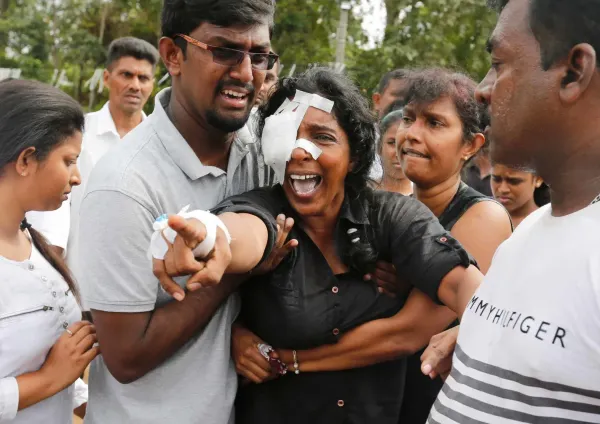
Over the course of that day, seven suicide bombers struck three churches, three Colombo hotels, and a guesthouse in Dehiwala. The dead were counted at St. Anthony’s Shrine in Kochchikade, at St. Sebastian’s in Katuwapitiya, at Zion Church in Batticaloa, and in the breakfast rooms of the Shangri-La, the Cinnamon Grand, and the Kingsbury. In all, 268 people were killed, and 586 were injured. At least 42 of the dead were foreigners. Nothing on that scale had happened in the country since the war ended in 2009.
The verdict, seven years on
On July 31, 2026, the Colombo Permanent High Court Trial-at-Bar sentenced two of the men who had been responsible that day to death: Pujith Jayasundara, the inspector general of police at the time of the attacks, and Hemasiri Fernando, then secretary to the Ministry of Defence.
Jayasundara was convicted on 854 of the 855 counts against him. Two of the three judges, Priyantha Liyanage and Thilakaratne Bandara, voted to convict. The third, Viraj Weerasuriya, would have acquitted both men. On top of the death sentence, the court imposed twelve years’ rigorous imprisonment on each of 586 counts of abetting attempted murder, the terms to run concurrently.
In practice, the death sentences are unlikely to be carried out. Sri Lanka has not executed a prisoner since 1976, and President Anura Kumara Dissanayake has made clear that he intends to maintain the moratorium. As a result, death sentences are typically commuted to life imprisonment. Both men have the right to appeal.
Eight warnings in twelve days
The charges are built on eight pieces of intelligence that reached Jayasundara between April 9 and the morning of the attacks.
The first came on April 9, in a letter from the director of the State Intelligence Service. Mohamed Zahran Hashim, the leader of a group called National Thowheeth Jama’ath, was planning suicide attacks with a circle of associates. The likely targets included prominent churches and the Indian High Commission. The letter named the men expected to take part, Rilwan, Shahid, Milhan, and others, and gave their addresses. The same day, a second warning, passed on by the Chief of National Intelligence on behalf of the Defence Secretary, repeated the substance, listed the methods the group might use, from suicide vests to a truck, and asked that the police be put on alert.
A week later, the intelligence turned specific. On April 16, someone connected to the group set off a motorcycle packed with explosives at Palamunai, near Kattankudy, apparently as a test. The reports that followed traced the motorcycle’s chassis number back to Zahran’s people, tracked the suspects’ movements, logged their calls to numbers abroad, and described how relatives had been selling land to raise money. One report mentioned that some of the men were carrying automatic weapons. Another noted that officers at the Kattankudy police station had been in contact with a wanted suspect and had not arrested him.
Then, on April 20, a foreign service reported that the group intended to carry out a martyrdom attack in Sri Lanka “at any time on or before 21.04.2019.” Eight places had been chosen, it said, among them a church and a hotel where large numbers of Indians stayed. The last message, the one that arrived at 8:27 the following morning, said only that the attackers would probably move within hours.
What the police chief did
When the case reached the Supreme Court, the judges pressed the defence on one question: What had Jayasundara actually done with these reports? His counsel could point to only four things.
In one of the letters, the April 9 note from the Chief of National Intelligence, he wrote three letters, “F.N.A.,” and sent them on to four senior officers. One witness thought the initials stood for “For Necessary Action.” Another told the court that this was the kind of marking an officer uses to get a file off his own desk, not to demand that anything be done about it. Jayasundara himself never said what he had meant by it.
When Nilantha Jayawardena, the intelligence director, asked him to hand the reports to the Criminal Investigation Department, Jayasundara’s reply, by Jayawardena’s account, was “tell Ravi” — meaning a senior deputy. After the April 20 warning, Jayawardena telephoned him again, and this time he was told, “tell Nandana,” another deputy. The fourth action was a note Jayasundara wrote on the dry-run reports, asking his intelligence branch to report back on progress by May 5. He dated it April 21, the day the bombs went off.
Both sides agreed, in a formal admission on the record, that Jayasundara had received each of those reports on the day it was written, April 18, 19, and 20, and not on the 21st, as his lawyers later suggested. He had therefore been sitting on the most detailed warnings for the better part of a week, and his response, written on the morning of the attacks, was to ask for an update in a fortnight.
Jayasundara had accepted in court that Section 56 of the Police Ordinance applied to him. It requires every police officer to use their best endeavors to prevent crime and to gather and pass on intelligence affecting public order. The judges wanted to know how three initials on a letter and two telephone calls telling subordinates to handle it could count as best endeavors in the face of a plan to bomb churches.
In 2024, a three-judge Trial-at-Bar had acquitted Jayasundara and Fernando on all charges. The Supreme Court found the reasoning behind that acquittal grossly erroneous. The trial court, it held, had demanded proof that Jayasundara was as culpable as the bombers when he was charged only with aiding the attack by failing to act. That error, the court said, let both Jayasundara and the force he commanded avoid answering for their inaction. The Supreme Court ordered a retrial, which ended in July 2026 with convictions and death sentences.
A government at war with itself
The failure, though, was never Jayasundara’s alone. The same warnings passed through the State Intelligence Service, the Chief of National Intelligence, and the Defence Secretary’s office. Some were produced inside the country. Others came from foreign services.
The problem, in April 2019, was a government that could barely function. President Maithripala Sirisena and Prime Minister Ranil Wickremesinghe were in open conflict, months after Sirisena had tried to remove him and set off a constitutional crisis. Wickremesinghe had stopped being invited to National Security Council meetings. Sirisena himself was out of the country from April 16 to 21, on a visit to India and Singapore, and had gone without appointing anyone to act as defence minister. The office at the centre of national security sat empty in the days when the warnings were mounting.
A parliamentary committee that examined the attacks concluded that Jayawardena, the intelligence chief, had treated his job as finished the moment he forwarded the warnings. He did not tell the President, nor did he pass the reports to the army, navy, or air force. In the end, the intelligence never travelled beyond a small circle of senior men talking to one another on the telephone. The public was never warned. Churches and hotels went into the Easter weekend, when they were at their fullest, with no extra protection.
Not the first inquiry
The July verdict was not the first attempt to assign responsibility for the Easter Sunday attacks. A Presidential Commission of Inquiry, in its final report in January 2021, recommended criminal proceedings against a number of senior officials, including former President Maithripala Sirisena, former Defence Secretary Hemasiri Fernando, former Police Chief Pujith Jayasundara, intelligence chiefs Sisira Mendis and Nilantha Jayawardena, Jayasundara's deputy Nandana Munasinghe, and a former cabinet minister. Two years later, the Supreme Court, ruling on petitions filed by victims and their families, found several of those officials had violated the victims' fundamental rights and ordered them to pay compensation.
For many families, however, the convictions of Jayasundara and Fernando marked only a partial reckoning.
Several relatives who spoke to Jaffna Monitor welcomed the verdict before turning to the one person they believe has yet to be held fully accountable: former President Maithripala Sirisena.
"They have punished the officials, and that matters," said a relative of a victim killed in the Easter Sunday attack on Zion Church in Batticaloa. "But Sirisena was the president. He was also the defence minister. He received the warnings, nothing was done, and he has never faced a criminal trial. That is not justice for our people."
At the time of the attacks, Sirisena held the defence portfolio in addition to the presidency, placing him at the head of the country's national security apparatus. The only legal penalty he has faced was the 100 million rupee compensation payment ordered by the Supreme Court in 2023 after it found that he had failed to prevent the attacks, violating the fundamental rights of the victims.
He has never been criminally prosecuted.
Although the Presidential Commission recommended criminal charges against him, no government has acted on that recommendation.
Victims' families and the Catholic Church have long argued that compensation cannot substitute for criminal accountability in an attack that killed 268 people. They continue to call for Sirisena and the other officials named by the commission to face trial.
The unanswered part
There is an unresolved awkwardness in who is now doing the reinvestigating. The two officers driving it, Ravi Seneviratne and Shani Abeysekara, were the men running the Criminal Investigation Department when the warnings arrived in 2019. Seneviratne, a retired senior DIG who had overseen the CID for years, is now secretary to the Ministry of Public Security. Abeysekara, who was the CID’s director at the time of the attacks, was reinstated by the current government and returned as its director in July 2025.
Before he was sentenced, Fernando told the court that he believed former President Maithripala Sirisena had wanted only him and Jayasundara prosecuted, while others who shared responsibility had been spared.
What the verdict settles
The verdict settles one thing, even if only in part. What went wrong before Easter Sunday was not a lack of information. The authorities knew the group and its leader. They knew the likely targets and, by the morning of April 21, knew the attacks were imminent. They had the legal powers to intervene and the institutions to act. What failed was the final link: turning intelligence into orders and orders into police officers protecting the identified churches and hotels.
Two men will now spend the rest of their lives in prison for what the court found they failed to do. Others, including former President Maithripala Sirisena, remain under a cloud of unresolved accountability as victims continue to press for criminal prosecutions.
Whose Lives Demand Justice?
For the families, however, no verdict can undo what happened that morning.
"My child is never coming back," said Swarna, a Tamil mother who lost her son in the bombing at Zion Church in Batticaloa. "The lives of 268 people are gone forever. We can only hope that one day everyone who failed them will be held to account."
Another relative, who also lost a family member at Zion Church, said the search for justice had endured because the Easter Sunday attacks cut across Sri Lanka's ethnic divide.
"Sinhalese, Tamils and foreigners—we all died together that day," she said. "That is why the country could not look away. People from every community demanded justice, and Cardinal Malcolm Ranjith became its most powerful public voice."
Then her voice faltered.
"Sometimes I ask myself a painful question," she said. "If the bomb had exploded only at Zion Church in Batticaloa, killing only Tamil worshippers, would the same fight for justice have continued for seven years? Would Cardinal Malcolm Ranjith have become its torchbearer? I don't think so."
She paused before continuing.
"For decades, Tamil civilians in the North and East have lived through massacres, disappearances, the killing of priests, humanitarian workers, and countless other atrocities. Yet I never saw the same moral outrage from the national establishment or the same sustained campaign from the leadership of the Catholic Church in Sri Lanka. Those wounds were treated as Tamil tragedies, not national ones."
She fell silent for a moment before offering one final thought.
"Easter became the nation's wound because it claimed everyone. Had it been only another massacre of Tamils in the North or East, I believe it would have joined the long list of unresolved crimes this country has learned to live with. That is the hardest truth for me to accept."