
By Aruliniyan Mahalingam
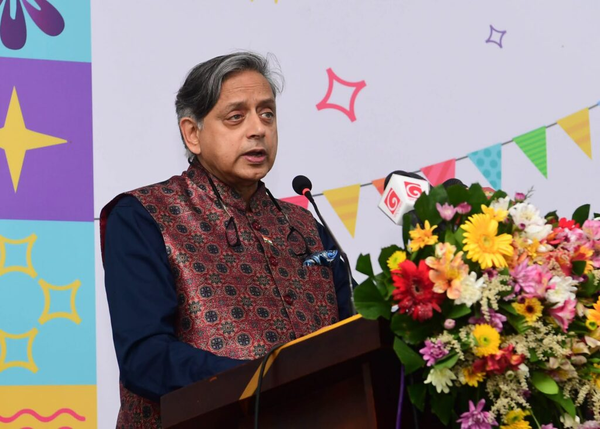
Shashi Tharoor gave the sort of speech he is known for at the Colombo Literary Festival last week: fluent, warm, faintly flattering to its hosts. Standing in the Arcade at Independence Square, he called Sri Lanka a land “profoundly steeped in rich, mesmerising oral traditions,” and traced its historical pulse to two ancient chronicles: the Mahavamsa, or Great Chronicle, and its predecessor the Dipavamsa, or Island Chronicle. These, he said, were “a library of cultural memory,” and, in the phrase that lingers, “transnational literary and cultural highways that connect our people in faith, language, and history.” Borrowing from the American scholar Diana Eck, he described the island’s inheritance as a “sacred geography,” in which mountains and rivers are “not merely physical features on a map, but characters in a living, breathing national story.”
For the Tamil-speaking people of this island, the Mahavamsa has never been only a library of cultural memory. For a century and more, it has been the founding text of a majoritarian creed that named us invaders and unbelievers, and, in the chronicle’s most quoted line, creatures worth rather less than men.
The Dipavamsa was composed in Pali around the fourth or fifth century of the common era; the Mahavamsa came perhaps a hundred years later, the work of a monk called Mahanama writing within the Mahavihara, the orthodox monastery that dominated Anuradhapura. Neither is an eyewitness. The war they are best known for, between the kings Dutugemunu and Elara, was fought in the second century before the common era, which means Mahanama set down his famous account of it something like seven centuries after it happened, and set it down with a religious argument to press. Anyone who reads the Mahavamsa as a plain record of the deep past has mistaken a devotional poem for a ledger.
The argument begins on page one. The Mahavamsa presents the island as Dhammadipa and Sihadipa: the land set aside to protect the Buddha’s teaching, and the land of the Sinhalas, the lion people. Its origin myth tells of Prince Vijaya, a descendant of a lion, being sent from north India to Lanka on the day the Buddha dies, to father the Sinhala race. Gananath Obeyesekere, the foremost Sinhalese scholar of this material, who died earlier last year, read the Vijaya story as an early nationalist “colonisation myth.” Sri Lankan schoolchildren today meet it not as myth but as history.
Around this sits the tale of the Buddha’s three visits, during which he drives the yakkhas and nagas, the island’s supernatural, and by implication its prior inhabitants, off the land and blesses it for Buddhism. Put the pieces together, and the chronicle makes one claim above all others: that Lanka was meant, from the start, for a Sinhala-Buddhist people, and that everyone else is here on tolerance rather than by right.
In the twenty-fifth chapter, Dutugemunu, a prince from the southern kingdom of Ruhuna, defeats Elara, a Tamil king of Chola stock who had held Anuradhapura for some forty years. The dead, the chronicle says, are beyond counting, and the victorious king cannot rest for remorse.
Eight arahants, enlightened monks, come to settle his conscience. In Wilhelm Geiger’s 1912 translation, they perform a piece of arithmetic. Of all the slain, they tell him, he has in truth killed only one and a half human beings. The whole one was a layman who had taken refuge in the Buddha and kept the five precepts; the half was a man who had taken refuge but not the precepts. The rest, being unbelievers, were “not more to be esteemed than beasts,” and cost him no merit at all.
Set that beside Tharoor’s sacred geography. The island’s foundational chronicle is telling a king that the killing of non-Buddhists, Tamils, in the story, barely registers on the moral scale, because the victims were not really people. A close study of the chapter from Queen’s University concludes that the episode lays “the foundation of a Sinhalese nationalism which justifies violence against the minority Tamil population”: make the enemy less than human and the Buddhist prohibition on killing quietly falls away. The Sinhala monk-scholar Walpola Rahula, who admired the story, wrote that it was from this war onward that “the patriotism and the religion of the Sinhalese become inseparably linked.”
This is why the International Crisis Group, which has no stake in Tamil grievance, observes that under its historical surface the Mahavamsa carries “a profoundly religious-nationalist subtext,” and that the story of Elara’s defeat is taught to nearly every Sinhala child.
Mahanama wrote a chronicle. More than a millennium later, it became a manifesto for modern Sinhala-Buddhist nationalism. Its enduring political consequences were not the work of its author but of later ideologues who recast a medieval Buddhist narrative into a political doctrine defining who truly belonged on the island and who did not.
Its chief architect was Anagarika Dharmapala. Born Don David Hewavitharana into Colombo's Buddhist bourgeoisie in 1864, he remade himself as a celibate lay evangelist, founded the Maha Bodhi Society, and carried the Mahavamsa into the columns of the revivalist press. He read its lion myth as literal history: the Sinhalese were an Aryan people, the island's first and rightful owners, and the Tamils and other minorities were latecomers spoiling an inheritance that had never been theirs. The chronicle supplied the antiquity; Dharmapala supplied the movement. He took a medieval devotional poem off the monastery shelf and made it a political programme, and the century that followed was built on the conversion.
From there, the sequence is bitterly familiar. The chronicle’s logic sat beneath the Sinhala Only Act of 1956, which erased Tamil as an official language overnight. It justified the state colonisation schemes that reengineered the demography of the north and east. It ran under the anti-Tamil violence of 1958, 1977, and 1983. Tamil politics gave the whole complex a name that has since entered the island’s vocabulary, the Mahavamsa mindset: the belief that to be truly Sri Lankan is to be Sinhalese, and to be truly Sinhalese is to be Buddhist, with the rest of us permitted rather than belonging.
The end of the war did not retire the myth. When the army destroyed the Tigers in May 2009, President Mahinda Rajapaksa was hailed, by his supporters and much of the press, as a second Dutugemunu, the hero-king come again to break the Tamil enemy. Asked about the comparison, Rajapaksa waved it away and said the old story had been misunderstood as one race’s triumph over another. It was a convenient thing to say while pocketing everything that misreading paid him. And the residue can be counted: Sinhalese Buddhists now make up more than 97 percent of the military and more than 92 percent of the state bureaucracy.
It’s tempting to call the Mahavamsa a book of lies. It’s also wrong. A lie sets out to deceive; a sixth-century monastic chronicle braided from myth, legend, and dynastic record is doing something older and stranger than lying. But genre stops being a defence the moment the mytho-history is handed to schoolchildren and quoted from podiums as fact — and as fact, it can be tested. Held against ordinary evidence, the frame the anti-Tamil story hangs on does not survive.
Start with the dates. The whole edifice of “two and a half thousand years of unbroken Sinhala-Buddhist civilisation” rests on the chronicles’ insistence that Vijaya landed on the day the Buddha died, in 543 BCE. That figure, the uncorrected long chronology, comes from the Dipavamsa and Mahavamsa themselves, and modern scholarship has largely abandoned it. Fixing the calculation against Ashoka’s known reign pulls the Buddha’s death forward to around 486 BCE. The 1988 Göttingen symposium moved it later still: Gombrich, Norman, and Bechert settled near 400 BCE, a date Norman notes fits the archaeology better.
Then the blood. The Vijaya myth insists on a distinct Sinhala people arriving from northern India, the germ of the cruder modern claim of an “Aryan” Sinhala race set against “Dravidian” Tamil interlopers. Genetics does not cooperate. A whole-genome study published in Current Biology in June last year, the largest yet conducted on the island, and reported in Jaffna Monitor, found the Sinhalese and Sri Lankan Tamils sitting together in a single genetic cluster, both of them closer to the Dravidian-speaking populations of South India than to anyone in the north. Earlier work by Kshatriya had already put the two communities’ shared gene pool at roughly 55 percent, with the Sinhalese drawing their largest single ancestral share, close to 70 percent, from South Indian Tamils. Whatever northern migration the Sinhala language records, twenty-five centuries of the intermarriage the myth denies have worn it almost to nothing in the bone. The invader and the son of the soil turn out to be cousins.
Then the empty island. The Buddha’s clearing of the yakkhas frames Lanka as a vacant vessel waiting for the Dhamma. Archaeology frames it as long occupied: modern humans have lived here for more than thirty-eight thousand years, the people archaeologists call Balangoda Man, and the island’s indigenous Adivasi carry more of that ancient ancestry than anyone else on it.
And then the categories themselves, which is the finding that does most to dismantle the two-thousand-year war. In his essay “The People of the Lion,” the historian R. A. L. H. Gunawardana showed that the word “Sinhala” appears just twice in the whole Mahavamsa, and not at all in the island’s oldest Brahmi inscriptions, which record instead group-names like Dameda, Kabojha, and Milaka. The hard modern ethnic blocs, “Sinhala” and “Tamil” as sealed nations at each other’s throats since antiquity, are a colonial and post-colonial invention read backwards onto a looser ancient world of rival dynasties and porous loyalties. When Dutugemunu marched, Gunawardana argued, it was not, in the language of his own age, Sinhalese against Tamils. It was one dynasty against another.
The strongest evidence against the Mahavamsa mindset is found within the Mahavamsa itself.
The same chronicle that reduces Elara’s soldiers to beasts also draws Elara himself as a paragon of justice, the king who, in the famous anecdote, put his own son to death for crushing a calf beneath a chariot wheel. It has Dutugemunu build his defeated enemy a monument and command the living to honour it. It gives him his remorse, and gives his war a stated purpose that is the protection of the Buddhist order rather than conquest. Historians from K. M. de Silva to H. L. Seneviratne have argued for decades that the Dutugemunu-Elara conflict is far more tangled than the nationalist reading permits. Obeyesekere spent a career on the hybridity the myth buries, showing, for one, that the succession crisis the chronicle dramatises makes best sense once you notice that one of the royal claimants was himself half Tamil through his mother.
DeVotta, who documents the ideology’s damage, calls the notion of Sinhalese and Tamils as enemies across two millennia simply false. As late as the eighteenth century, the Kandyan throne was held by South Indian Nayakkar kings who worshipped at Hindu and Buddhist shrines both, and ruled in Sinhala and Tamil, and the Sinhala nobility made no objection, so long as the king kept Buddhism safe.
None of this is an argument for discarding the Mahavamsa, denying its literary greatness, or questioning the deep civilisational ties that bind India and Sri Lanka. It is a narrower argument: that we resist the sanitised version of the chronicle—the one that celebrates it only as a bridge between cultures while overlooking the ways it has, for more than a century, been invoked to legitimise exclusion, dispossession and majoritarian politics.
Tharoor is right that books outlast treaties and travel further than armies. But some books have marched with the armies, and the right response to those books is not applause. It is the full memory, the monument, and the war together.