By Aruliniyan Mahalingam
JAFFNA, Sri Lanka, Oct. 7, 2026
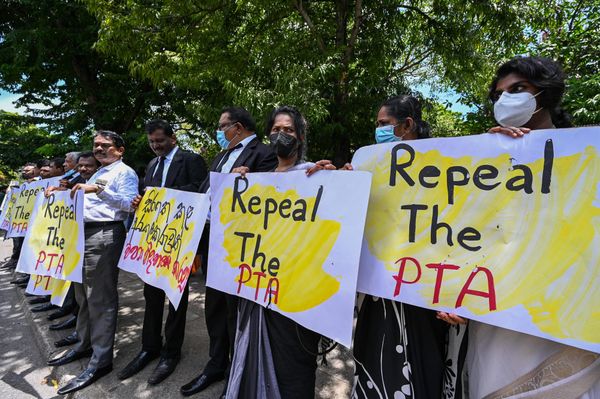
On Tuesday, Justice Minister Harshana Nanayakkara presented the Protection of the State from Terrorism Bill to Parliament. It would repeal the Prevention of Terrorism Act of 1979, a law successive governments promised to abolish and kept using. The same day, the Government Printer released a second bill under his name, the Prevention of Organised Crimes Bill, which the government says will give effect to the United Nations Convention against Transnational Organised Crime.
The government presents them as separate pieces of legislation, yet their detention provisions are almost word for word the same. Under both, a ministry secretary can order a suspect held for up to a year without charge at a senior police officer's request, and the magistrate who sees the suspect must either give effect to that order or remand him. Only the High Court can grant bail.
On some points the organised crime bill goes further than the terrorism bill. It brings back the rule, at the centre of abuses under the 1979 act, that a confession made to a senior police officer can be used against the person who made it. It requires no political motive. And it reaches offences as minor as obstructing a public servant.
"This is far more draconian than the current PTA," M. A. Sumanthiran, a President's Counsel and former member of Parliament for Jaffna, wrote in a public comment on a Facebook post about the organised crime bill. Together with the terrorism bill, he wrote, it would be "ten times more oppressive" than the present law. "The definitions in the two Bills are more than enough to catch all human activity." Saliya Pieris, a President's Counsel and former president of the Bar Association of Sri Lanka, replied in the same thread: "This will lead to serious abuse."
Who counts as organised crime?
The organised crime bill covers any "serious crime" committed by a member of an "organised criminal group." A serious crime is any offence with a maximum sentence of four years or more, a threshold taken from the U.N. convention, plus 53 offences listed in a schedule that count regardless of penalty. They include obstructing a public servant, mining without a licence, copyright infringement and wearing a soldier's uniform.
The bill also borrows the convention's definition of a group: "a structured group of three or more persons, existing for a period of time and acting in concert" to commit serious crimes for "a financial or other material benefit." Such a group needs no defined roles, continuity of membership or "developed structure." The bill then goes beyond the convention by defining benefit to include any "nonfinancial inducement" or "other advantage, including services."
The convention was written for cross-border criminal networks. Sri Lanka's bill adds minor domestic offences and detention and evidence rules borrowed from the 1979 act. On that wording, a prosecutor could describe three villagers mining sand without a permit, or three organisers of a land protest who stop officials from surveying, as an organised criminal group.
To decide who is a member, Section 4 lets a court consider attendance at "physical or virtual meetings with known members," association with members, identification as a member "by any evidence," and "the style of dress, hand signs, language or tattoos" a person adopts. Under Section 13, a person is treated as knowing a fact if he thought it reasonably possible and did not check.
Terrorism and protest
The terrorism bill is narrower in one respect. An act is terrorism only if it is meant to spread terror or to "unduly" compel a government "to do or to abstain from doing any act," and only "in order to advance a political or ideological objective."
Most political campaigns try to make a government do something, and "unduly" is not defined. The act must also cause one of the listed harms, several of which turn on "substantial economic loss," including serious damage to a transport system or "any infrastructure facility" and interference with computer networks. A blockade that damages a highway or a protest that shuts a port could be framed as terrorism.
Section 3(4) says that protest, advocacy, dissent or a strike "is not by itself a sufficient basis for inferring" terrorist intent. That still leaves room to charge a protester if the police can point to anything else. Mr. Pieris, who sat on the committee that reviewed the bill as the Bar Association's nominee, has said he dissented from its majority on this definition, which he considers too broad.
Section 9 penalises speech made with the "knowledge" that it will "directly or indirectly" induce terrorism. Section 10 punishes distributing, transmitting or merely possessing a "terrorist publication," meaning material that indirectly induces terrorism or is "useful" to it. The penalty is up to 15 years. New exemptions cover good-faith journalism, research, art and "legitimate political discourse," but they are defences raised in court after an arrest, and the arresting officer decides first what counts as indirect inducement.
Detention on a secretary's signature
Under the terrorism bill, a senior police officer applies to the Secretary of Defence for a detention order. Under the organised crime bill, he applies to the secretary of the ministry in charge of the police. Either secretary may issue an order if "satisfied that reasonable grounds exist," for two months at a time and up to a year in total. One permitted purpose is "to question the suspect in detention."
When the suspect reaches court, the magistrate "shall make an order giving effect to such Detention Order," and without one, "shall order that the suspect be remanded." Neither bill lets the magistrate release him. Mr. Pieris has said the review committee agreed that magistrates should be able to grant bail where there was no material against a suspect, and that this was dropped from the bill sent to Parliament without the committee being told who changed it or why.
Extensions past two months need High Court approval, and those hearings can be held in camera. After that, a suspect can be kept in remand for up to a year before indictment. Human Rights Watch has calculated that a person could be held without charge for up to two years under the terrorism bill. The same is true of the organised crime bill. Both also allow a person in remand or prison to be moved into detention, "in isolation," for up to six more months.
The terrorism bill has safeguards the other lacks. Detainees must be held in gazetted places that magistrates and the Human Rights Commission can visit without notice, and a magistrate who suspects torture must send the detainee for medical examination, move him and bar the investigators from seeing him. A review committee can examine detention orders at a detainee's request. Its members are appointed by the Minister of Defence, it can only make recommendations to him, and the defence portfolio is held by President Anura Kumara Dissanayake. The organised crime bill has no review committee and allows detention "at a police station."
The police confession returns
Section 16 of the 1979 act allowed a confession made to a police officer of Assistant Superintendent rank or above to be used in evidence. Ordinary Sri Lankan law excludes confessions to the police because of the risk that they are beaten out of suspects, and U.N. human rights experts have for years linked the PTA's rule to the torture of Tamil and, later, Muslim detainees.
The terrorism bill drops that rule. A suspect's statement counts only if a magistrate records it, with a medical examination before and after.
The organised crime bill restores it. Section 46 suspends the Evidence Ordinance's protections against police confessions. Under Section 47, a statement "signed by such person at any time," in custody or not, is admissible if made to an Assistant Superintendent or above, and the accused must prove it was obtained by threat or inducement. It can be used against a co-accused if corroborated. Interviews are meant to be filmed, but an unrecorded statement faces only "heightened judicial scrutiny."
A statement from a witness who has died "or who cannot be found" is admissible without cross-examination, and a witness who contradicts an earlier statement to a magistrate can be tried for perjury without the prosecution showing which version was false.
A suspect could thus be held for a year at a police station under an order permitting his questioning, and his signed statement used against him unless he proved coercion, much as PTA detainees were during the war.
Surveillance and the press
Section 28 of the organised crime bill lets any officer of Sub-Inspector rank or above intercept "digital, voice, and video communication" and extract data from phones. Its heading mentions judicial authorisation, but the text says only that the officer "may" apply to a magistrate. A Deputy Inspector General can obtain call records and tower locations for any phone "without an order of a Magistrate," informing the court afterwards. A magistrate "shall" authorise interception and decryption of emails and calls if the request is made in good faith and is reasonably necessary to "facilitate the conduct of an investigation." A senior officer could find out who has been calling a journalist without going to a judge.
Section 14(3) makes it an offence, punishable by two years, to publish "any matter in relation to any proceeding in any court" on a serious crime under the bill without the court's prior permission. Read literally, a newspaper would need a judge's consent to report a bail hearing. Section 56 punishes "tipping-off," disclosing anything "likely to prejudice" an investigation, with 10 years. Lawyers and law enforcement officers are exempt. Journalists are not.
Section 65 makes it an offence, punishable by seven years, to withhold information about someone one has reason to believe is committing or planning a serious crime, "notwithstanding any obligation of secrecy" under "law, agreement, contract, oath or otherwise." There is no protection for sources. The terrorism bill's version at least allows a defence of reasonable excuse, including professional secrecy.
The terrorism bill also penalises gathering "confidential information" with reason to believe it will be used for an offence, a category covering non-public details of investigations, detainees and any police or military operation that "has been carried out." That describes much of the daily work of reporting in the North and East.
Powers held by the President
Under Section 59 of the terrorism bill, the President may ban any organisation by Gazette notice if he has "reasonable grounds to believe" it is involved in an offence. A ban can prohibit membership, meetings, fund-raising, "lobbying and canvassing," and publishing material that advances the group's objects, and it lasts "until rescinded." The remedies are an appeal to the President or judicial review. Mr. Pieris has argued that the power to proscribe should rest with a judge.
The Defence Secretary may declare any place prohibited for 72 hours, including bans on photography, and a police station chief may, in an emergency, ban a rally pending a magistrate's approval within 24 hours. Both bills shield officials who act in good faith, and the organised crime bill extends that protection to acts in "purported pursuance" of the law.
The transitional clause keeps the old act alive. Anyone suspected of a PTA offence committed before the new law takes effect "shall be prosecuted under the provisions of the repealed Act." Bans issued under the old law, on the LTTE and the Tamil Rehabilitation Organization in 2011 and on groups proscribed after the Easter Sunday attacks in 2019 and 2021, stay in force. The Minister of Defence will decide when the new law takes effect.
How the powers could be used
The 1979 act was used against Tamil civilians during and after the war, against Muslims after the 2019 Easter attacks and against student activists after the 2022 protests. The lawyer Hejaaz Hizbullah was held for almost two years before bail. The poet Ahnaf Jazeem was held for about 19 months over a book of Tamil poems. According to Human Rights Watch, citing figures the Human Rights Commission gave the U.N., there were 46 PTA detention cases in 2025 and 12 in the first three months of 2026. In June, police used the act to detain a 24-year-old Tamil rapper, Sangeethan Ganeshkumar, over a music video.
The two bills would give any government a choice. Where a political motive is hard to prove, the organised crime bill needs none, sets a lower standard of knowledge and admits police confessions.
A land campaign in the North or East, a fishermen's blockade or a strike that obstructs officials could be charged as terrorism if it is said to pressure the government and cause economic loss, or as organised crime if three organisers are said to act together for some "advantage." Their leaders could be held for a year on a secretary's signature before a court looks at the evidence.
Civil society groups could face presidential bans. Under the organised crime bill, when a company commits a serious crime, every director is personally liable unless he proves he did not know of it or took all due care to prevent it, and the company can be dissolved or barred from public funds. Many NGOs and independent media outlets in Sri Lanka are registered as companies. Barath Arullsamy, whose post started the discussion, wrote that these bills and a proposed NGO bill should be examined together for their combined effect on fundamental rights and judicial independence.
In the North and East, soldiers may search and arrest wherever they are "deployed in an area for the purpose of maintaining public order or conducting counter-terrorism operations." They have 24 hours to hand a suspect to the police, who then have 48 hours to bring him before a magistrate.
What has improved
The terrorism bill improves on the 1979 act. It drops the confession rule and shortens the time before a suspect sees a magistrate. Suspects must be told the reason for arrest in their own language, women must be searched by women, families and the Human Rights Commission must be notified, interviews must be filmed, and dissent is explicitly protected. The organised crime bill's restriction orders must be necessary and proportionate and can be reviewed in court.
The government faces a real problem. Gang shootings and the reach of drug networks into politics and the police have alarmed the public, and Sri Lanka ratified the U.N. convention in 2006 without passing the law it requires. The objection from Mr. Sumanthiran and Mr. Pieris concerns the method: the organised crime bill applies the old terrorism law's evidence rules to a far wider range of offences, including one the terrorism bill itself has abandoned.
In Parliament
Any citizen may now petition the Supreme Court to test whether the bills are consistent with the Constitution. The court can require amendments, or rule that some clauses need a two-thirds majority and, in some cases, a referendum. The National People's Power won 159 of Parliament's 225 seats in 2024, enough to pass either bill on a two-thirds vote.
The party's 2024 manifesto promised to abolish "all oppressive acts including the Prevention of Terrorism Act." Under the terrorism bill, the date on which the 1979 act stops applying to new cases will be set by the Minister of Defence. The President holds that post.