
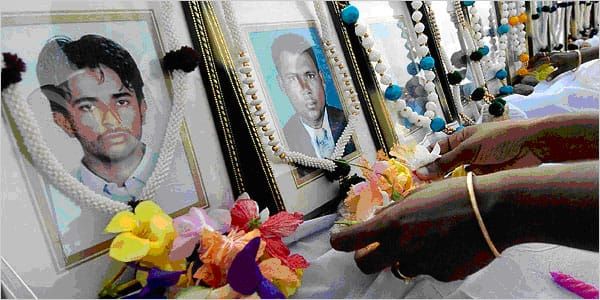
JAFFNA, 26 November 2026: When members of a humanitarian consortium reached the Muttur office of Action Contre la Faim on 6 August 2006, they found 17 of the French charity’s Sri Lankan staff lying face down on the front lawn. The victims, they wrote, appeared to have been “lined up and shot at very close range.”
Twenty years later, the United Nations human rights office says it has gathered further evidence that members of the Sri Lankan security forces carried out the killings after government troops had retaken the town. The office says the material also bears on who may have ordered the executions or failed to prevent or punish them. It has been preserved for future proceedings in Sri Lanka or in the courts of other countries.
The finding is among the most significant in a 40-page report released in Geneva on Thursday by the Office of the UN High Commissioner for Human Rights. The report takes its title, “I died many times,” from a nurse’s description of working through the last months of the war. It examines attacks on aid workers, hospitals and relief operations from 2006 to May 2009 and concludes that they were “neither isolated nor incidental.” Tamil civilians trapped in the Vanni bore most of the cost, it says.
No one has been held criminally responsible for any of the four cases the report examines in detail. The office asks the government to acknowledge the attacks, including the involvement of state security forces, to apologise publicly on behalf of the state and to pay reparations to the families of aid and medical workers who were killed or disappeared.
The government has not responded. On 24 September the office sent Sri Lanka’s mission in Geneva 27 questions on the cases and asked for answers by 5 October. On 3 November it sent an advance copy of the report and invited comments by 13 November. It received no reply to either.
Pressure on aid groups
The report draws on the 2011 findings of the UN Secretary-General’s Panel of Experts, the 2015 OHCHR Investigation on Sri Lanka and evidence gathered since 2021 by the office’s Sri Lanka Accountability Project. It also draws on interviews conducted this year with 16 people, 11 men and five women, who worked in aid or medical roles in the war zone between 2005 and 2009. Their identities were withheld.
The war between the government and the Liberation Tigers of Tamil Eelam ended in May 2009 with the Tigers’ defeat. The Panel of Experts said credible sources put civilian deaths in the final months at as many as 40,000.
Attacks on aid workers began well before the final offensive. From January 2006 to December 2007, at least one aid worker was killed or forcibly disappeared in almost every month, according to a Sri Lankan rights organisation cited in the report. The Panel of Experts counted 66 humanitarian workers killed or disappeared between 2006 and the end of the war.
In August 2007, John Holmes, the UN’s humanitarian chief, said Sri Lanka had one of the world’s worst records for the safety of aid workers. A cabinet minister, Jeyaraj Fernandopulle, responded by calling him a terrorist. The foreign minister later said the remark did not reflect the government’s view.
In September 2008, the government ordered UN agencies and international aid groups to pull their staff out of the Vanni. A 2012 internal UN review found that the withdrawal removed “the most significant protection layers” for civilians. Most national staff, nearly all of them Tamils from the Vanni, stayed behind, partly because the Tigers would not issue passes for their families. “For us, all those who could witness and testify on the atrocities were leaving,” a medical worker told the office.
Four cases
On 29 January 2006, armed men in a white van stopped five employees of the Tamil Rehabilitation Organisation (TRO) shortly after they passed the army checkpoint at Welikanda, in Polonnaruwa District. The three women among them were later released. The two men have not been accounted for.
The next day, according to the organisation, a white van blocked 15 more of its staff about 100 metres past the same checkpoint. Five of them, four men and a woman, also disappeared. The organisation blamed the Karuna Group, a pro-government paramilitary force made up of former Tiger cadres. The government denied involvement and promised an investigation. The families have never received a report or a substantive reply, and no one has been arrested. The government banned TRO in 2007, saying it was a front for the Tigers. The UN report notes that it was legally registered when the abductions took place.
The report says the Muttur killings were, at the time, the deadliest single attack on aid workers anywhere in the world. The ACF team, 16 Tamils and one Muslim, was trapped in the town after the Tigers attacked it on the night of 1 August and government forces counterattacked. On 4 August, a defence spokesman was quoted as saying the security forces were in full control of Muttur. At about 7 a.m. that day, ACF lost radio contact with its staff.
On 7 August, the day the bodies were recovered, the security forces publicly blamed the Tigers. The 2015 UN investigation said that announcement “pre-empted impartial investigations.” Three weeks later, the Nordic-staffed Sri Lanka Monitoring Mission found that the killings were a gross violation of the ceasefire by the security forces.
A second autopsy found a bullet lodged in one victim’s skull that was consistent with ammunition used by the police Special Task Force. The bullet was later removed from the official exhibits. The Australian forensic pathologist who reported it withdrew his finding after what the report describes as harassment and pressure. The inquest was moved to Anuradhapura, a Sinhalese-majority area that Tamil witnesses could not easily reach.
In 2009, a presidential commission of inquiry reported that it had found “no evidence of any Army personnel being seen” in the town centre on 4 August. It rejected evidence implicating naval personnel, which left the Tigers as the only organised force among the possibilities it named. That report was made public only in May this year. In 2014, the Ministry of Defence issued its own report, which denied that the security forces were involved and blamed ACF.
The Criminal Investigation Department reopened the file in 2015. After the 2019 presidential election, the report says, a senior detective who had arrested military suspects in major cases left the country, and the department’s head was demoted, transferred, and then arrested. That officer, Shani Abeysekara, was reappointed director of the department in 2025. The report records no new step in the case. Its most recent hearing, on 6 July, was adjourned to 7 December pending advice from the Attorney General.
Convoy 11 was the last UN convoy allowed into the Vanni by road. It entered on 16 January 2009 with 58 trucks and 11 UN staff and unloaded at Puthukkudiyiruppu. The government did not clear its return until 21 January. The next day, Tiger cadres turned back national staff and their families at a checkpoint and called them traitors for trying to leave.
Government forces then ordered a group of 17 national staff, 86 dependents and two international staff to move into a newly declared No-Fire Zone at Udayarkaddu. The group set up a clearly marked site there and sent its coordinates to the government. According to the report, the site came under sustained artillery fire from government lines from 23 to 25 January, at times more than three shells a minute. Relatives of staff and civilians sheltering nearby were killed and wounded. A 2015 presidential commission accepted that civilians had died but presented the episode as an example of the Tigers endangering protected people. No criminal investigation has been opened.
By late January 2009, Puthukkudiyiruppu Hospital was the only permanent hospital in the Vanni with an operating theatre. It was treating more than 500 patients; it was marked with Red Cross emblems, and its coordinates had been given to the government. On 1 February, it was hit directly three times, and at least five people were killed. The next evening, a shell struck a ward and killed seven more, including a member of the medical staff and an infant. The operating theatre was hit on or around 3 February, and that night at least 50 shells landed in the hospital grounds. Witnesses said the fire came from army positions.
On 2 February, Gotabaya Rajapaksa, then defence secretary and later president, called the hospital a “legitimate target” because it lay outside the government’s No-Fire Zone. The report says a hospital’s protection does not depend on a zone declared by one side. It found no record that any warning was given, and it received no information that the hospital was used for military purposes before it was evacuated. In 2015, a presidential commission recommended a judge-led inquiry into the shelling of hospitals. None has been held.
Food and medicine
UN agencies and the government’s own district officials estimated that 300,000 to 330,000 civilians were trapped in the Vanni. Officials in Colombo put the number at 70,000 to 100,000. The Panel of Experts found that the lower figures were used deliberately to limit supplies. A senior government official said that in February 2009 fewer than 100 metric tons of food entered the area, against a World Food Programme requirement of 4,950 tons. Fuel for hospital generators and ambulances stopped altogether after January.
In March, government doctors in the area sent Colombo a report titled “Undue Deaths due to Non-Availability of Essential Drugs.” They wrote that they had received no antibiotics, no anaesthetics and not a single bottle of intravenous fluid. After the doctors left the war zone in May, they were detained and interrogated for months. In July, they retracted their casualty figures at a government news conference. UN investigators concluded that they had been under government pressure.
On 8 April 2009, shells struck a line of people waiting for milk powder at Ampalavanpokkanai, killing dozens of women and children. The location and hours of the distribution had been given to the government in advance. The 2015 UN investigation concluded, on reasonable grounds, that the site was one of three food distribution points that had been deliberately targeted.
The report also faults the Tigers. It says they stopped civilians from leaving areas under their control, which exposed them to shelling, and at times placed military assets near hospitals and UN premises. It found that in the Convoy 11 case both sides failed in their obligations to protect relief workers. The report says those findings do not reduce the obligations of government forces.
‘Who will tell the story?’
Several of those interviewed said medical teams eventually stopped marking their facilities. “We realised that immediately after we marked the place as a hospital, the place got attacked,” one said. Another had helped civilians move into the No-Fire Zone, believing it would protect them. “We brought them to death,” that worker said.
The nurse whose words gave the report its title described a boy who was brought in with a wound to his belly, still holding a piece of vaipan he had just been given. Vaipan is a fried sweet made from wheat flour and sugar, and it was handed out to displaced civilians in the last months of the war. She knew he would not be able to eat it, so she took it from him and threw it away. “I still think about it,” she said.
Another worker said: “As long as I am alive, I have to tell people about the pain, to tell people about the history. If I do not do it, who will tell the story?”
No new steps
President Anura Kumara Dissanayake took office in September 2024 promising accountability. The report says investigators have taken new steps in a few other cases, but in none of the four it examines. The government has not yet set up the independent prosecutor’s office it pledged. In October 2025, it rejected Human Rights Council resolution 60/1, objecting in particular to the UN evidence-gathering project on which this report partly relies.
The office says it knows of no one who has been publicly prosecuted and tried for international crimes related to the war. Only one soldier has been convicted of killing Tamil civilians during the conflict. Sunil Ratnayake was sentenced to death for the Mirusuvil massacre of 2000, and President Gotabaya Rajapaksa pardoned him in March 2020.
The report asks Sri Lanka to set up a prosecutor independent of the Attorney General, to make war crimes and crimes against humanity offences under domestic law and to join the International Criminal Court. It also asks the government to end the surveillance and harassment of victims, rights defenders and journalists. It urges other states to prosecute suspects under universal jurisdiction, to consider asset freezes and travel bans, and to vet Sri Lankan military and police personnel before accepting them for UN peacekeeping.
The office links the Sri Lankan record to a rise in attacks on aid workers worldwide: more than 1,010 were killed from 2023 to 2025. In 2011, the report notes, Sri Lanka invited representatives of 54 countries to a seminar in Colombo titled “Defeating Terrorism: The Sri Lankan Experience.” One of the aid workers interviewed for the report put it this way: “The Sri Lanka model was a blank cheque.”