By: Asela Kuruluwansha
COLOMBO, Sri Lanka — The heads of Sri Lanka's four main Buddhist monastic orders have objected to the prison authorities' decision to bring the jailed nationalist monk Galagoda Aththe Gnanasara Thero to court in lay clothing, saying that only the Buddhist clergy can decide whether a monk loses his ordained status.
In a letter to the commissioner general of prisons, the prelates said that no council of monks had found Gnanasara Thero guilty of a pārājika, the gravest category of offense under Buddhist monastic law and one that ends a monk's ordination, and that none had ruled he should be expelled from the order. In the absence of such a ruling, they wrote, action by prison officials could amount to a challenge to the continuity of the Buddha Sasana, the Buddhist religious order as a whole.
The intervention carries particular weight in a country whose Constitution gives Buddhism "the foremost place" among religions and requires the state to protect the Buddha Sasana. Images of Gnanasara Thero in court out of his robes had already prompted debate among Sri Lankan Buddhists over whether a prison sentence imposed by the state can affect a monk's religious standing.
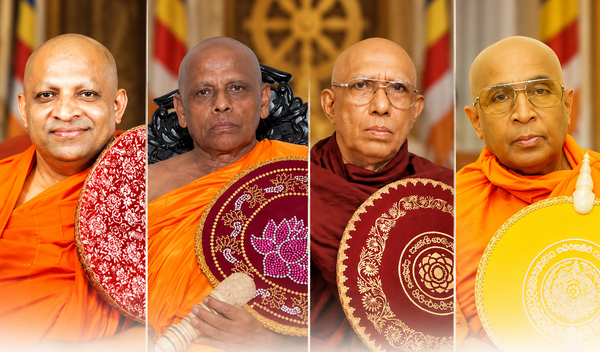
The letter was signed by the Most Venerable Thibbatuwawe Sri Siddhartha Sumangala Thero of the Malwatte Chapter, the Most Venerable Warakagoda Sri Gnanarathana Thero of the Asgiriya Chapter, the Most Venerable Karagoda Uyangoda Maithree Murthi Thero of the Sri Lanka Amarapura Maha Nikaya and the Most Venerable Makulawe Wimala Thero of the Sri Ramanna Maha Nikaya. A copy was sent to Harshana Nanayakkara, the Minister of Justice and National Integration.
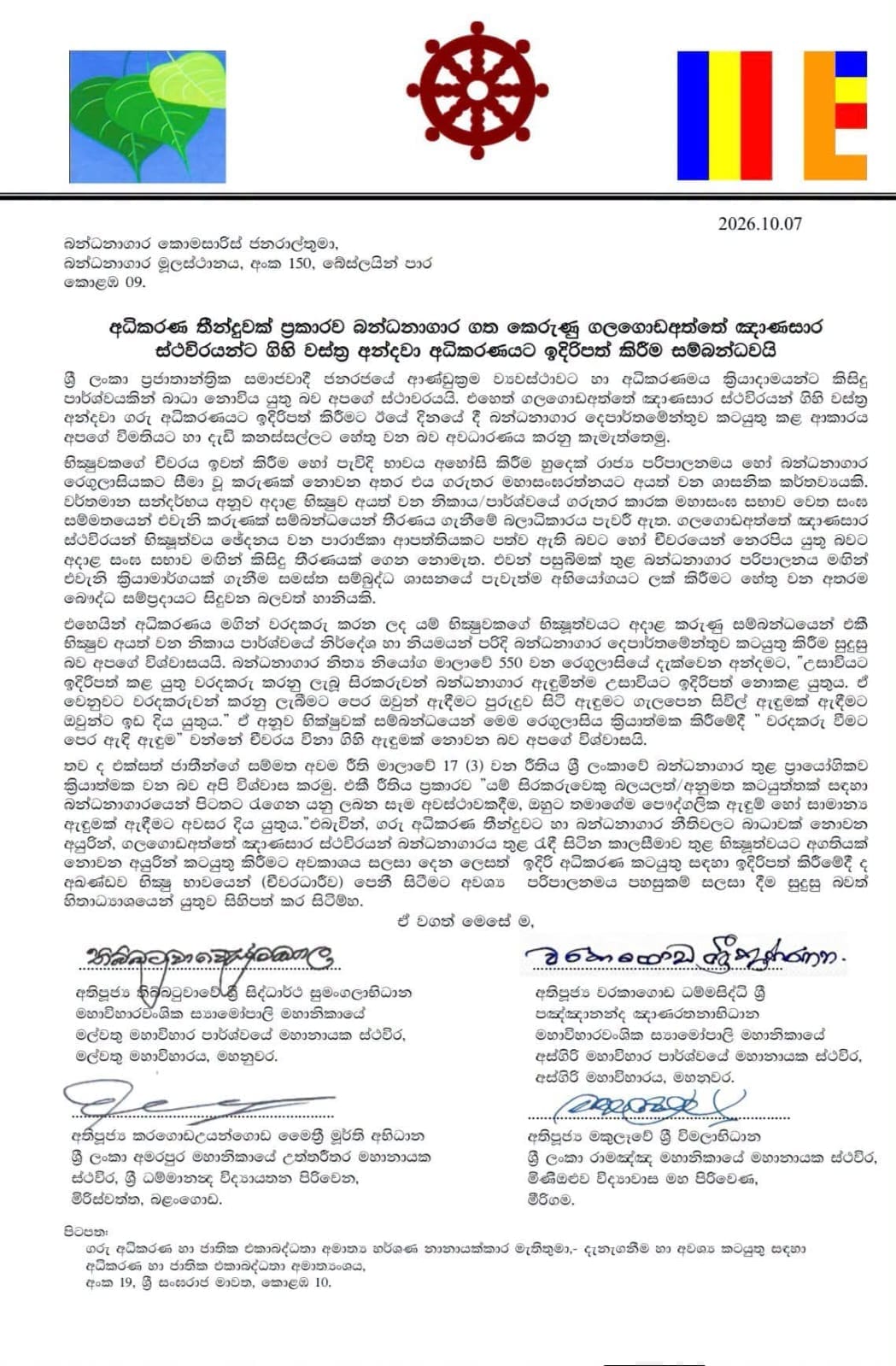
The prelates said they did not seek to interfere with the courts or with the monk's sentence. "It is our position that no party should obstruct the Constitution of the Democratic Socialist Republic of Sri Lanka or judicial processes," they wrote. But they said the Department of Prisons' decision to dress him in lay clothing and produce him in court a day earlier had caused them "astonishment and grave concern."
Removing a monk's robes or ending his ordination is an ecclesiastical function of the Maha Sangha, the community of Buddhist monks, the prelates wrote, and lies outside the scope of state administration and prison regulations. That authority rests with the governing council of the chapter to which a monk belongs, they said, and the prisons department should follow that chapter's rules in deciding how to treat a convicted monk.
The prelates also turned to the prison system's own rules. They cited Regulation 550 of the Prison Standing Orders, which they said bars convicted prisoners from being brought to court in prison uniforms and allows them to wear the civilian clothing they wore before conviction. For a Buddhist monk, they wrote, "the clothing worn before conviction is the robe, and not lay clothing."
They also cited Rule 17(3) of the United Nations Standard Minimum Rules for the Treatment of Prisoners, which they said applies in Sri Lankan prisons and allows a prisoner taken outside a prison for an authorized purpose to wear his own clothing or other inconspicuous clothing.
The prelates asked that Gnanasara Thero be allowed to serve his sentence without prejudice to his status as a monk, and that prison officials arrange for him to appear at future court hearings in his robes, within the limits of the court's judgment and prison law.
Gnanasara Thero, the general secretary of the hard-line group Bodu Bala Sena, has for years been one of the most divisive figures in Sri Lankan public life. He is serving a sentence for contempt of court imposed in August 2018, when the Court of Appeal convicted him on four counts arising from an episode in January 2016 at the Magistrate's Court in Homagama, near Colombo. He had forced his way into the court complex and disrupted a hearing in the case of Prageeth Eknaligoda, a journalist and cartoonist who disappeared in 2010. The court sentenced him to 19 years of rigorous imprisonment, with the terms running concurrently for an effective sentence of six years.
The Homagama court had separately convicted him that year of threatening Sandhya Eknaligoda, the journalist's wife, on the court premises.
Maithripala Sirisena, then the president, pardoned him in May 2019. On Sept. 10 this year, the Supreme Court declared the pardon invalid, ruling on petitions filed by Sandhya Eknaligoda and others. When the attorney general moved the Court of Appeal to enforce the original sentence, Gnanasara Thero's lawyer told the court on Sept. 29 that his client was ill. The court then issued an open warrant for his arrest and barred him from leaving the country.
In a separate case, the Colombo High Court in June upheld a nine-month sentence imposed on him over remarks about Islam that he made at a 2016 news conference.
The letter leaves the government of President Anura Kumara Dissanayake to weigh enforcement of a court-imposed sentence against the objections of the country's most senior Buddhist clergy.