
By Jeevan Thiagarajah
A temple is never really finished. It is destroyed, it is rebuilt, and somewhere in that cycle it becomes sacred all over again — not despite the disruption, but partly because of it. That is the argument at the heart of a new book, Sacred Shrines of Sri Lanka: A Profile of Major Hindu Temples. It is also the argument behind the ecosystem now being built around it — a Kindle edition, a website, a Facebook page, and Kovil, a mobile app — so that the same material can reach a person however they happen to arrive: as a first-time visitor curious what a puja involves, or as a devotee who has performed one every week for forty years. Temples do not become famous on their own.
What makes this more than a book with a companion app is that each format serves a different depth of engagement, and one of them — the app — serves it instantly. A reader can spend an evening with the printed chapter on Thiruketheeswaram; a devotee standing at the temple gate can open Kovil and have the same temple's founding legend, its festival dates, and the exact pujas being performed that day pulled up in seconds. Nothing is lost in that shortcut — it is the same 46-source scholarship underneath — only the time it takes to reach it changes. And because the same search sits behind every entry, it levels a field that has traditionally depended on who you were born to: a newcomer with no family lineage to draw on gets the same instant access to learn, to search, and to begin practising as someone raised inside the tradition from birth.
The book documents 114 temples across Sri Lanka, spannin six deity traditions — 21 for Shiva, 22 for Parvati and Shakthi, 13 for Vinayakar, 23 for Murugan, 4 for Vishnu, and 6 for Anjaneyar — plus two special multi-temple island chapters covering Neduntheevu (17 temples) and Pungudutheevu (8 temples), a thematic chapter on Kataragama, and a closing essay on the symbiotic evolution of Hinduism and Buddhist temple traditions across India and Sri Lanka. Scores of counterpart shrines across South India are linked throughout, tracing the two traditions' shared roots. Priests, or Kurukkals, continue to perform Agamic rites rooted in the Saiva Agama tradition — Abishekam, Alankaram, Naivedyam, Arathi — accompanied by mantras, mudras, and the Nadaswaram and Thavil. Since the end of the civil war in 2009, these same temples have become something more than places of ritual: spaces of healing, and a locus of identity for a generation navigating migration and modernity at once.
The book itself is a collaboration between the Swami Vivekananda Cultural Centre in Colombo and Sri Lanka's Department of Hindu Religious and Cultural Affairs, with funding from the India–Sri Lanka Foundation, and draws on foundational work by S. Arumugam and Professor S. Pathmanathan, among others. Its preface puts the intent plainly: "May this book serve as an offering — to the deities who inhabit these sacred shrines, to the ancestors who preserved them through turmoil, and to the generations yet to come who will continue to worship, study, and care for these extraordinary embodiments of Sri Lanka's spiritual heritage."
Why people come to the temple — and why one format was never going to be enough
Devotion rarely arrives out of nowhere. Most people are drawn in by something specific: an illness in the family, a wedding being planned, an exam on the horizon, a job that isn't going well. Each need has traditionally pointed toward a particular deity — Ganesha for new beginnings, Saraswati for exams, Lakshmi for prosperity — with the choice often guided by astrology, by a person's birth nakshatra, their ruling planet, or the day of the week tied to their situation.
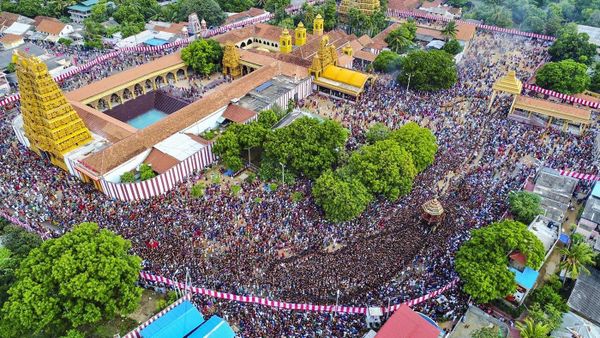
Others come to it more slowly. Children who grow up watching a grandparent perform puja eventually start asking why — wanting to understand a practice they've only ever seen repeated. And for many, it is the sheer spectacle that hooks them first: the kavadi processions, the fire-walking, the temple chariots at festivals like Nallur or Kataragama, which pull people in emotionally long before any explanation is needed.
For the diaspora, the pull is different again. Tamil and Sinhalese-Hindu-adjacent communities abroad — in London, in Toronto — often turn toward temple life out of a sense of disconnection, trying to reclaim something their parents practised but never fully explained. They notice, too, that rituals abroad don't quite match the ones back home, and want to know what was simplified and what survived intact. Interfaith households add another layer: explaining one's own practice to a partner or in-laws is, for many, the first time they've had to articulate it at all.
And then there is a more academic curiosity — the kind drawn to Kataragama, a shrine worshipped across Hindu, Buddhist, and Muslim communities alike, or to the gap between myth and ritual: people encounter the story of Murugan's spear or Ganesha's elephant head first, and are pulled toward the living practice only afterward.
No single format serves all of these people equally well. A grandparent's answer to a curious grandchild doesn't need an app. A diaspora parent trying to explain, mid-conversation, why Tuesday belongs to Murugan does. The ecosystem exists because the range of people walking into this material is that wide.
Idols with histories — destroyed, and standing again
What the book insists on, chapter after chapter, is that Sri Lanka's Hindu temples are not static monuments. They are institutions that have been knocked down — by war, by colonial-era iconoclasm, by displacement — and then rebuilt, largely by the same communities that lost them, using the same devotion that built them the first time.
Thiruketheeswaram, one of Sri Lanka's most revered Shiva temples and among the 21 Shaivite shrines covered in the book's opening chapters, carries exactly this arc: a site of ancient sanctity repeatedly disrupted and repeatedly restored by the people who considered it theirs to protect. It was razed once and rebuilt later. A benefactor purchased the land at an auction by the British. Scores of people digging there found the temple's original remnants. It was rebuilt with the original lingam and has become one of the most significant and iconic Sivan temples by devotion and belief. Kathirgamam, covered not as a single temple entry but as its own thematic chapter — a social-anthropological essay on a shrine shared across three faiths — became famous in much the same way: not simply by surviving, but by being continuously re-consecrated by the crowds who kept returning to it, generation after generation. Here too it is said Kathirgamam is Lord Murugan's sixth home with links to Boghar associated with the five homes in India. The sixth being located deep in the South of the country is itself unique. It continues to see steady, unceasing crowds of devotees. A related history belongs to the complex of Hindu temples in Dondra, at the southern tip of the country, now home to a famous temple for Lord Vishnu.
Five doors into the same tradition: book, Kindle, web, Facebook, app
The book's companion platform, Kovil, is where the ecosystem becomes something a devotee can practically use. Alongside the book, a Kindle edition, a website, and a Facebook page carrying daily panchanga updates are all part of the same effort to put the material wherever a person is already looking. But it is the app that is built for the moment someone needs one specific fact, right now.
Kovil is built around eight sections: a day-by-day sacred Calendar for 2026–27 with festival, tithi, nakshatra and kalyanam filters and .ics export; a fast Search layer across two years of events; a Temple Directory of more than 134 temples across Sri Lanka and India, filterable by country, province, and deity tradition, with "Twin Shrine" badges linking each idol to the counterpart source temple in India it traces back to; an Itinerary Builder for cross-border pilgrimage planning; a tradition-first Deities & India Shrines gallery; a searchable Pujas reference explaining what each ritual involves and requires; a Resources hub built on a 46-source scholarly bibliography; and an About section documenting the project's origins.
By September, this stops being a description and becomes something you can watch happen. Open the Calendar and Ganesh Chaturthi is tagged to Ganesha, Navaratri to Devi — each with its own puja items and the temples observing it, not a generic month view. Search the Temple Directory for Nallur Kandaswamy in Jaffna and its own festival dates surface with it, down to the day the chariot processions peak — along with a Twin Shrine badge pointing to the temple in India its idol is linked back to. The Itinerary Builder times a cross-border trip against those same dates rather than an arbitrary week. The Pujas reference attaches the day's specific rite to what it actually requires, item by item. Even the Deities & India Shrines gallery and the Resources bibliography hold this down to the shrine and the citation, not just the tradition. Every section, in other words, resolves to a day, a deity, and a place — not a category. Tithi and nakshatra tracking work the same way, day by day rather than only on named festivals: open September 1 and the Daily Panchanga shows Chaturthi tithi in the waning fortnight, Ardra nakshatra under Rudra, and a Tuesday ruled by Mangala — a day the tradition ties to Murugan and Hanuman.
What makes this relevant to a devotee, rather than merely comprehensive, is how these layers converge instead of standing alone, and how quickly. A given day carries three separate deity associations at once — the weekday's presiding deity, the tithi's, and the nakshatra's — so a Tuesday points to Murugan and Hanuman independently of whatever tithi or nakshatra also falls that day. The Temple Directory narrows the same way by place: country, then province, then deity tradition, so a devotee planning a visit can go straight to, say, Shiva temples in a single province rather than scroll the full 114. Auspiciousness itself isn't a single flag either — every tithi carries its own purpose: Ekadasi for a Vishnu fast, Ashtami as a day to hold off on new ventures, Amavasya for ancestral rites, Pournami sacred across traditions. For some entries the app narrows further still, to the hour: Pradosham's window for abhishekam is given as 4:30 to 6 PM, not simply auspicious for the day. The information resolves, for a specific devotee on a specific day, to which deity, which temple, and increasingly which hour — pulled out of two years of data in the time it takes to open the app.
A template from Tamil Nadu: touring temple towns, not single temples
Kovil's Itinerary Builder currently sequences a trip stop by stop. But the Tamil Nadu temple trail suggests a richer model — one Sri Lanka's own temple towns could follow, using tools Kovil already has.
A seven-day route through Tamil Nadu doesn't treat each town as a single flagship stop; it treats each as a cluster of four or more shrines, and the cluster is the point:
Town | Flagship | Also in the cluster |
Kanchipuram | Kailasanathar Temple | Ekambareswarar Temple; Varadaraja Perumal Temple; Kamakshi Amman Temple |
Thanjavur | Brihadeeswarar Temple | Airavatesvara Temple, Darasuram; Gangaikonda Cholapuram; Thanjavur Palace & Art Gallery |
Madurai | Meenakshi Amman Temple | Thirumalai Nayakkar Mahal; Koodal Azhagar Temple; Pazhamudircholai |
Rameswaram | Ramanathaswamy Temple | Kothandaramaswamy Temple; Five-Faced Hanuman Temple; Agnitheertham |
In Kanchipuram, the "City of a Thousand Temples," the route runs from the 8th-century Kailasanathar Temple — the oldest Pallava-sandstone shrine in the city — to Ekambareswarar, one of the five Pancha Bhoota Sthalams, where a 59-metre gopuram rises over a mango tree said to be 3,500 years old; to Varadaraja Perumal, a Vishnu shrine with a hundred-pillared hall and a stone chain carved from a single block; and finally to Kamakshi Amman, one of the Shakti Peethas.
Thanjavur repeats the pattern at grander scale. Brihadeeswarar, completed by Raja Raja Chola I around 1010 CE, carries a 66-metre vimana capped by an 80-tonne granite block whose hoisting method engineers still debate — but it is only the anchor. Nearby stand Airavatesvara at Darasuram, whose steps are carved to sound like musical notes when struck, and Gangaikonda Cholapuram, the third of the Great Living Chola Temples, raised by Rajendra Chola I. The Thanjavur Palace and Art Gallery, with its collection of Chola bronzes, rounds out the cluster.
Madurai centres on the Meenakshi Amman Temple, with its fourteen painted gopurams and a Hall of a Thousand Pillars in which no two pillars are alike — alongside the Thirumalai Nayakkar Mahal next door, the quieter Koodal Azhagar Vishnu shrine, and Pazhamudircholai in the hills, one of Murugan's six sacred abodes.
Rameswaram closes the route. The Ramanathaswamy Temple holds the longest pillared corridor in India — over a thousand metres and more than 1,200 columns — and is one of the twelve Jyotirlingas. The town also holds the Kothandaramaswamy Temple, the only structure to survive the 1964 cyclone that erased the nearby town of Dhanushkodi, the Five-Faced Hanuman Temple, and Agnitheertham, the sacred bathing shore. A detour to Chidambaram adds the Nataraja Temple, unusual for enshrining not an idol but akasha — the element of space itself.
Nothing about this model needs inventing for Sri Lanka. The Temple Directory already holds this material town by town; the Itinerary Builder can sequence clustered depth rather than a single flagship stop; Twin Shrines can surface a Sri Lankan cluster to an Indian devotee planning the same trip in reverse; the Sacred Calendar can time the visit against festival dates; and the Pujas guide can tell the traveller what to bring. The promise, town by town, is every trip these features can already generate.
A small team behind a large undertaking, and an ecosystem still growing
What began as a survey of 69 temples has already grown into more than 114 individual shrines once multi-temple clusters are counted, and an expanded survey now underway is looking at what may eventually be well over 1,000 Hindu temples across the island. A video reel per temple, a wider Facebook presence for daily panchanga updates, a dedicated address at temples.lk, a Kindle edition of the book, and a concept-stage feature matching a devotee's nakshatra and tithi to a recommended deity or ritual are all on the roadmap — each one another door into the same material. The intent, in short, is to put the whole of this living tradition — its calendar, its temples, its rituals — into a form a devotee can carry in one hand, and reach in a moment.
For all its scope, the project runs on the equivalent of two and a half people — a 1 + 1 + 0.5 arrangement — supported by sponsors. This article's writer works from the back end. The scholarship and the hand of co-editor Ankuran Dutta are evident throughout — from the book's original form as a 69-temple survey, through the preface, to the curating of its final composition.
The world of Hinduism, quite literally, in your palm.