
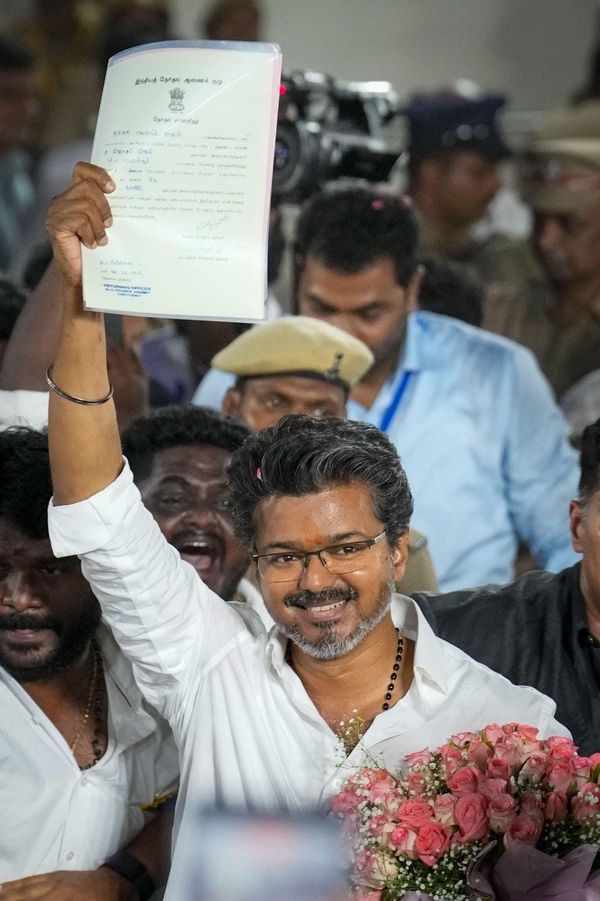
CHENNAI — Whether one supported actor-turned-politician Vijay or not, almost everyone agreed on one thing: he had done the impossible.
In a state where political power had rotated between two Dravidian parties for nearly six decades, Vijay emerged out of the blue, entered the political spectrum, and led his fledgling Tamilaga Vettri Kazhagam to 108 seats, making it the single largest party in Tamil Nadu’s 234-member assembly.
It was, by any measure, a democratic earthquake.
Even his critics acknowledged that he displayed considerable political shrewdness during the campaign, successfully mobilizing women and youth voters on a massive scale.
But what followed was something else entirely.
The First Misstep: Walking In With the Wrong List
The first mistake was made before Vijay had even sat down with Tamil Nadu Governor Rajendra Vishwanath Arlekar.
Constitutional convention in cases of a hung assembly is well established: the leader of the single largest party is typically invited by the Governor to attempt to form a government, with a floor test to follow. TVK, with 108 effective seats, was unambiguously that single largest party.
When Vijay first presented his claim to the Governor, the letter submitted to Raj Bhavan reportedly included signatures not only from TVK legislators but also from Congress lawmakers. By explicitly framing the submission as a coalition claim,112 seats, comprising TVK’s 107 plus Congress’s 5, TVK inadvertently handed the Governor a straightforward counterargument: the majority mark was 118, not 112. “Come back with the numbers,” was effectively the response.
By approaching Raj Bhavan as a coalition rather than solely as the single largest party, TVK had transformed what could have been a democratic right into a numerical obligation it had not yet fulfilled.
The Congress Embrace: Strategically Costly, Constitutionally Premature
The decision to publicly embrace Congress before securing any invitation to form government was a political miscalculation as much as a procedural one.
When counting was still being finalised, even as it became evident that TVK was short of a majority, the party's camp openly welcomed Congress's conditional support, offered with a rider that the incoming government maintain a secular character and keep the Bharatiya Janata Party at arm's length. Congress senior leader K.C. Venugopal stated the party's position publicly: it wanted a secular government in Tamil Nadu.
This announcement did several things, none of them helpful. It handed the BJP, and through the BJP, New Delhi, and by extension Raj Bhavan, a ready-made ideological pretext for unease about the incoming administration.
The correct sequence would have been to first establish Vijay's claim as the single largest party leader, receive the Governor's invitation, and then disclose the coalition's shape. By reversing the order, TVK gave opponents a preview of its vulnerabilities before the battle had formally started.
WhatsApp Politics
Perhaps the most publicly embarrassing episode in TVK’s government-formation saga was the manner in which the party initially approached its prospective allies.
Multiple smaller parties, including the VCK, the CPI, the CPI(M), and others, reportedly received outreach from TVK functionaries via WhatsApp messages seeking expressions of support and asking recipients to respond in kind. In Tamil Nadu’s political culture, where personal protocol and hierarchy carry considerable weight, the approach was widely perceived as a sign of either arrogance or ignorance, or perhaps both.
VCK general secretary Sinthanai Selvan gave a public voice to what several party leaders were saying in private. "Shouldn't Mr Vijay have immediately met them in person?" he demanded. "Sending a message via WhatsApp — how is one supposed to understand this?" VCK, he added, had found TVK's conduct toward it to be characteristic of a party guided by "second-rung leaders" whose advice had left Vijay poorly positioned.
Left party leaders echoed the criticism, describing the approach as “Gen-Z politics.” TVK, a party that had built its campaign momentum on social media savvy and youth mobilization, had applied the same toolkit to coalition negotiations, where it proved entirely the wrong instrument.
It was only after criticism over TVK’s initial outreach methods became public that the party moved to correct course. Although Vijay did visit CPI and CPI(M) leaders in person on the very day they extended their support, the earlier attempt by TVK functionaries to initiate negotiations through WhatsApp messages had already created an impression of political immaturity.
The Paperwork Problem: Verbal Promises at the Wrong Address
At each of his three visits to Lok Bhavan, Vijay arrived with a different documentation issue.
On May 6, his team submitted a letter combining TVK and Congress signatures — 112 seats in total — which invited the Governor’s blunt counter: come back with 118.
On May 7, Vijay returned. The Governor rejected the claim again, issuing a formal statement that “the requisite majority support in the Tamil Nadu Legislative Assembly, essential for forming the government, has not been established.”
On May 8 — the third visit in three days — Vijay arrived with what appeared, on paper, to be a commanding coalition. The formal letter he submitted to Governor Arlekar claimed the support of 121 legislators, three above the majority threshold: TVK’s 108 seats, plus the Indian National Congress (5), the Communist Party of India (2), the Communist Party of India (Marxist) (2), the Viduthalai Chiruthaigal Katchi (2), the Indian Union Muslim League (1), and the AMMK (1).
The Governor’s office, upon reviewing the documentation, found verifiable support for only approximately 116 legislators, two short of the majority mark. The VCK’s letter was reportedly submitted only via email rather than as a signed physical document. Meanwhile, the IUML publicly stated, after Vijay had already left Raj Bhavan, that it had not in fact extended support to TVK.
The AMMK entry in that letter was the most damaging of all. Within an hour of Vijay’s departure, AMMK general secretary T.T.V. Dhinakaran arrived at the Governor’s residence with a rival letter, alleging that TVK had forged the signature of AMMK’s sole legislator, S. Kamaraj of Mannarkudi.
He then returned a second time — this time with Kamaraj himself — who reportedly told the Governor in person that he had signed no such letter for TVK.
TVK released video footage after midnight purportedly showing Kamaraj voluntarily writing a support letter inside a car, claiming he had done so with Dhinakaran’s approval. Dhinakaran, however, dismissed the footage as AI-generated.
VCK has yet to officially announce its support, as leader Thol. Thirumavalavan’s press conference, originally scheduled for 11 a.m. today, has been postponed to 4 p.m.
The historian will record that TVK broke Tamil Nadu's Dravidian order in May 2026. The political realist will note that it spent four days doing its best to give the achievement away.