
By M.R. Narayan Swamy
Relations between India and Sri Lanka have depth and are blossoming. But all is not hunky-dory, notwithstanding the generous multi-faceted help India has provided during crises, more so in recent times. Yes, more and more Sinhalese, the community most cross with India for more than one reason, have begun to view India sympathetically but it will take a long time for bitter memories to fade and the irritants in overall bilateral ties to dissipate. Indeed, if Sri Lanka’s economy had not collapsed in 2022 and if India had not come to its rescue, the state of bilateral affairs could have been grim even today.
The overt reasons are not difficult to identify. The average Sri Lankan — not just the Sinhalese — feels let down by India’s decision in the 1980s to provide weapons training, arms, ammunition and sanctuary to Tamil militant groups, which enabled the rebels (later the Tamil Tigers) to confront the Sri Lankan state. India’s reluctance to eliminate LTTE leader Velupillai Prabhakaran, despite having precise intelligence on his whereabouts during the war, did not help matters. Moreover, New Delhi’s hesitation to supply the heavy weaponry that proved crucial during the decisive phase of the war against the Tigers was a setback for Colombo, which ultimately had no choice but to procure such support from other countries, including China and Pakistan.
Many Indians feel upset that Sri Lankans are holding on to a grudge over a decision pertaining to Tamil militants taken by a previous government in New Delhi. But the memories over the bloodbath the island nation endured due to the Indian misstep are not going to fade away easily despite the passage of four decades, just as sections of Hindus and Sikhs do not stop recalling the horrors of partition though it took place almost eight decades earlier. One hopes that the situation will change for the better with the passage of time.
This is why the collection of some very well-researched essays that make up the book under review is so important. The contributors, Indians and Sri Lankans, are mostly those who have studied India-Sri Lanka relations from various angles for long decades and, in the case of some including the editor, served in Colombo as diplomats and gathered immense knowledge. All of them have seen the ups and downs in the bilateral relationship trajectory from close quarters.
It is not a coincidence that both Bernard Goonetilleke, one of Sri Lanka’s most respected diplomats, and Yashvardhan Kumar Sinha, a former Indian high commissioner in Colombo, underline the lingering row over fishing in the narrow sea dividing the two countries as one of the most serious issues straining bilateral ties. As Goonetilleke rightly says, India needs to urgently address the repeated infringements by Indian bottom trawlers (in particular) since these illegal activities massively harm the environment and derail the livelihood of tens of thousands of fishermen, overwhelmingly Tamil, in Sri Lanka’s north-eastern coast. Sinha is more to the point when he says that the fishermen issue is an unnecessary irritant that has been allowed to fester for too long.
Until India imposes clear restraint on bottom trawling by a moneyed and politically connected class in Tamil Nadu, Sri Lanka will continue to feel cheated by India.
Similarly, economist Mathisha Arangala provides valuable insight into the problems confronting India-Sri Lanka economic ties which have hit repeated roadblocks despite their potential to expand massively. Although the economic partnership has evolved into one of the most significant bilateral relationships in South Asia, Sri Lankan businessmen complain how quotas and non-tariff barriers imposed by India have killed the advantage of duty-free access provided to their goods. Arangala explains in details the issues due to which the Sri Lankan business community’s confidence has eroded in furthering trade pacts and deepening economic integration with India. His essay is one of the finest in this collection.
Unless and until Indian policy makers make decisive moves on both these fronts, India-Sri Lanka relations will progress at a pace but lose its stream every now and then. No amount of generosity New Delhi shows will take away the irritants notwithstanding a most unexpected U-turn by the Janatha Vimukthi Peramuna (JVP), Sri Lanka’s dominant ruling party which from being once passionately anti-India has now become a votary of strong ties with Sri Lanka’s giant neighbour. The importance of this change is not just diplomatic, it is vitally ideological. Let us not forget that the JVP was the most organized anti-India force Sri Lankan society ever produced.
This caution, even if lengthy, is necessary because the India-Sri Lanka relationship needs to be preserved and bettered but it is not an easy task amid the global tremors. It is another matter that the book’s focus is on areas that shape lives every day: climate resilience, water and maritime cooperation, public health, education, culture, and the vital role of women and youth. The volume emphasises that non-traditional issues demand a central place in foreign policy thinking. This is certainly true, more so when it concerns two countries as culturally and otherwise entwined as Sri Lanka and India.
While examining the current state of connectivity between India and Sri Lanka as well as potential new forms, Prof Rohan Samarajiva finds fault with India on the issue of cross-border electricity trading. Balasubramanian Chandrashekar points out that Sri Lanka’s ability to manage the complexities of global power dynamics will determine its trajectory over the coming decades; at the same time, strategic deliberation from New Delhi is needed to translate intent into action – through investments, connectivity enhancements or diplomatic initiatives – to ensure a partnership that fosters mutual benefit and regional stability amidst China’s enduring presence.
Some scholars delve into water management, with Omar Rajarathnam and Dr Uditha Devapriya suggesting that India should seriously consider repairing existing infrastructure including tanks in the irrigation-starved Northern Province. Dr Dhanasree Jayaram and Varun Mohan warn that the changing climate and its impact were affecting and will further strain India-Sri Lanka bilateral relations.
Retired Rear Admiral Sudhir Pillai NM says India and Sri Lanka can transform shared maritime challenges into opportunities for regional leadership while Dr Satheesh Chandra Shenoi is optimistic that the two countries are well positioned to lead the transformation of the blue economy in the Indian Ocean by embracing regional and global cooperation. The blue economy indeed offers a pathway for India and Sri Lanka to achieve sustainable growth while safeguarding their respective vital marine resources.
For a variety of reasons that do not apply to other countries, India and Sri Lanka can tremendously expand and boost their multi-faceted partnership for their own best interests. But as diplomat Sinha warns, India continues to bear the cross for its past actions; “the anger has largely dissipated but the memory still rankles”.
Sinha comes out with some enduring tips on how India can take forward its bilateral relationship smoothly. One, eschew the temptation to play the ‘Big Brother’; New Delhi must refrain from a prescriptive approach on Sri Lankan domestic developments and allow concerned parties within that country to reach a modus vivendi; India must seek to resolve the genuine grievances of the Sri Lankan business community; at the same time, New Delhi must be clear what its security red lines are and these must be clearly communicated to the Sri Lankan leadership.
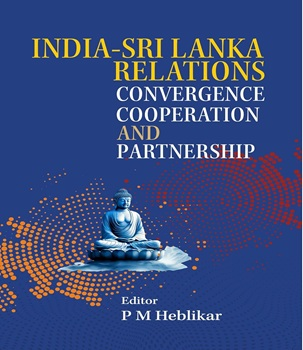
India–Sri Lanka Relations: Convergence, Cooperation and Partnership
Edited by P. M. Heblikar
Published by Vivekananda International Foundation and Pentagon Press
xviii + 398 pages | Price: Rs. 1,095