

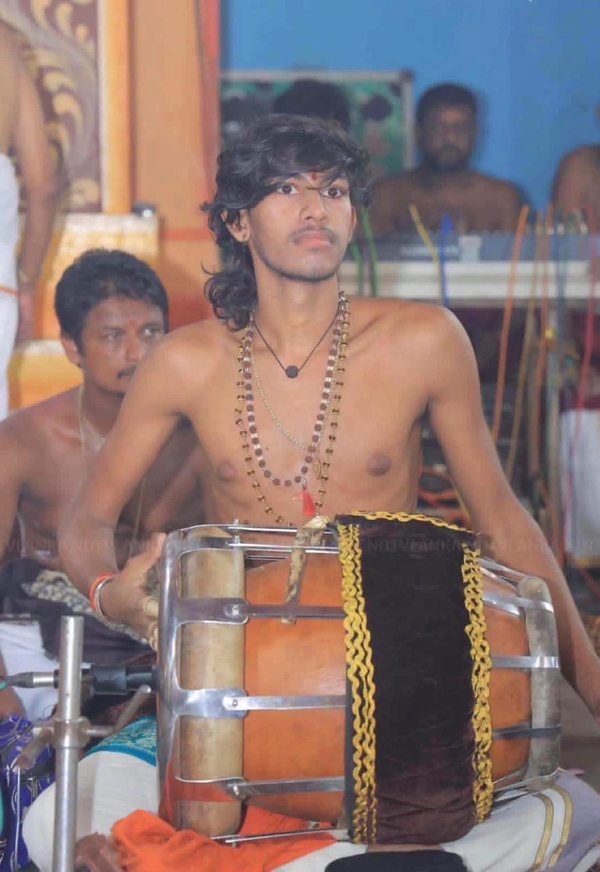
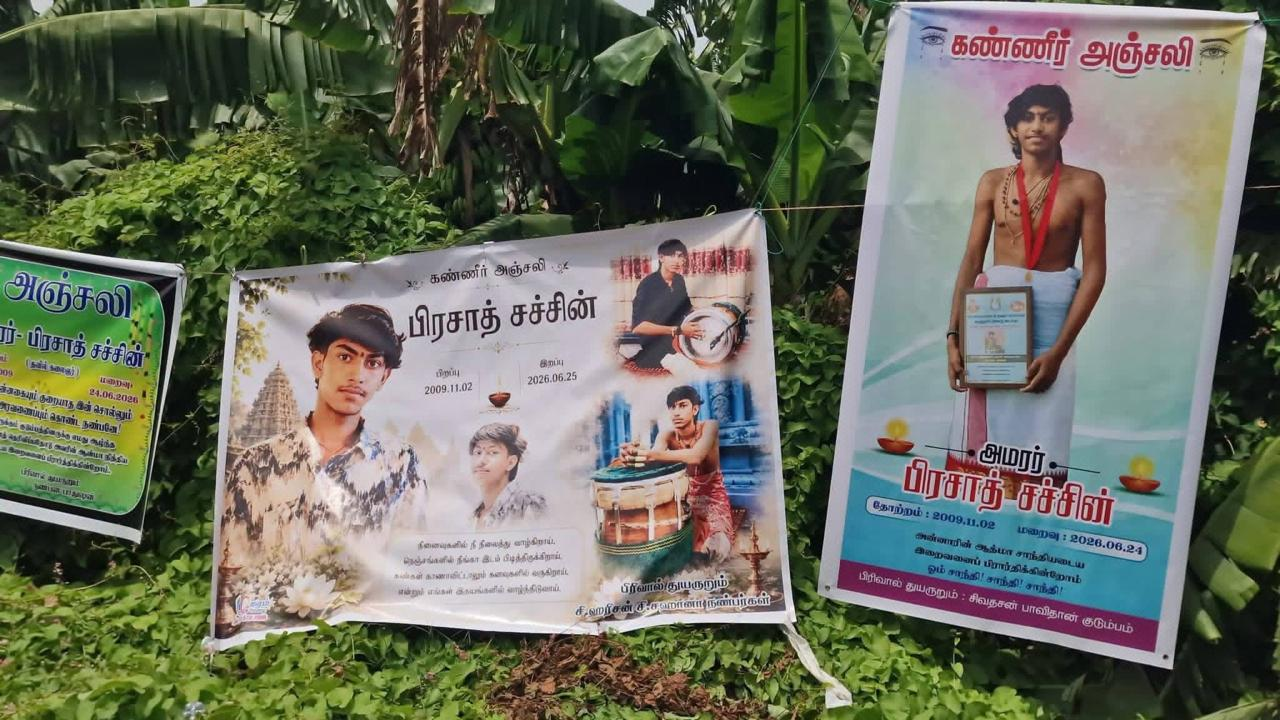
JAFFNA — Prasanth Sachin, a teenage thavil virtuoso from a family of thavil musicians whose self-taught command of the instrument had marked him, in the eyes of senior artists, as one of the most gifted of his generation, and some believed, a successor in the making to the great Yazhppanam V. Thedchanamoorthy, died on Tuesday night. He was 17.
His death, at his home on Rasapathai Road in Kopay North, was ruled a suicide following an inquest conducted by the Inquirer into Sudden Deaths, Namasivayam Premkumar.
Born on Nov. 2, 2009 — barely six months after Sri Lanka’s long civil war ended at Mullivaikkal with the military’s final defeat of the Liberation Tigers of Tamil Eelam — Sachin belonged entirely to the generation that came after. He was among the children who carried no memory of the conflict, growing up instead in its quiet aftermath.
He took up the thavil at the age of eight under the guidance of his father, Prasath, himself a thavil player, fellow nadaswaram and thavil vithuvans in Jaffna said. Yet, despite that lineage, he did not remain confined to tradition. Where most players learn within an established grammar handed down through teachers and family, Sachin developed a technique of his own — a distinctive style that audiences came to recognise as unmistakably his. By his teens, temples and concert organisers across the Jaffna peninsula were requesting him by name.
A close friend from the music industry told Jaffna Monitor that Sachin was known for his discipline and single-minded devotion to his craft. Unlike some musicians, the friend said, he neither drank, smoked nor chewed betel, choosing instead to focus almost entirely on his music. As performance requests grew, he eventually left school to keep pace with the demands of his schedule.
Earlier on the day he died, Sachin had travelled to a temple in Pungudutivu to perform at a thavil concert. He was scheduled to perform later that day at a temple in the Achchuveli area, but did not appear. Just a few hours before his death, he had been playing with his sister’s children, a family member told Jaffna Monitor.
Friends and relatives told Jaffna Monitor that Sachin had been in a relationship with a woman about 10 years older than him, who also came from a musical family. They said she was separated from her husband, a thavil player, and that divorce proceedings were underway.
Screenshots purporting to show chats between Sachin and the woman shortly before his death later circulated widely on Facebook.
A senior nadaswaram musician who knew his work, and who spoke on condition of anonymity, said Sachin’s stature was evident in the demand for his performances. Temples and organisers pressed specifically for his inclusion in their line-ups, the musician said — a level of demand rarely commanded by someone so young. That reputation extended to the Tamil diaspora, taking him abroad for performances while he was still a boy.
In such a short span of time, he achieved what takes most musicians decades," the musician said. "Many of us believed he would one day be spoken of alongside the great masters. But he is gone far too soon.
If you or someone you know is struggling or in crisis, help is available in Sri Lanka. The National Mental Health Helpline can be reached on 1926 (toll-free, 24 hours). Sri Lanka Sumithrayo offers free, confidential emotional support on 0707 308 308 (WhatsApp: 0767 520 620). The CCC Foundation crisis line is 1333. For young people, Childline Sri Lanka can be reached on 0114 602 806. Reaching out for help is a sign of strength, and support is available.