

Japan Funds Debris Removal and Service Restoration After Sri Lanka Cyclone

Japan Funds Debris Removal and Service Restoration After Sri Lanka Cyclone


Share this post

COLOMBO — Japan and the United Nations Development Programme signed an agreement with the Sri Lankan government on Wednesday to fund disaster waste clearance and the rehabilitation of community facilities in areas devastated by Cyclone Ditwah, which struck the island in late November and affected an estimated 1.7 million people.

The project will focus on the Central Province — the districts of Kandy, Matale, and Nuwara Eliya — where the cyclone caused some of the worst damage to infrastructure, leaving services disrupted and debris piled up in communities for more than six months.

Under the initiative, formally titled the Project for Disaster Waste Clearance and Rehabilitation of Community Facilities through Participatory Approach, electric three-wheelers will be deployed to collect recyclable and light disaster waste, while multipurpose community centers that provide healthcare, education, childcare, and social services will be restored.

Officials said the project would directly benefit roughly 228,500 people, with a further 700,000 expected to gain indirectly through improved services and waste management. It is also designed to create livelihood opportunities through community-based waste collection and rebuilding work, with an emphasis on employing women and vulnerable groups.

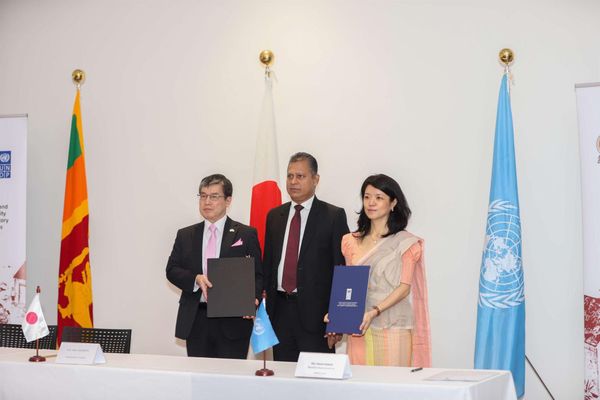
The agreement was signed in Colombo by Akio Isomata, Japan's ambassador to Sri Lanka, and Azusa Kubota, the UNDP's resident representative, in the presence of S. Aloka Bandara, secretary to the Ministry of Public Administration, Provincial Councils and Local Government.

Mr. Isomata said the project was guided by the principle of "Build Back Better" and would strengthen resilience by putting communities at the center of implementation. "By encouraging local communities to participate," he said, Japan hoped to "strengthen social cohesion and enhance resilience to disaster."

Mr. Aloka Bandara called the agreement "an important milestone in our national recovery efforts," saying it would help affected communities "regain access to essential services and rebuild their lives with dignity."

Ms. Kubota said recovery "is not merely about rebuilding what was lost," describing the partnership as a commitment to "inclusive, sustainable recovery that leaves no one behind."

The signing marks a shift from emergency humanitarian relief toward longer-term recovery in the cyclone's aftermath, and officials said the project aligns with Sri Lanka's broader efforts to strengthen climate resilience and modernize its waste management systems.


Share this post

Be the first to know

Join our community and get notified about upcoming stories

Subscribing...
You've been subscribed!
Something went wrong
JVP Sang the Same Songs. Only Tamil Rapper Went to Jail.
Sangeethasan Ganeskumar

JVP Sang the Same Songs. Only Tamil Rapper Went to Jail.

By M.R. Narayan Swamy “O land that yearned for valour O soil where Tamil pride has flourished The land where history was born And gave the nation its national leader (Prabhakaran) A bronze statue of the Tamil national leader Shall stand in the land of his birth.” These lyrics are not from the Tamil Tigers’ liberation songs. They are from a song — believe it or not — popularized by Sri Lanka’s incumbent ruling party, whose government has now sent a young Tamil man to prison for singing


M.R. Narayan Swamy

M.R. Narayan Swamy

Why Sri Lanka Has Yet to Unlock the Indian Market

Why Sri Lanka Has Yet to Unlock the Indian Market

By M.R. Narayan Swamy Why are India and Sri Lanka struggling to embrace a mutually beneficial trade agreement despite plenty of attempts? Why do exports to India account for only about 6 percent of Sri Lanka’s total exports? Colombo and New Delhi have long sought to upgrade the original India-Sri Lanka Free Trade Agreement (ISFTA) by addressing its shortcomings and expanding its scope to include services and investment provisions. The Comprehensive Economic Partnership Agreement (CEPA) was pr


M.R. Narayan Swamy

M.R. Narayan Swamy

At Jaffna University, a Damaged Vesak Lantern Tests a Fragile Consensus

At Jaffna University, a Damaged Vesak Lantern Tests a Fragile Consensus

JAFFNA, Sri Lanka — When a few Vesak lanterns erected by Sinhala Buddhist students at the University of Jaffna were vandalized this week, the damage itself was limited. What followed was more unusual: student leaders, university representatives, and even Tamil nationalist politicians quickly united to condemn the act and reject attempts to turn it into an ethnic controversy. The lanterns, displayed as part of Vesak celebrations at the university’s Faculty of Management Studies and Commerce, wer


Our Reporter

Our Reporter

Deepthi Attygalle, Pioneer of Sri Lankan Anaesthesia, Dies at 86
Deepthi Attygalle

Deepthi Attygalle, Pioneer of Sri Lankan Anaesthesia, Dies at 86

Deepthi Attygalle, the Sri Lankan anaesthesiologist whose work on magnesium sulphate became an important reference point in the treatment of severe tetanus, died on June 1, 2026. She was 86. For much of the twentieth century, severe tetanus was managed by heavily sedating patients and supporting them on mechanical ventilators for weeks at a time, a regimen that consumed intensive-care resources often unavailable in many developing countries. At the General Hospital in Colombo, Dr. Attygalle and


Jaffna Monitor

Jaffna Monitor