
By Asela Kuruluwansha
KANDY, Sri Lanka, Oct. 16 — Sri Lanka’s prison authorities told the country’s two most senior Buddhist prelates on Friday that monks serving prison sentences will be allowed to wear their robes when taken outside prison. The change follows weeks of objections from the clergy over the treatment of Galagoda Aththe Gnanasara Thera, the nationalist monk who was returned to prison this month.
Senaka Palletenna, a spokesman for the Department of Prisons, described the changes at meetings in Kandy with the chief prelates of the Malwatta and Asgiriya chapters of the Siyam Nikaya.
Under the procedure he outlined, when a monk is jailed after a criminal conviction, the monastic chapter he belongs to will have 10 days to decide what action, if any, to take on his religious status. The Prisons Department will then act in line with that decision. Monks and members of other religious orders will be allowed to wear their religious dress when taken outside prison premises.
Mr. Palletenna did not say when the changes would take effect, whether they would apply immediately to Gnanasara Thera, or what would happen if a chapter failed to decide within 10 days.
The proposals come from a committee that President Anura Kumara Dissanayake set up after meeting representatives of the three main Buddhist fraternities on Oct. 8. The President’s Media Division said this week that the revised regulations were expected to be finalized within two weeks, and that the provisions on monks would first be put to the senior clergy for their views. The Prisons Ordinance of 1877, which governs the prison system, contains no specific provisions for monks serving sentences, according to the division.
Gnanasara Thera, the general secretary of Bodu Bala Sena, a hard-line Sinhala Buddhist organization, was arrested on the night of Oct. 3 at a monastery in Thiniyawala, in Kalutara District. The Court of Appeal had issued a warrant for him after he failed to appear before it on Sept. 29. That hearing followed the Supreme Court’s ruling on Sept. 10 that the pardon granted to him by former President Maithripala Sirisena in May 2019 was invalid.
The Court of Appeal convicted Gnanasara Thera in 2018 on four counts of contempt of court over his conduct at the Homagama Magistrate’s Court on Jan. 25, 2016, during proceedings in the case of Prageeth Eknaligoda, a cartoonist and journalist who disappeared in January 2010. He was sentenced to six years of rigorous imprisonment and had served about nine months when Mr. Sirisena pardoned him.
The petitions that led to the Supreme Court ruling were filed by Sandya Eknaligoda, the missing journalist’s wife, and the Centre for Policy Alternatives, a Colombo-based research group. Justice Janak de Silva wrote the judgment for a three-judge bench.
Gnanasara Thera also faces a nine-month sentence in a separate case over remarks about Islam. The Colombo High Court upheld that sentence in June.
After his arrest, he was produced in court in prison-issued clothing. The Malwatta and Asgiriya prelates wrote to the Commissioner General of Prisons, saying that decisions about a monk’s robes and monastic standing belong to his chapter, and that the clothing a monk wore before conviction is his robe. The Prisons Department said its regulations require prisoners sentenced to rigorous imprisonment, or to more than three years, to wear prison clothing. On Oct. 8, a fundamental rights petition was filed in the Supreme Court seeking an order that he be produced in court in robes.
Mr. Palletenna told the prelates on Friday that the department had acted under the existing Prisons Ordinance.
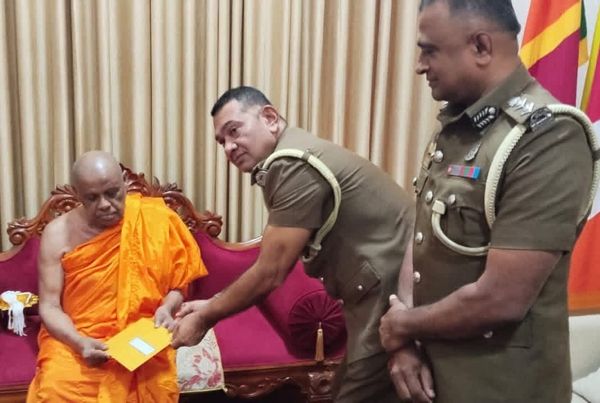
The Mahanayake of the Malwatta Chapter, the Most Venerable Thibbatuwawe Sri Siddhartha Sumangala Thera, proposed that prisons set aside separate accommodation for monks. Mr. Palletenna said he would refer the proposal to the minister responsible for prisons. Both prelates welcomed the decision to allow jailed monks to appear outside prison in robes.
The Mahanayake of the Asgiriya Chapter, the Most Venerable Warakagoda Sri Gnanarathana Thera, asked the authorities to consider releasing Gnanasara Thera, saying his return to prison had caused considerable public unease. He cited the monk’s earlier release under the 2019 pardon, which the Supreme Court has since ruled invalid, and said freeing him again would be better than prolonging the controversy.
On Thursday, Prime Minister Harini Amarasuriya, during a separate visit to the two prelates, said any further direction on Gnanasara Thera’s imprisonment should come from the judiciary. She said the government was committed to respecting the Constitution, the courts and established traditions, and defended its record on protecting Buddhism while ensuring religious freedom for other communities.
Article 9 of Sri Lanka’s Constitution gives Buddhism “the foremost place” and directs the state to protect and foster the Buddha Sasana, while guaranteeing the rights of all religions.
The government has not said whether it will consider the request to release Gnanasara Thera. He remains in custody.