
By M.R. Narayan Swamy
One day in 1997, Sri Lanka’s air force chief, Oliver Ranasinghe, learnt from a “little bird” that the Defence Secretary had gone to the UK with his son to buy two C-130 aircraft.
The C-130 was ideally suited for Sri Lanka. It can carry heavy loads and even operate out of unprepared airfields. But there were problems with these two aircraft.
Both had been parked on a tarmac in the UK for 13 long years in extreme weather, without being flown or even the engines being run. Worse, they were 34 years old.
So, Air Chief Marshal Ranasinghe alerted President Chandrika Kumaratunga that someone was planning to take a decision that would not benefit Sri Lanka. “Madam, we decommissioned our Avro aircraft after 22 years in service, and now we are buying 34-year-old aircraft! I am sure somebody will have to answer for it one day.”
Until Ranasinghe retired in March 1998, the subject of the two C-130 never came up. But they were purchased after he left the air force! The letter of credit was opened actually for three aircraft, but only two reached Sri Lanka for the same price. The third was given up so that the other two could be made serviceable – for 700,000 pounds each!
Ranasinghe, who served in the air force for 30 years beginning in 1968, has peppered his book with stories of rampant corruption in the armed forces even as the country fought a long and costly war against the Tamil Tigers. The book gives a good idea why it became so difficult for Colombo to overcome its adversary.
The other reason why this book should be read is to understand the narrow Sinhalese mindset that continues to derail Sri Lanka.
Ranasinghe’s understanding is that the Sri Lankan Tamil youths were “misled” and nurtured with foreign funding and sponsored by India. He says: “Prime Minister Indira Gandhi’s government created the LTTE (Liberation Tigers of Tamil Eelam) problem for us; they trained the LTTE in India.”
There are sweeping statements which can come only from one who doesn’t understand what ignited the Tamil problem in Sri Lanka. There are many aspects of India’s Sri Lanka policy which can be faulted, at least in retrospect. But India did not give birth to the LTTE and did not “mislead” Tamil youths.
Right or wrong, Tamil militancy was home-grown. There was no LTTE when anti-Tamil violence gripped Sri Lanka in 1956 and 1958; the LTTE was a crawling baby even in 1977 when Tamils again came under attack. Prabhakaran was a largely unknown entity when Sinhalese vandals destroyed the Jaffna Tamil library with 97,000 books and priceless palm leaf manuscripts. There was no India in the picture when hundreds of Tamils were slaughtered and thousands left homeless in the Sinhalese orgy that followed the killing of 13 soldiers by the LTTE in 1983.
Linguistic domination, discrimination in education, political marginalisation, and equating Sinhalese (Buddhists) with the idea of Sri Lanka gave birth to Tamil militancy. Even with all these, there may have been no insurgency but for the 1983 horror in Colombo and elsewhere. It is childish to say that Tamil youths were “misled” or that Indira Gandhi “created” the LTTE.
Unlike many Sinhalese (retired military personnel included) who today admit to some of the historical wrongs committed since independence in 1948, Ranasinghe comes across as a political novice, negating the roots of Tamil grievances. He speaks about the death of around 30,000 security personnel in the war but makes no mention of the tens of thousands of Tamils who too perished. And we are talking about Tamil civilians (Sri Lankans after all), not combatants. How can any country be emotionally united when people at the leadership level have such a jaundiced outlook?
Ranasinghe also makes a fanciful claim that he was happy that President Ranasinghe Premadasa told the Indian military deployed in Sri Lanka under a bilateral pact to quit. According to the author, the Sri Lankan military was not happy with the Indian Army because “all signs showed that they wanted to be in Sri Lanka forever”.
This is ridiculous, to say the least. I reiterate that there is nothing wrong with taking a critical look at India’s past vis-à-vis Sri Lanka. I have often wondered what exactly India achieved by air-dropping food in Jaffna in June 1987, beyond hurting the sentiments of a majority of Sri Lankans. Even then, Indian External Affairs Minister P.V. Narasimha Rao, who later became prime minister, wanted the 1987 pact to be signed between the LTTE and Colombo, rather than between India and Sri Lanka.
But to say that the Indian military wanted to make Sri Lanka their new home is preposterous. Blame it on poor intelligence or naivete, the Indian military brass landed in Jaffna thinking they needed to oversee a surrender of weapons by Tamil militants and then go home. Many officers brought with them clothes to last just a few days. But LTTE chief Velupillai Prabhakaran had other ideas. The rest, as we know, is history.
Ranasinghe displays more of a narrow worldview when he argues that devolution of power “will separate us ethnically and lead to possible separatism”. Did Prabhakaran embark on militancy because of devolution or was devolution under the 1987 India-Sri Lanka pact conceived of as an alternative to separatism?
The former air force chief tries to frighten Sri Lankans by referring to the 75 million Tamils in India, separated by a narrow strip of sea from Jaffna, insinuating a possible major Tamil invasion from India. This is another popular Sinhalese nationalist myth. Tamil Nadu may have exploded in the aftermath of the 1983 bloodbath, but the sympathy for Tamil militants in Sri Lanka evaporated a long time back, barring among pockets of Dravidian political players. This is why those who speak most vocally about Prabhakaran today struggle to get a decent number of votes in elections in the state.
Ranasinghe feels unveiling provincial councils in the nine provinces amounts to “breaking this country into nine states”. Oh, really? Did Sri Lanka splinter when the provincial councils existed? “Just imagine the scenario when they get police powers and land powers! They (Tamils) will want to be kings, and the country will disintegrate sooner than later.” Wow! I do wonder what will happen if the Northern Provincial Council were to control the local police force? Jaffna will break free of Sri Lanka?! And get immediate recognition from the UN?!
Perhaps people like Ranasinghe do not realise the enormous damage they are doing to Sri Lanka with such outlandish theories. Sri Lanka can never break as long as its people and communities have healthy respect for one another. It is no point paying lip service to national unity when a dominant ethnic group continues to suspect the loyalty of the minority. Mistakes and blunders happen in every society and country. But one cannot permanently live in the past. In any case, majoritarian nationalism can never lead to “One Nation, One People”.
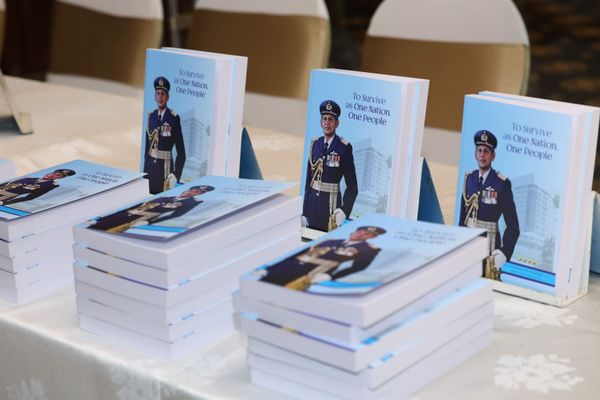
Title: To Survive as One Nation, One People
Author: Air Chief Marshal Oliver Ranasinghe
Publisher: Self-published, Rajagiriya, Sri Lanka
Pages: vii + 316
Price: LKR 3,750
(To Survive as One Nation, One People is available at www.vijithayapa.com)