
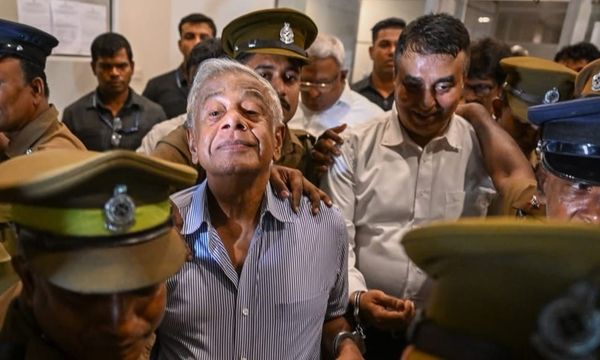
COLOMBO, Sri Lanka — Moments before a Colombo court sentenced them to death on Friday for failing to prevent the 2019 Easter Sunday bombings, Sri Lanka's former police chief and former defence secretary were each invited, as the law requires, to explain why they should not receive the death penalty. Their answers could hardly have been more different: one was a quiet surrender to fate; the other, a defiant insistence that the men he said truly bore responsibility for the massacre remained shielded by the state.
Pujith Jayasundara, who was inspector general of police when suicide bombers struck churches and hotels across the island on Easter morning, told the three-judge bench that he had never in his life committed a massacre, and that as a Buddhist, he could only understand his predicament as the karma of some wrong from a previous life now catching up with him.
“From the very beginning of this case, I have been subjected to injustice,” he said, addressing the court in open session after his conviction but before sentence was passed. He acknowledged that, as part of the country’s national security apparatus, he “bore responsibility.” But others, he noted pointedly, had walked free. “Please consider how humane it is that someone who served as the Inspector General of Police of this country has been brought to such a situation.” He asked the judges to look upon him “with mercy and compassion,” said he had never deliberately neglected his duty, and closed simply: “I have nothing further to say.”
Hemasiri Fernando, who was Secretary to the Ministry of Defence at the time of the attacks, told the court that there was no office formally called "Defence Secretary." He said he had served as Secretary to the Ministry of Defence, a civil administrative post no different from that of any other ministry secretary and one that carried no special powers. He could act only on the instructions of the minister, he said. At the time of the attacks, the Minister of Defence was President Maithripala Sirisena, who was abroad, and no acting minister had been appointed. "When there is no minister, the functions of the Secretary to the Ministry of Defence are effectively paralysed," Fernando told the court.
The intelligence, he insisted, had never reached him. He said the president had personally instructed him, on his appointment, to leave intelligence matters to Nilantha Jayawardena, the director of the State Intelligence Service, and to concentrate on administration. For four years, Fernando said, it was Jayawardena - not he -- who briefed the president directly. Until the day before the bombings, he said, he had received nothing on the threat but a single WhatsApp message.
At an intelligence review meeting on April 9, he said, the spy chief presented nothing about the coming attack, though military and naval intelligence officers were in the room and could have acted had he spoken. Jayawardena, he told the court, “took steps to suppress these intelligence reports on seven occasions.”
“Your judgment is the final outcome of that conspiracy surrounding the Easter Sunday terrorist attacks,” Fernando said. Two men, he added, would be pleased by his conviction: Sirisena, the former president, and Jayawardena, “whom the Attorney General’s Department has protected from the very beginning.” He called the intelligence chief “the principal conspirator behind these attacks.”
He went further, describing how, in his telling, the two officials in the dock had come to be there at all. After the bombings, a committee headed by Justice Malalgoda investigated, and on the strength of Jayawardena’s own statement, the attorney general instructed the acting police chief to arrest 14 people, Fernando said. The acting chief, he claimed, took the matter to the president and warned that jailing all 14 would leave him unable to run the police. The president, according to Fernando, then asked who had ordered the arrests — and directed that only he and Jayasundara be taken into custody. “In what way is that just?” he asked.
The presiding judge, Priyantha Liyanage, then read out the sentence of death for each man.