
K. Mohammad Riyas
Translated by eḻuttukkiṉiyavaṉ (https://ezi.asokan.org/about). from the Tamil story “பெம்பலா” (pempalā) by K. Mohammad Riyas from the short story collection titled “சிகரி மார்க்கம் (cikari mārkkam)”
Pempalā ’s bicycle was absent from its usual place under the lone palmyra tree outside the village. Had he been in town, he would have been there by this time of day. He was absent yesterday, too. One of the men playing cards under the tree declared definitively that if he was absent yesterday and absent today, then he must have fled the village. It was hard to dismiss the assertion. The man had lost a considerable sum of money to Pempalā over the past several days. He remembered how elegantly Pempalā would hold his cards in his hand, spread out like an umbrella. Without realizing it, he opened his palms and held them as if they were playing cards.
“Pempalā fleeing in a bus? That’s a joke!” declared the butcher Rahim, a little miffed at having lost Pempalā’s custom that morning. “He would pedal his bicycle with his bad leg even to get to Maṇamēlkudi over there!” he continued, and the crowd tittered.
“Rahim, count your goats! Perhaps Pempalā sneaked away with one of them.”
“Stop it… you all know that Pempalā never coveted someone else’s property.” Rahim was more concerned about finding Pempalā quickly and taking him to the Dēvakōṭṭai goat market in his van that was parked nearby.
Because it was autumn, the banyan tree at the center of the village had lost some of its shine. The village elders had assembled under it. The excoriating heat seemed to radiate in concentric circles like never before. Village folks sat atop the dried-out, completely sand-covered well debating the whereabouts of Pempalā. Everyone advanced their own theories, speculating where he was or who he was chatting with in which tea stall. The village chief sent someone to check at the Idiñcamēdu mosque colony where he lived.
A white Ambassador car entered the village and started driving through every nook and cranny, leaving a cloud of dust in its wake. “A public announcement from the government for the people of the village. You have a golden opportunity to confirm your citizenship! Those of you whose citizenship may be questioned are required by this government directive to approach the Tehsildar with the thirteen types of documents needed for confirmation. This is a government order.”
The government announcement reverberated across the three village ponds.
Although the muezzin was well aware that it was time for the Dhuhur prayer, his ears were focused entirely on the village meeting by the covered well. He was indeed the last person to have had a long chat with Pempalā the previous evening. He thought of his unmarried daughter Rāfia, who sat in their front yard, wearing no jewelry whatsoever. Overcome with weariness, the muezzin closed his eyes.
“Vāppā…,” she had said plaintively, “I am not yearning for nikāh again, vāppā. What do we do if the next man is also a drunkard like the previous one?’
“I know Pempalā very well, my child. I did talk at length with Uncle Mustafā. Pempalā had lost his parents at a young age. I am going to put the responsibility on God and go ahead with this, dear. Everyone needs a helpmeet to share the ups and downs of life with, before it is too late. I am always going to do what is good for you, child.”
Someone in the village meeting quipped, “If the village elders had found a suitable bride for Pempalā in time, he wouldn’t be lost now. He’d be lying on his wife’s lap,” and guffawed. No one laughed. Saddened, the man continued, “We had an obligation and duty towards Pempalā.” The crowd listened in silence.
Sahib Maraikkār stood up, put his towel over his shoulder, and declared that he did not care about a man who had fled, abandoning the preparations for his daughter’s wedding before they were completed. The crowd parted to make way for him as he walked forward, chasing the crows perched on the tree branches. "You must not issue a fatwa like that Maraikkāṉ!” said the chief of the village jamāt.
The stagnant rainwater in the mosque pond, just to the left of the banyan tree had turned a shade of green. The hawks circling overhead seemed to know instinctively that the water was no longer fit for the villagers of Kōṭṭaiyūr — a place so utterly dependent on rain — to bathe or wash in. They dove for the tilapia fish in the pond, grabbed them with their sharp talons, flew to the topmost branches of the banyan tree to gobble the flesh, and dropped the leftovers on the heads of the village panchāyat assembled below. A hawk aimed for Maraikkār’s shiny bald head and did not miss. He yelled, “fucking harām shit!”, snatched up a rock, and flung it at the hawk. It landed on the mosque roof, making the people at the meeting titter. That only incensed Maraikkār further. The villagers had last seen Pempalā at the wedding in Sahib Maraikkār’s house. Despite their frantic searches, no one had seen him since.
The stench of the rotting fish in the mosque pond was overwhelmingly nauseating. Unable to withstand the stench, people who had to pass by the banyan tree on their way towards the village store crossed the road to the left at Meezan Stone and walked through the Mayyattaṅkollai graveyard.
Ayub, who was returning by bicycle after purchasing something at the village store , jumped off the bicycle, let it fall down by the roadside, and ran to the crowd atop the covered well.
“I am going to get mad if anyone here badmouths Pempalā machāṉ. When my ummā lay dead, I didn’t even have money for the bus fare to go around informing people. It was machāṉ who went from village to village to convey the news. If he is lying dead somewhere today, I will foot the entire bill for all the funeral costs, from rosewater for the ghusl washing to changing into the kafan shroud.
A maulavi from the south who had come with the hope of collecting some money from the village jamāt for his daughter’s wedding addressed the jamāt to ask, “Who is this Pempalā? What is his caste and provenance? What is he like? I had to change buses five or six times as I traveled here from Thenkāsi. Perhaps I may have seen him somewhere. Do you have a photo of him?”
There was no response.
“Don’t misunderstand me… I only want to help you. I don’t expect the jamāt to do anything for me in return. I need help in marrying off my young daughter. I won’t get another chance.” He spread out a piece of white cloth in front of the crowd and crossed his arms across his chest.
“Respected members of the jamāt. I have been serving as the imam at the Karambakkudi jamiyā mosque for about twenty-five years. My salary is four thousand each month. I have three daughters …”
Uncle Mustafā smoked his cigar as he listened intently to the maulavi. The muezzin hurriedly went into the mosque, picked up the microphone, and cleared his throat twice.
“Assalāmu alaikum ladies and gentlemen! Pempalā, a long-term resident of our village has gone missing. If anyone has seen him in the village or in the neighboring villages, please notify the jamāt, currently assembled on the covered well.
Once again, ‘’Assalāmu alaikum…”
(2)
Subaidā stood at her doorstep waiting to buy fish for lunch. The fisherwoman appeared with a bucket full of fish, hawking her wares. She was new to the village. She paused and asked Subaidā, “What really happened to Pempalā, rātā? Did he run away with someone’s money?
Shāhul, who had returned home from abroad on vacation, was shaving inside his house as he listened to the conversation between the two women. He recalled a fond memory of Pempalā. Shāhul was probably nine back then. The torrential rains that year had filled the mosque pond to its brim, covering the steps on the men’s side. The wall separating the men’s and women’s sections was completely submerged. Only when he reached the middle of the pond did Shāhul realize the folly of his action. He started mouthing all the different names of the Lord that he could remember. His friends, eager to reach the submerged separating wall so that they could do somersaults off it, swam rapidly towards it, unaware that Shāhul was not following them. He felt the force of the water dragging him down. As he submerged, he watched the Meezan stone slowly disappearing from view. He had folded his sarong in half at the knee and tied it, trapping air inside like a balloon to keep him afloat. He felt the air seeping out of his balloon. Suddenly, Pempalā materialized out of nowhere, whipped off his sarong, jumped into the water, and hurried towards Shāhul like a speedboat. He grabbed the drowning boy by his hair and dragged him to the shore. Lying on the ground near the Meezan stone, Shāhul opened his eyes. Pempalā smiled and said, “Boy! You aren’t going to go see your maker so soon. You still have a few more balls of rice waiting for you on this earth.” Shāhul said, “Pempalā machāṉ, don’t rat me out to my parents.” Pempalā stroked Shāhul’s head and started walking towards the village store, dragging his feet behind him.
The blade cut Shāhul’s cheek. He thought of Pempalā machāṉ’s compassion. He pictured a kid goat sprinting forward as he groped around under the sloping roof for the piece of alum stone to stem the bleeding from the cut. In his mind’s eye, he saw Pempalā herding goats in a grassy meadow, the village urchins scampering behind him and the goats, yelling “Pempalā machāṉ!”
In Shāhul’s imagination, Pempalā machāṉ lay dead. Goats surrounded him and sniffed at him. They trampled on his chest. But he did not get up. He wondered if Pempalā machāṉ had perished at the Odāvimadam sea where he usually went to cast his fishing net, or on his way to Maṇamēlkudi to help fetch groceries to someone in need or having slipped while climbing a palmyra tree. In any case, Shāhul resolved, he would assume responsibility for burying Pempalā’s body. He wanted to see Pempalā’s smiling visage as he pointed it towards Al Kaaba in Mecca.
Shāhul turned to face the loudspeaker in the mosque. Someone at the village panchāyat atop the covered well yelled aloud, “Pempalā is a sorcerer. He could talk to goats just like Mŭsā nabi could, and the goats talk back to him.”
“Are you crazy? You are babbling like a crazed chicken.” The imam prepared to start the Dhuhr Waqt prayers. The jamāt folks from the meeting hurried for prayers. Utterly confused, the Thenkāsi maulavi from the neighboring village asked one of the worshippers, “I feel like I am going crazy. Who is this Pempalā? Where did he come from?” The worshipper stuffed a ten-rupee bill into the maulavi’s tunic pocket and hurried on.
(3)
Nasser the accountant lay unconscious. Pempalā lifted the body onto the funerary bed that had been brought from the mosque. He yelled at the top of his voice that he was going to bathe the corpse and that all the womenfolk should vacate the front yard.
He had let jujube leaves soak in a cauldron of water. He now sprinkled a bit of water from Mecca’s Zamzam well and added the right amount of hot water so that the temperature would be just right. He used a tumbler to draw the water and gently poured it over Nasser’s body, careful not to rupture his bedsores resulting from having been bedridden for an extended time. He then turned the body over and inserted his thumb into the anus to draw out a lump of feces and flung it away. In order to purify the body before sending it on to God, he inserted his thumb again and poured the water from the tumbler as he chanted,
“Ashhadu an la ilaha illa Allah!”
He tore off long pieces of white Kafan cloth and wrapped Nasser’s body in them, stuffing all four corners with a paste of javadhu powder mixed with rose water. He then invited family members to view the body and came out of Nasser’s house. Uncle Mustafā was sitting under the canopy erected for the funeral. Pempalā smelled his hands, which still carried a funerary fragrance of rosewater and javadhu powder.
“I don’t think the corpse will last for long, māmā,” he said. “I don’t think we should wait for Nasser’s son to arrive.” He wiped the sweat off his face with his sarong and sat down next to Uncle Mustafā, despite the many empty seats around them. Then, with a wisp of sadness, he said, "In these thirty years, there isn't a single corpse in Kōṭṭaiyūr that I have not cleaned, māmā!"
He sobbed for a while. Uncle Mustafā remained silent because he understood why Pempalā was crying. He had confided in Uncle Mustafā before. Those words tear the heartstrings asunder every time one hears them. He asked again in a feeble voice, “Māmā, I don’t have a place to live in peace! Is there a place in this world where I can at least rest in peace?”
(4)
Preparations for the wedding at Sahib Maraikkār’s home swung into high gear. Pempalā was unloading sacks of vegetables, cans of oil, raisins, and spices from the truck that had arrived from the Gandhi market in Trichy. Since it was his only daughter’s wedding, Sahib Maraikkār had pulled out all stops: lavish preparations with ornate decorations and fragrant biriyani. He had invited the entire village for a feast. An army of women arrived as casual laborers to assist in the preparations. Pempalā was directing them towards various tasks like chopping vegetables and preparing the dishes. One of them, Vanarōjā, tugged at Pempalā’s sarong.
“Pempalā machāṉ. I have no blemish whatsoever. I will even convert to be one of you.”
“Get away from me, you water buffalo,” he cursed Vanarōjā and walked into the kitchen.
“I’ll wait and see how long you’re going to last in this single life,” she retorted loudly.
These days Pempalā increasingly felt that he was tripping over his past. He thought that grey hairs that started pouting here and there on his face and his yellowing teeth were all preparations for his old age. Although he would be at the forefront of every wedding in Kōṭṭaiyūr, he never expected to be paid for it. He treated every wedding as a wedding in his own household. He imagined that he saw his rātā in every bride being decked up for a wedding. He would be there to tie the banana tree decorations, to apply turmeric paste, and to chant the fātihā and drive down poles into the ground for holding up the marquee. But he would make himself scarce on the day of the wedding.
He sees his rātā in bridal dress, being taken away in a truck, lunge towards him amidst gunfire. He sprints after the truck, panting and out of breath. He sees the helplessness of his father who promptly fainted. He bangs his chest in frustration.
“Just leave with what you are wearing!” yells a fighter holding a gun. The fireworks launched to celebrate the wedding at Sahib Maraikkār’s home remind him of the shells flying overhead in his own land. He shuts his eyes tightly. It appears that an armored truck is hurtling towards the wedding guests. Another crowd was heading from Jabal Nagar towards Osmania Park in his own city. The multitudes of humanity were overwhelmed by weeping and whimpering. A fighter shoots in the air to attract their attention and announces into a megaphone, “Leave with what you have on you. You must leave the North within the next two hours. This is an order of the Leader.”
Pempalā’s vāppā reports his assets to the fighter at the desk: two large stores, and land holdings near the house. His eyes brimming with tears, he looks up at the fighter and says, “We are like a punching bag being pummeled from both sides, the army on one side, and you guys on the other.” Pempalā thinks that the animal in the new flag hoisted over the town had bloodstains in the corners of its mouth. Sometimes Pempalā goes to their grocery store some three kilometers away. There was a different flag flying there. It features an animal holding a weapon. That weapon, too, is bloodstained.
Pempalā looks at the people huddling together with them – old folks, women and children. Shaken, he asks his vāppā whether there was any flag in this world which could guarantee peace to them. Vāppā stays mum.
The fighter who was recording people’s assets divides people into two streams, one to the left, the other to the right. The bright LED lamp of the truck begins to dim. So do Pempalā’s memories. He escapes into a forest. As he runs, a bullet strikes his left foot. He dives into the sea. Heavily armed patrol boats to the east scan the horizon for any signs of Pempalā. A fighter says, “He has shot two of our boys.”
Pempalā opened and closed his eyes. He retreated to a corner and continued to weep. Over at Sahib Maraikkār’s home, Nagore Hanifa’s song played over the loudspeaker: “How many trials, how many sorrows,
In the life of the flawlessly golden paighāmbar …”
Unable to withstand the heat from the biriyani stove, Uncle Mustafā had taken off his shirt. Pempalā got up to walk over to the pot of boiling white rice and used a ladle check if the rice was done. Uncle Mustafā and the muezzin were waiting for just the right moment to have a chat with Pempalā as they had agreed between themselves.
“I don’t have a particular desire to live on, māmā,” Pempalā said. Before I die, I want to visit my parents’ grave once.
It was Uncle Mustafā who had found a shivering Pempalā as he stumbled off the wooden boat onto the shore and brought him into the village. He heard everything about Pempalā’s story and took pity on him. He cautioned Pempalā never to discuss his past with anyone. Even if someone ventured to inquire about Pempalā, Uncle Mustafā somehow deflected the question so that such enquiries never proceeded far. At the beginning, Pempalā did not talk to anyone at all. He would do any available odd job at anyone’s house, going to sleep in their verandah. Or he would herd the butcher’s flock of sheep onto the grassy meadows to graze.
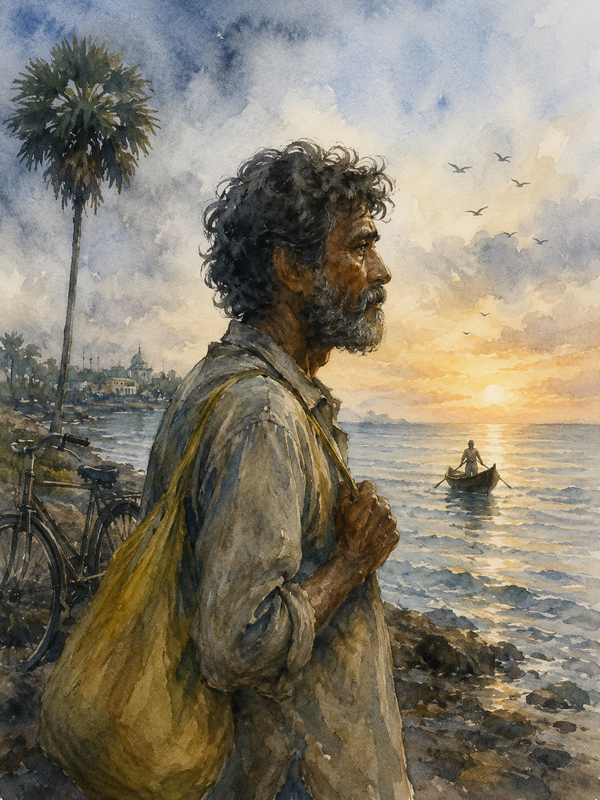
Pempalā’s jet-black complexion reminded Uncle Mustafā of a friend in Sri Lanka. That was why he had bequeathed the name ‘Pempalā’ on the young man who washed up his shore. Gradually, everyone in the village came to like Pempalā. On the day of the Kōṭṭaiyūr sandalwood casket chariot festival, when the flagpole started to tilt and everyone believed that it was a bad omen but no one dared to climb up the pole, Pempalā came forward without a moment’s hesitation, scrambled up the pole with hanks of rope around his neck, leapt on to a nearby bo tree, and secured the flagpole to the bo tree by tying a rope between them. No one could remember if the flagpole in Kōṭṭaiyūr had ever toppled. Grateful for preserving the honor of the village, the jamāt granted him a house in Idiñcamētu.
Pempalā continued, “Mustafā māmā, life and hunger made me learn all sorts of professions. I know fishing, but no one will admit me to the Fishermen’s Society. I know how to build buildings, but I am not welcome at the Masons’ Guild. I know how to cultivate, but I don’t have the means to buy a plot of farming land. No one wants to include me, māmā.”
“Why do you want to leave? Stay here. I will find you a wife,” Uncle Mustafā lit a cigar. The muezzin's face lit up with a hint of hope. “Enough! Having endured my rātā’s wedding is enough to haunt me. I don’t need another one. I am not as agile as I used to be. I have this irresistible urge to go visit my parents’ and my sister’s qabr.
He accepted two cigars from Uncle Mustafā, unrolled them, tucked in some ganja, rolled them back up and retreated to a corner to inhale deeply.
“If you want to go back to your village, you need a passport. What do you have, Pempalā?”
Pempalā said nothing.
Uncle Mustafā noted that a marriage might increase his chances of getting a passport. He suggested a marriage could be arranged between Pempalā and Rāfia, the muezzin’s daughter. But Pempalā did not budge. He appeared immune to all advice.
“In this country, to get on to a train, or to buy sugar at the market, or to travel, you need an identity. Tell me what you have, Pempalā, what was your identity in your country?”
“It is true that I have no one left back home. But it was there that my ancestors were shot at, it was there that they fell down and were buried. At least their qabr remains there, māmā.”
“Pempalā, in this day and age, our own existence and the identity of our ancestors imprinted in this very land, have been called into question. You and I are all under suspicion. It is your identity that will determine who you are and how you are to be treated. Pempalā, what is your identity? What is indeed your real name?
In truth, Pempalā did not even possess a photograph of himself. He had not even seen his likeness in a mirror for a long time. His face had taken on a yellowish tinge, patches of white had started to show up in his curly stubble. Pempalā, inhaled deeply once more, checked whether he still had a box of matches rolled up in his sleeve and started walking towards the sea. As he walked, he cursed the evil night that had toppled his identity. It was a starless night. He walked far away from Uncle Mustafā and the muezzin.
Nagore Hanifa was crooning through a distant loudspeaker: “Having lost mother and father, having herded sheep,
How many trials …”
Two rings of smoke from his cigar rose up and led the way in front of him. Through the rings, he saw a Neynar motorboat at the Kōṭṭaiyūr shore, ready to venture into the sea. A man who looked like Pempalā’s vāppā was very slowly untying the knot that bound the boat to a pillar in the harbor. Pempalā sprinted towards the Neynar boat.
The boat stopped. The old man holding the rudder sat with his back to Pempalā. He was smoking a cigar. Through the rings of smoke, he asked, “Where do you want to go?” Pempalā mumbled incoherently. In his confusion, he could not think of a place name. “Tell me the name of a coastal village and I will drop you off there,” said the old man. The yellow bag Pempalā was holding had no identity document whatsoever. He himself had forgotten his own identity.
The old man looked at Pempalā with pity in his eyes. He cleared his throat and signaled Pempalā to come on board. Pempalā hopped on board and sat down. The boat launched into the sea. It roared forward for days on end, without regard to the time of day, be it midnight or dawn. It appeared as though the boat had a limitless supply of fuel. It kept chasing the ever-retreating horizon, singing songs of the sea. The endless journey exhausted Pempalā. He looked around and found himself surrounded by the sea. Seagulls circled overhead. The boat sped forward as if no shore had been created to welcome and cherish the birds. He felt himself aging, the grey in his hair and stubble slowly expanding. The old man at the helm did not turn around to look at him even once.
About the Author — K. Mohamed Riyas, also known as Anisha Maraikkayar, is a Tamil writer from Kottaipattinam, India. He is currently based in Singapore, where he works as an information technology professional. He is the author of the short-story collections Attar and Sigari Markkam, as well as the novel Effendi.