

By Asela Kuruluwansa
COLOMBO, Sri Lanka — President Anura Kumara Dissanayake said on Thursday that his government would review prison regulations on the treatment of Buddhist monks. The decision follows objections from senior clergy after prison officials removed the robes of Galagoda Aththe Gnanasara Thero, a prominent and divisive monk serving a prison sentence.
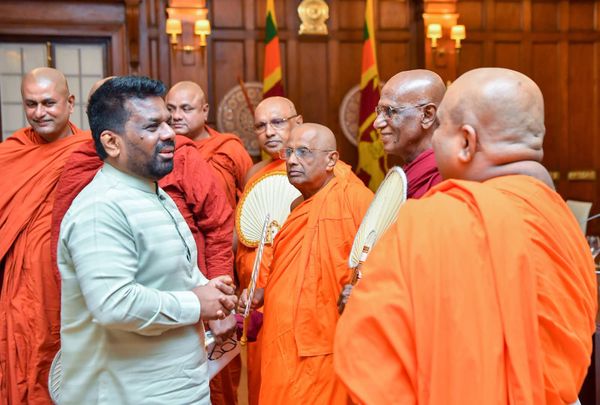
Mr. Dissanayake announced the review after meeting with representatives of the country's four main monastic orders at the Presidential Secretariat. Their leaders had protested after Gnanasara Thero was brought to court in civilian prison clothing instead of his saffron robes.
The president told the monks that he would appoint a committee to examine the rules and recommend changes within two weeks. It will include officials from the Attorney General's Department, the ministries responsible for justice, public administration and Buddhist affairs, and the prison service. The review will cover how monks are treated inside prisons and how they must be dressed when they are taken outside, including to court.
Mr. Dissanayake said the clergy would be consulted before any changes were finalized. He also said he would not issue an order exempting an individual prisoner. If the existing rules were no longer suitable, he told the monks, they should be amended through the proper legal process.
The case touches a sensitive issue in Sri Lanka, where Buddhism has a protected status under the Constitution. The question is whether prison authorities can require an ordained monk to give up his robes when the monastic authorities have not expelled him from the order.
After prison officials removed Gnanasara Thero's robes and issued him prison clothing, senior monks wrote to the Commissioner General of Prisons to object. They argued that only the Buddhist ecclesiastical authorities could decide whether a monk had committed an offense serious enough to warrant expulsion. The matter was then taken to the president.
On Thursday, Mr. Dissanayake said the monks' concerns went beyond conditions inside prison. He said the more pressing issue arose when imprisoned monks were taken out of prison and could be seen by journalists and the public. The review should cover all such occasions as well as court appearances, he said.
He cited the Prisons Ordinance, first enacted in 1877 and amended since, as the main law governing the prison system. Section 94 of the ordinance allows the minister responsible to issue regulations, he said, which gives the government a legal means of changing current practice.
Two cabinet ministers took part in the meeting: Hiniduma Sunil Senevi, the minister for Buddhist, religious and cultural affairs, and Harshana Nanayakkara, the minister of justice and national integration.
The clergy included representatives of the Asgiriya and Malwatta chapters of the Siyam Nikaya and of the Amarapura and Ramanna Nikayas. Among them were Narampanawe Ananda Thero, deputy prelate of the Asgiriya Chapter; Pahamune Sri Sumangala Thero and Mahawela Sri Rathanapala Thero, the chief secretary and deputy secretary of the Malwatta Chapter; Balapitiye Siriseevali Thero and Ahangama Maitreemurthi Thero, the chief secretary and deputy secretary of the Amarapura Nikaya; Attangane Sasanarathana Thero, chief secretary of the Ramanna Nikaya; and Kongasthenne Ananda Thero.