
By Asela Kuruluwansha
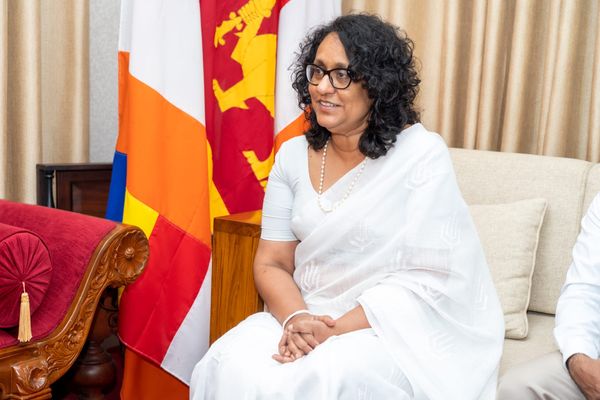
KANDY, Sri Lanka — Prime Minister Harini Amarasuriya accused political opponents on Thursday of giving her special prominence in an effort to portray a split within the governing National People's Power, and said she would not be drawn in.
"Our opponents are giving me special prominence not because they have any affection for me or because they appreciate our policies," she told reporters in Sinhala. "They want to bring an individual into the spotlight and create the impression that there is some kind of division within the movement. We will not fall into those traps."
Ms. Amarasuriya spoke after calling on the chief prelates of the Malwatta and Asgiriya chapters, the two senior Buddhist orders based in Kandy, and receiving their blessings.
Her remarks followed weeks of speculation about her position on the 22nd Amendment to the Constitution, which extends the retirement age of Supreme Court judges from 65 to 67 and of Court of Appeal judges from 63 to 65. Some opposition figures had predicted that her stance would differ from the government's, but she voted with the party. Parliament passed the amendment with 158 votes in favor and 63 against. The day the bill passed, the Leader of the House, Bimal Rathnayake, acknowledged in Parliament what he called a fractional division within the government over the amendment, while saying the opposition could not exploit it.
"I was present when the 22nd Constitutional Amendment was presented to Parliament," Ms. Amarasuriya said on Thursday. "I voted in favor of it and spoke about it. I intervene when necessary, at the appropriate place and in the appropriate manner. I do not speak according to what others want me to say."
"There is no division whatsoever within the National People's Power," she added, describing the alliance as a movement built by many people and created by no single individual.
She also addressed accusations by opponents that the government had neglected Buddhism, which Sri Lanka's Constitution gives the foremost place among the country's religions. She said a recent statement by the Malwatta chapter's chief prelate had answered those claims and that the government had earned it through its conduct.
"We have to demonstrate through our actions the kind of respect we have for Buddhism and the place we accord it," she said. "We will continue along the same path." She added that the government placed no restrictions on followers of other faiths.
Asked whether Galagoda Aththe Gnanasara Thera, the hard-line monk who leads the Buddhist nationalist group Bodu Bala Sena, would be pardoned, Ms. Amarasuriya said the matter belonged with the courts.
"His imprisonment was the result of a judicial process, and a court has delivered its judgment," she said. "We have to seek guidance from the judiciary on this matter."
Gnanasara Thera was arrested on Oct. 4 on warrants issued by the Court of Appeal, the Colombo High Court and the Colombo Magistrate's Court. The next day, the Court of Appeal ordered the prisons department to enforce the remaining period of a sentence imposed on him for contempt of court. A prisons spokesman later said his robes had been removed and that he was being held in a ward for ordinary inmates, a step condemned by an opposition alliance, which said discipline of the clergy belonged to the chief prelates.
He was separately sentenced in January 2025 to nine months in prison for insulting Islam, a ruling the Colombo High Court upheld in June. His lawyer has said an appeal is before the Supreme Court. The monk has been released by presidential pardon before: President Maithripala Sirisena freed him in 2019, less than a year into a six-year sentence for contempt of court.
Ms. Amarasuriya said President Anura Kumara Dissanayake made the right decisions at the right time, with a sound understanding of the country's situation. The president, she said, had stated that the government respected the judiciary, the country's traditions and the Constitution, and he would continue to decide on that basis.