

By Asela Kuruluwansa
KANDY, Sri Lanka — A senior Sri Lankan cabinet minister said on Wednesday that the government needed new antiterrorism powers to prevent a revival of ethnic nationalism. His comments were an unusually direct explanation of the rationale behind legislation intended to replace the country’s Prevention of Terrorism Act.
“Ethnic nationalism is still lurking in our country. It has not disappeared,” said the minister, K.D. Lal Kantha, who holds the agriculture, livestock, lands and irrigation portfolio. “Everyone can see that attempts are being made to revive it whenever an opportunity arises.”
“We will not allow it to resurface,” he said. “Such tendencies must be controlled and stopped.”
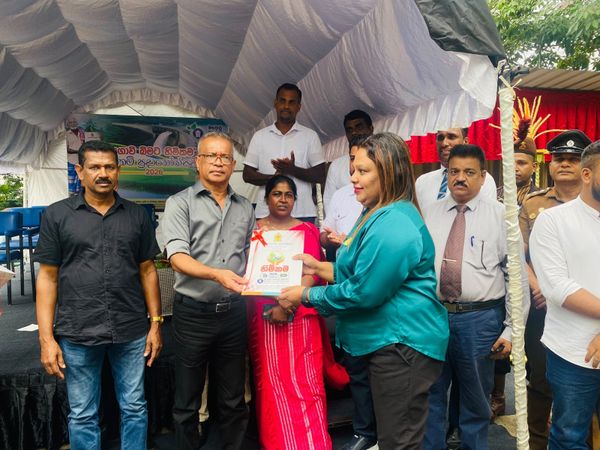
Mr. Lal Kantha did not name any group he considered a threat, and he did not say what kinds of activity the new law would be used against. He was speaking to reporters in Digana, near Kandy, after a ceremony at which land deeds were given to settlers under the Victoria project of the Mahaweli development program.
“The Prevention of Terrorism Act is being repealed and replaced with the proposed Protection of the State from Terrorism Act,” he said. “The new legislation is now open for discussion, and those discussions are ongoing.”
The Prevention of Terrorism Act was introduced in 1979 as a temporary measure and made permanent in 1982. It became one of the state’s main legal tools in the civil war against the Liberation Tigers of Tamil Eelam, which ended in 2009. Human rights groups say the law has allowed people to be held for long periods without trial and has been linked to torture, and that it has been used disproportionately against Tamils and Muslims.
Successive governments have promised to repeal it. Earlier proposed replacements, including an Anti-Terrorism Bill put forward in 2023, were criticized for defining terrorism broadly and for the powers they would have given the security forces. President Anura Kumara Dissanayake’s National People’s Power coalition pledged during its 2024 campaign to abolish the law.
Mr. Lal Kantha is a longtime leader of the Janatha Vimukthi Peramuna, the leftist party at the core of the governing coalition. The party led armed uprisings against the state in 1971 and in the late 1980s.
He said some criticism of the new bill was politically motivated, though he called the debate healthy.
“People with different political agendas are expressing various opinions and criticisms about the proposed legislation according to their respective agendas,” he said. “That is perfectly acceptable. In fact, it is a good thing.”
“Not everything certain individuals say is true,” he added. “They express their views according to their own political agendas. I do the same. I express my views according to our political agenda. That is simply the nature of politics.”
He also defended the government’s record on civil liberties. Demonstrations would be allowed, he said, as long as protesters did not damage public property or cause hardship to the public, and he said the government had not fired “even a single tear gas canister” at any protest in its two years in office.
“Protesting is a right of the people,” he said. “We have fully guaranteed the right of citizens in this country to demonstrate on any issue.”
He said the government would not act against criticism of Mr. Dissanayake. “People are free to hold different opinions about the government. They can even criticize the president,” he said. “We do not concern ourselves with such criticism.”