
By Asela Kuruluwansa
COLOMBO, Sri Lanka — Buddhist monks who had occupied a park in Sri Lanka’s capital for 10 days to demand a presidential pardon for a jailed hard-line cleric suspended their protest on Sunday, after the country’s most senior Buddhist prelates said they had intervened with the government and cautioned that the demonstration was being used to tarnish the reputation of the clergy.
In a joint letter dated Sunday, the four chief prelates of Sri Lanka’s three main monastic orders said they had made “the necessary intervention” with the government to resolve the case of the cleric, Galagoda Aththe Gnanasara Thero, “through lawful means and discussion.”
The letter was addressed to the monks taking part in the protests. It warned that “certain groups” were exploiting some of the demonstrations to damage the high regard in which monks are held in Sri Lankan society and internationally, and said all monks had a duty to deny them that opening.
The monks at Viharamahadevi Park in central Colombo decided on Sunday evening to temporarily suspend their sit-in after the prelates told them they would hold talks with the government to secure Gnanasara’s release through legal means.
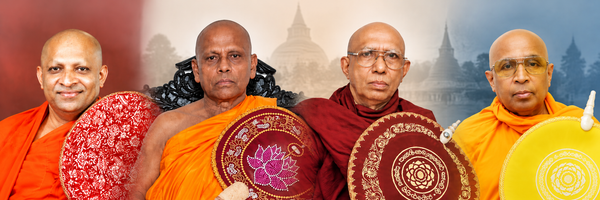
The letter was signed by the Most Venerable Tibbatuwawe Sri Siddhartha Sumangala, chief prelate of the Malwatte chapter; the Most Venerable Warakagoda Sri Gnanarathana, chief prelate of the Asgiriya chapter; the Most Venerable Karagoda Uyangoda Maithri Murthi, supreme chief prelate of the Amarapura order; and the Most Venerable Makulewe Sri Wimala, chief prelate of the Ramanna order. The prelates, based mostly in the central city of Kandy, carry considerable moral and political weight in a country where about 70 percent of the population is Buddhist.
The body of the letter did not call for a pardon, the protesters’ central demand. Instead, it urged monks of every order to resolve any crisis “in accordance with the Dhamma and the Vinaya,” the Buddha’s teaching and the monastic code of discipline, and to protect the unity of the Sangha, the community of monks.
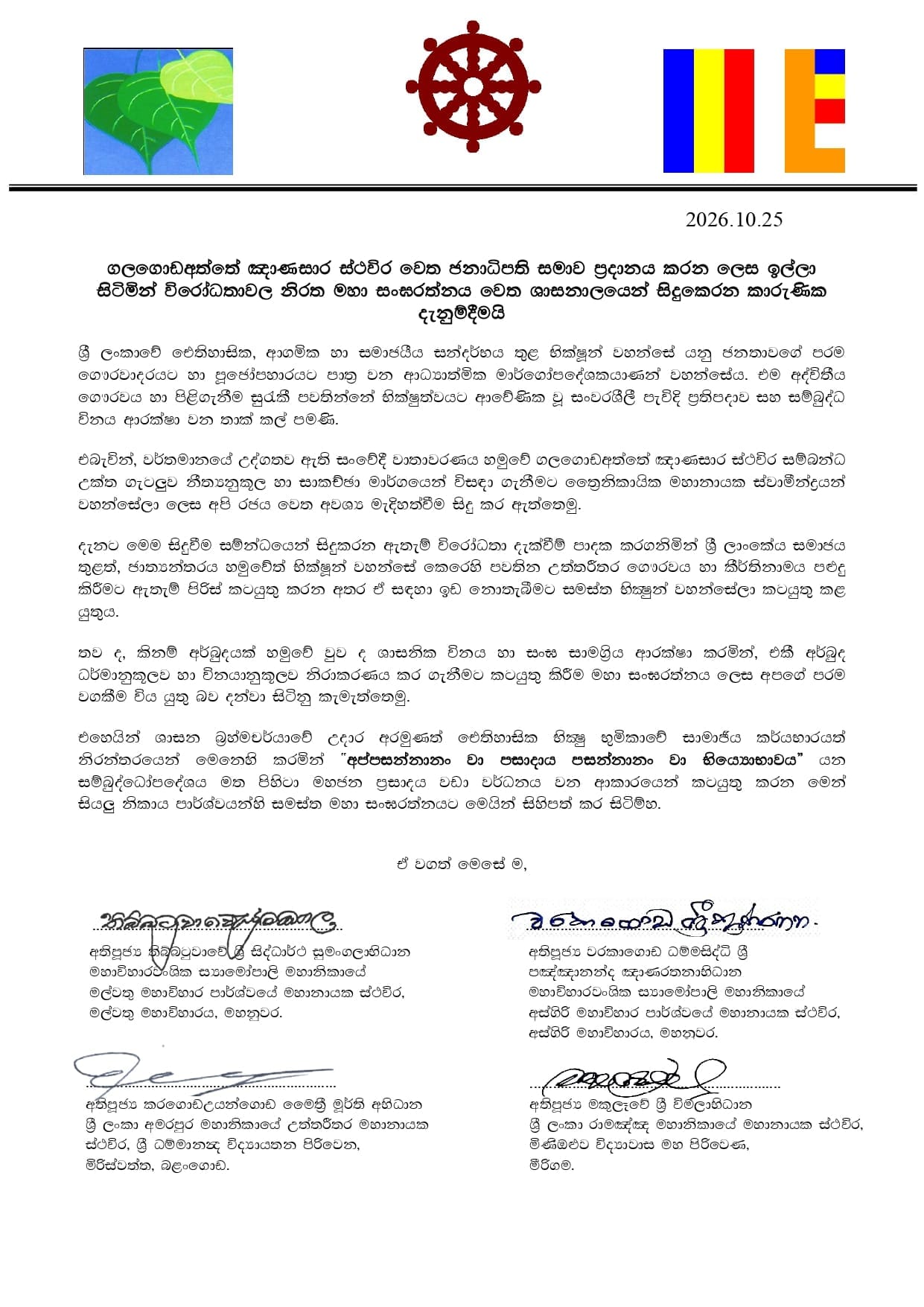
“In Sri Lanka’s historical, religious and social context, the bhikkhu is the spiritual guide who commands the highest reverence of the people,” the prelates wrote. That respect endures, they added, “only for as long as the disciplined monastic life and the Buddha’s Vinaya are protected.”
The prelates’ tone differed from May 2024, when the chief prelates of the same chapters jointly asked the president at the time, Ranil Wickremesinghe, to pardon Gnanasara after he was sentenced to four years in prison for a 2016 speech threatening a Muslim religious site at Kuragala.
Gnanasara, 51, is the general secretary of the Bodu Bala Sena, or Buddhist Power Force, a Sinhalese Buddhist nationalist group he helped found in 2012. The group led a campaign against Sri Lanka’s Muslim minority, and a rally he addressed in the southern town of Aluthgama in June 2014 was followed by deadly anti-Muslim riots. In 2021, the former president, Gotabaya Rajapaksa, appointed him to head a presidential task force on a “One Country, One Law” policy.
He was returned to prison this month to serve the remainder of a six-year sentence for contempt of court. The case stems from a 2016 hearing at a magistrate’s court in Homagama, outside Colombo, into the disappearance of Prageeth Ekneligoda, a political cartoonist and journalist who vanished in January 2010. Gnanasara was accused of disrupting the hearing and intimidating Mr. Ekneligoda’s wife, Sandya Ekneligoda, who has campaigned for years to learn what happened to her husband.
The Court of Appeal convicted him in August 2018 on four counts of contempt and sentenced him to six years of rigorous imprisonment. He served about nine months before the president at the time, Maithripala Sirisena, pardoned him in May 2019.
On Sept. 10, the Supreme Court ruled that the pardon was legally invalid. The Court of Appeal ordered on Oct. 5 that his sentence be reactivated, after earlier issuing an open warrant for his arrest. Two days later, the Colombo High Court upheld a separate nine-month sentence imposed on him in January 2025 over remarks about Islam that a court found had promoted discord between Muslims and Sinhalese. His lawyers have challenged that ruling in the Supreme Court.
His supporters say the punishment is unjust. Sarath N. Silva, a former chief justice, told a gathering of the All Ceylon Buddhist Congress on Oct. 12 that the six-year sentence exceeded what the law permits and defended Mr. Sirisena’s pardon.
The imprisonment has also stirred anger among clergy over the treatment of jailed monks. Gnanasara was brought to court in civilian clothes rather than his saffron robes, and the protesting monks made the disrobing of imprisoned clergy a central grievance during their march from Kandy to Colombo. The Court of Appeal has put off petitions challenging the removal of his robes until Nov. 18.
The protesters reached the Presidential Secretariat in Colombo on Oct. 15. After a court order barred them from remaining there, they moved to Viharamahadevi Park on Oct. 16 and began what they called a satyagraha, a nonviolent sit-in. Police later read out an order from the Colombo chief magistrate directing them to leave the park, and on Friday the magistrate refused the monks’ request to lift it. The monks stayed.
One of the protest leaders, Balangoda Kassapa Thero, had escalated the dispute last week, declaring that President Anura Kumara Dissanayake had only two options: resign or pardon Gnanasara.
Mr. Dissanayake, whose National People’s Power coalition won power in 2024 promising to apply the law equally to all, has not granted a pardon. It was not immediately clear when the prelates’ talks with the government would take place or what outcome they would seek.