By Sidhartha Thamby
Every society that has passed through large-scale political violence carries the obligation to reckon with it honestly. That Sri Lanka shares this condition with dozens of other countries is not a reason for complacency — it is a reminder that resolution is possible because others have achieved it, and that failure is not inevitable.
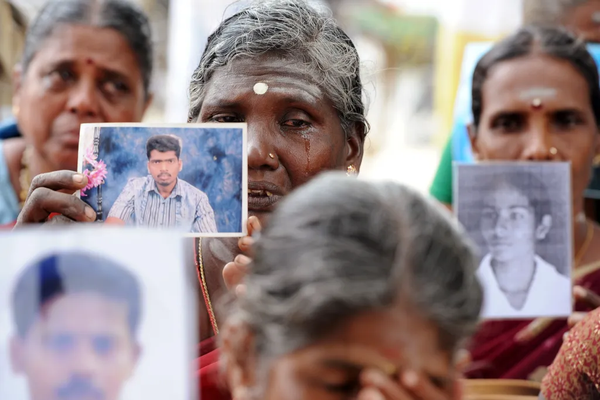
More than seventeen years after the Sri Lankan military crushed the Liberation Tigers of Tamil Eelam in a brutal final campaign, the country has still not honestly confronted what happened — or why. No credible legal process has examined the conduct of either side. The constitutional structures that enabled decades of majoritarian discrimination remain largely intact. A generation of schoolchildren has grown up without a shared understanding of the conflict. And the families of the disappeared — mothers who filed paperwork in the 1980s and 1990s and have been waiting ever since — are older now. Some have died waiting.
This is not a history of the conflict. It is an argument — organised around four demands that the record makes unavoidable. Each is grounded in specific events and specific failures. None of them is novel. All of them remain unmet.
I. A CONSTITUTION THAT MEANS WHAT IT SAYS
The structural roots of the Sri Lankan conflict run through its constitutional history. The Sinhala Only Act of 1956 — passed just eight years after independence — stripped Tamil civil servants of their language rights overnight and is widely regarded by scholars as a founding moment of ethnic alienation. The 1978 constitution concentrated executive power in a president elected by a majoritarian vote, leaving minority communities with virtually no structural veto over the policies that governed their lives. The All Party Representative Committee, convened in 2006 to find a negotiated political solution, produced in its Committee C report a detailed mapping of these structural exclusions — a record of minority grievances that the political class commissioned and then set aside.
What is required is a constitutional framework that prevents discrimination driven by majoritarianism — one with teeth, not merely aspirations. This is not about giving one community an advantage over another. It is about building a state whose rules apply to everyone, and whose institutions are structurally incapable of weaponising the majority against the minority.
Comparative constitutional scholars point to power-sharing models — Belgium's linguistic community councils, Switzerland's Federal Council, Northern Ireland's mandatory coalition — as designs that compel majorities to govern with minorities rather than over them. Sri Lanka has never adopted such mechanisms.
II. ACCOUNTABILITY — ALL PARTIES, ALL CRIMES
The final campaign of 2006 to 2009 produced suffering of an order that is well-documented and insufficiently acknowledged. A UN Panel of Experts estimated in 2011 that tens of thousands of civilians may have died in the war’s final months. That estimate rests on a longer evidentiary foundation: the University Teachers for Human Rights (Jaffna), whose reports documented disappearances, extra-judicial killings, and the fate of surrendered combatants across every phase of the conflict from the 1980s onward; and the 1993 volume The Broken Palmyrah, compiled by the Faculty of Science at the University of Jaffna, which remains among the earliest systematic accounts of civilian deaths and displacement under military occupation in the north.
Accountability must be pursued through credible legal mechanisms. This accounting must encompass children conscripted who never came back; the unmarked graves; the thousands of reported disappearances that remain officially unresolved; those tortured, illegally incarcerated, or raped; those who lost their property; and the thousands who fled as stateless persons or refugees.
This demand applies to all parties. The Tamil community must also reckon, within itself, with what was done by the LTTE to their own people — forced recruitment, the assassination of Tamil political opponents, the deliberate targeting of moderate Tamil leadership. Presidential Commission reports — including those convened after the assassinations of Tamil political figures in the late 1980s and 1990s — named these acts, took testimony, and produced findings that were never meaningfully acted upon. The South must undertake an equivalent reckoning with what was done in its name.
Sri Lanka’s domestic accountability mechanisms — flowing from the Lessons Learnt and Reconciliation Commission of 2010 — require closure. The LLRC collected thousands of depositions from survivors, displaced persons, and witnesses across the north and east. Those depositions constitute a public record: named individuals describing specific events, specific locations, specific perpetrators. They were heard. They were transcribed. They have not been acted upon. Many public officials — in the civil service, in the humanitarian agencies, in the ICRC and the UN — performed extraordinary service under the most constrained of circumstances during the final campaign. Their contributions are part of the record. So are the crimes committed within the fog of that campaign.
III. A POLITICAL CULTURE FIT FOR A PLURAL SOCIETY
Perhaps most fundamentally, a political culture must be built — through education, through civic institutions, through the example of leadership — that is capable of treating pluralism not as a problem to be managed but as the constitutive condition of Sri Lankan identity.
Research on post-conflict societies consistently finds that textbooks, curricula, and public commemoration shape whether the next generation inherits grievances or alternatives. Sri Lanka's school system has historically operated with separate Sinhala and Tamil-medium curricula carrying little shared civic content. The children graduating from those schools become the voters, officials, and community leaders of the next decade.
The mass uprising of 2022 — what protesters called the Aragalaya — demonstrated that a cross-ethnic generation exists and is capable of solidarity across communal lines. It also demonstrated how quickly economic crisis can expose the political fault lines that pluralism reforms were supposed to address. A political order that cannot treat this generation's demands seriously risks being swept aside by forms of change it will not be able to direct.
IV. ATONEMENT — THE OBLIGATION THAT ACCUMULATES
This is the dimension of the reckoning that legal mechanisms and constitutional frameworks cannot reach alone. Our faiths — all of them — prescribe a collective atonement, an addressing of the souls of the departed. That obligation does not dissolve with time. It accumulates.
The dead of this conflict — Sinhalese, Tamil, Muslim; civilian and combatant; killed by the state, by the LTTE, by paramilitaries, by circumstance — belong to communities that still carry them. The mothers in the East who registered disappearances in the 1980s and 1990s are older now. Some have died without knowing what happened to their sons. The UTHR (Jaffna) reports, published at considerable personal risk to their authors over more than two decades, recorded many of these cases by name — not as statistics, but as individuals with families, histories, and unanswered fates. That is not a historical fact at a safe distance. It is a present condition of Sri Lankan life.
Other societies have found their own forms for this acknowledgment. South Africa's Truth and Reconciliation Commission grounded its framework not in liberal legalism alone but in the concept of ubuntu — collective humanity — making it culturally legible in ways that purely prosecutorial mechanisms were not. Germany built its reckoning across decades through education, memorial culture, and the steady work of civic institutions. Argentina's Mothers of the Plaza de Mayo kept the question of the disappeared alive for a generation until the state could no longer ignore it. Rwanda, imperfectly and under enormous strain, attempted the gacaca community courts. None of them found a perfect form. All of them found that attempting it was better than not attempting it.
THE QUESTION THE RECORD REFUSES TO STOP POSING
We should not be complacent about what failed to be prevented. But neither should we be paralysed by it.
The history of this conflict is not only a history of political failures, institutional cowardice, and atrocity. It is also a history of people — named and unnamed — who acted with courage and conscience under conditions designed to make such conduct difficult. The generation that burned the Jaffna Library in 1981 and the generation that sheltered Tamil neighbours during the anti-Tamil pogroms of 1983 were formed by the same society.
That society produced both.