

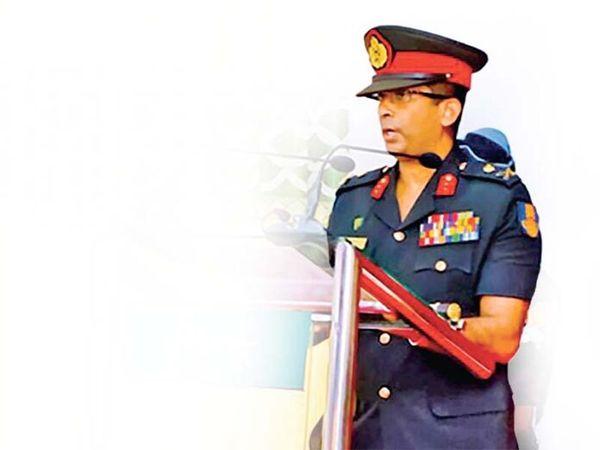
COLOMBO, Sri Lanka — Sri Lanka’s former military intelligence chief, retired Maj. Gen. Suresh Sallay, has begun a hunger strike while in police custody, according to Udaya Gammanpila, a former member of Parliament who has also acted as one of his lawyers.
Speaking at a news conference that he said had been convened at the request of Sallay’s wife and son, Mr. Gammanpila said the retired officer had resorted to the protest over conditions in detention.
Mr. Gammanpila said Sallay’s son visited him on Saturday morning and found him in a distressed state.
By that account, Sallay was served only a small portion of rice and radish curry for dinner on Friday, placed on a sheet of newspaper on the floor of his cell; the meal spilled as he tried to lift it. Distraught, Mr. Gammanpila said, Sallay refused to eat and resolved that night to begin a hunger strike, and has since declined water and medication as well. The officer told his son he was being treated "worse than a dog," Mr. Gammanpila said, and would rather die than continue to face what he called false accusations and degrading conditions.
The hunger-strike claim follows weeks of escalating complaints from Sallay's camp about his confinement. His supporters have alleged that he is held in a rat- and cockroach-infested cell beside a foul-smelling toilet, and that his migraine condition has worsened for lack of consistent medication. The police have neither substantiated nor rebutted those specific claims.
Sallay, who led Military Intelligence during the civil war and rose to direct the State Intelligence Service after Gotabaya Rajapaksa won the presidency in late 2019, was arrested by the Criminal Investigation Department in the Colombo suburb of Peliyagoda on Feb. 25 and is now held under a 90-day detention order issued under the Prevention of Terrorism Act. Investigators accuse him of conspiracy and of aiding and abetting the coordinated suicide bombings of three churches and three hotels, which killed at least 269 people. He is the third suspect held in the case, and has consistently denied any role.
In a writ petition challenging his detention, Sallay says he was posted to Sri Lanka's High Commission in Malaysia from 2016 to 2018 and was attending a defense course at India's National Defence College for most of 2019 — including on April 21, when the bombs detonated — and that he held the rank of brigadier at the time, before his later elevation to the country's top intelligence post. No investigative report into the attacks, he argues, recommended action against him.
The detention has become a political flashpoint. Allies of the former Rajapaksa government — among them Mr. Gammanpila, the former lawmaker Sarath Weerasekara, and Mr. Rajapaksa's former defense adviser Rohan Gunaratne — have cast it as a politically motivated reprisal against an officer credited with helping to defeat the Liberation Tigers of Tamil Eelam, several questioning the credibility of the testimony behind it. Mr. Gammanpila has gone further, accusing the government of staging a "theatrical performance" to divert attention from an unrelated coal-procurement scandal.
The most prominent of those critics has been Ali Sabry, the former foreign minister, who warned soon after the February arrest that it was a "deeply troubling day" for the Sri Lanka Army and its intelligence corps. Officers who once risked their lives to protect the country, he wrote on X, were being drawn into a "political battlefield shaped less by evidence and more by competing narratives." Accountability under the law was essential in any democracy, he said, but it had to be pursued "with fairness, restraint, and respect for institutional integrity." The tragedy deserved a professional, evidence-based inquiry; instead, he argued, it was being turned into a "public spectacle."
Mr. Sabry also questioned the value of reopening the inquiry, asserting that extensive international cooperation — including by the U.S. Federal Bureau of Investigation — had already taken place, and that external partners had signaled that further probes might yield little. Pressing the matter for partisan advantage, he warned, risked damaging Sri Lanka's credibility and its security interests.
Mr. Sabry served as justice minister and later foreign minister under Mr. Rajapaksa, in whose government Sallay rose to lead the State Intelligence Service, and he had defended the officer's wartime record from within the cabinet. In 2019, in the aftermath of the bombings, he urged Muslim voters to back Mr. Rajapaksa, who won that November after promising to crush Islamist extremism. Mr. Sabry has also invoked his own authorship of the very statute now used to hold Sallay, saying he introduced an amendment granting Prevention of Terrorism Act detainees judicial access after twelve months — a reform he credits with sharply reducing the number held under it.
On Saturday, as word of the hunger strike spread, Mr. Sabry returned to the matter obliquely. In a Facebook post carrying no commentary of his own, he quoted a 1935 opinion of the United States Supreme Court on the duty of a prosecutor:
"The United States Attorney is the representative not of an ordinary party to a controversy, but of a sovereignty… whose interest, therefore, in a criminal prosecution is not that it shall win a case, but that justice shall be done… He may prosecute with earnestness and vigor, indeed, he should do so. But, while he may strike hard blows, he is not at liberty to strike foul ones."
The passage, from Justice George Sutherland's ruling in Berger v. United States, carried no name and named no target. But posted by one of the prosecution's loudest critics, on the day the hunger-strike claim surfaced, it read as an unmistakable if oblique rebuke — a reminder, in the language of another country's courts, that the state's interest is meant to lie in justice rather than in winning.
The case against Sallay traces largely to a 2023 Channel 4 documentary, in which Azad Maulana — a former aide to Sivanesathurai Chandrakanthan, the ex-eastern provincial leader known as Pillayan — alleged that Sallay had met the bombers' leader, Zahran Hashim, before the attacks and allowed them to proceed to sway that year's presidential election. Sallay has called the claim false, and Mr. Maulana has produced no documentary corroboration.
President Anura Kumara Dissanayake, elected in 2024 partly on a pledge to complete the Easter investigation, has made the case a priority, and Sallay's detention is the first of a senior defense figure under his administration. Cardinal Malcolm Ranjith, the archbishop of Colombo, whose church bore the heaviest losses, has welcomed it as a breakthrough, and his counsel now represents the victims at hearings. Appearing for the attorney general last month, Additional Solicitor General Dileepa Peiris told a Colombo court that the bombings could not have been carried out without organized internal support and described Sallay as the principal operational force behind them — an account the defense rejects.