

By Sidhartha Thamby
The Dividends to Reap from State Land
According to the Land Commissioner General’s Department (eSlims, as at 7 February 2022), 123,141 land use permits have been issued against a total of 401,000 families in the province. The number eligible to receive permits in 2022 stood at 40,782, with 6,040 permits still unused.¹⁰
All permits ultimately flow through the Governor’s office for processing before titles are issued by the Director General of Lands in Colombo — a labour-intensive sequence that encompasses title settlement, land-use inspection, application verification, surveying, and document uploads.
A previous Governor identified the bottleneck clearly: he recommended creating a specialised provincial cadre of development officers, trained and assigned to divisional, district, surveyor’s department, and provincial land commissioner levels respectively.
He also requested the Water Board to identify reservoir locations in four of the five districts — one reservoir already exists — and the Forest Department to initiate forest cover in support of each. The Water Board identified the locations and moved papers to the Forest Department. There, progress stalled.
Just over a quarter of families in the province are nominal beneficiaries of state land. Understanding the law is therefore not academic — it determines what those families can actually claim. The lot sizes matter too: none falls below an acre, which shapes what “optimal use” even means.
What the Governor Can — and Cannot — Do
Under the 13th Amendment to the Constitution, the Provincial Council List — the 9th Schedule — assigns land settlement, land use, and land development to the province. The Governor, acting on the advice of the Board of Ministers, can assent to provincial statutes on these subjects, approve land settlement programmes, and allocate state land within the province for agricultural, housing, and industrial purposes.
Under Article 154B(4), a Governor may act in individual discretion — without ministerial advice — when directed by the President to do so. Under Articles 154B(5) and (6), when a province falls under Governor’s Rule, the Governor exercises direct executive power over state land, grants, and allocations that would otherwise require a Cabinet mandate. The Land Acquisition Act and the Land Development Ordinance remain central statutes. Whatever the Governor can do, the Governor cannot override national land policy.
Subject to the relevant checks and balances, there is a significant dividend to be gained from exercising the land powers available under the 13th Amendment. This was demonstrated in practice by a former Governor who not only convened meetings within the Province but also chaired discussions at the Lands Ministry, bringing together all mandated stakeholders to address land use and availability in the Province from a centrist perspective. Whether such an approach will be seen again in the near term remains an open question. The Central Subject Minister clearly held no reservations. The Governor holds protocol status equivalent to that of a Cabinet Minister.
Liability to the State and impact on Thesavalamai
Sri Lanka’s Land Acquisition Act No. 9 of 1950 is unambiguous: the State may acquire private land, but it must pay — market value, interest from the date of possession, and compensation for injurious affection to remaining land. These are legal obligations, not requests. What the Act scandalously omits is any solatium premium for the involuntary nature of the taking, any livelihood compensation for destroyed incomes, any penalty for deliberate non-payment, and any requirement to pay before taking possession. Practically, scores of landowners have written to numerous offices seeking answers for decades; in many instances even a basic acknowledgement has not been forthcoming. It is tardy, insensitive and arrogant .
Land appropriation in the Northern Province strikes at the very core of Thesavalamai — a customary legal code codified in 1706 and still operative today as both a personal and territorial law. Unlike ordinary property, land governed by Thesavalamai carries layered entitlements rooted in succession, mudusom rights, and matrilineal inheritance that cannot simply be compensated by market-value assessments. When the State takes possession of such land — often without prior payment under Section 38A of the Land Acquisition Act — it disrupts not merely ownership but the entire web of customary inheritance, family continuity, and community identity that Thesavalamai protects. Displacement severs the evidentiary chain of title, renders oral and customary claims near-impossible to prove, and leaves families permanently outside the formal legal system they were entitled to invoke.
The State’s exposure is both immediate and compounding. Taking possession before paying compensation creates an ongoing legal wrong — statutory interest accrues at inadequate rates while real value erodes, consequential economic losses go unaddressed, and affected owners retain rights to challenge valuations before the Board of Review, the Court of Appeal, and in fundamental rights applications under Articles 12(1) and 14 of the Constitution. International benchmarks, including decisions of the European Court of Human Rights, have held that delay in payment alone can independently constitute a violation of property rights.
The Numbers on the Ground: Acquisitions and Releases
The military presence did not begin with the war. The Jaffna International Airport — established at Palaly by the British Royal Air Force during the Second World War and later developed as a civilian and military base — became the nucleus of a progressively expanding security perimeter.
Between 1990 and 2009, the military appropriated 11,629 acres in the northern tip of Sri Lanka to create the Palaly High Security Zone, evicting residents of Tellipallai and surrounding communities. The High Security Zone in Valikamam North gradually absorbed agricultural land, fishing settlements, and residential properties. Tens of thousands of Tamil civilians were ordered to vacate — sometimes within hours — as the security forces consolidated their hold following Operation Riviresa in 1995.
According to President Sirisena’s office, at the conclusion of the civil conflict in 2009, approximately 84,675 acres of Tamil civilian land were under military control. By the end of March 2019, 71,178 acres had been released in total — leaving roughly 13,497 acres still with security forces, of which 11,039 acres were identified as state-owned.
The Rajapaksa government released 5,255 acres between October 2010 and the end of 2014, while the Sirisena–Wickremesinghe Yahapalana government released 1,000 acres in just the first few months of 2015. By December 2017, the Sri Lanka Army had released a cumulative total of 55,510.58 acres of private and state land across Jaffna, Kilinochchi, Mullaitivu, Mannar, and Vavuniya in the Northern Province. Intent, it turns out, matters enormously.
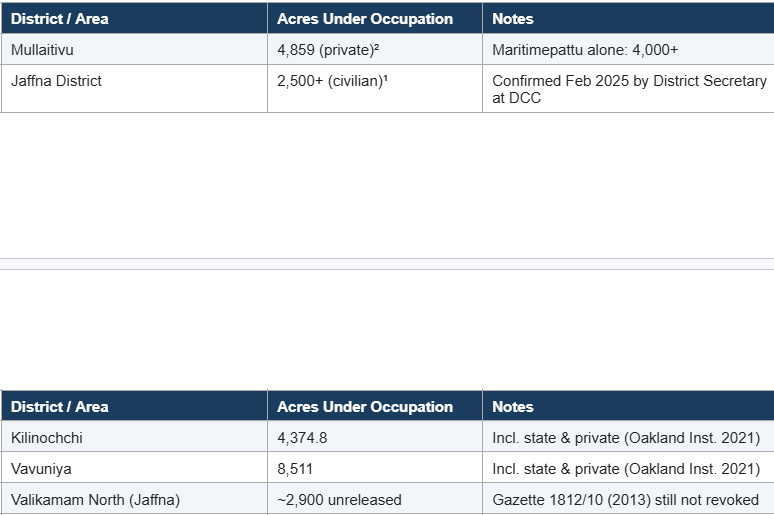
As of February 2025, Jaffna District Secretary Maruthalingam Pratheepan confirmed at the District Coordinating Committee meeting — in the presence of President Anura Kumara Dissanayake — that the Sri Lankan military continues to occupy more than 2,500 acres of civilian land in Jaffna District alone. At the same meeting, it was disclosed that the Sri Lanka Air Force continues to hold 1,009 acres of Tamil-owned land in Jaffna under the Civil Aviation Authority’s control, affecting 643 landowners.
A Right to Information request to the Mullaitivu District Secretariat separately revealed that 4,859 acres of privately-owned land remain under military occupation in Mullaitivu, with the Maritimepattu division alone accounting for over 4,000 of those acres. The government reported returning only 86.24 acres of private land in the North during 2025 — a pace that, if maintained, would take generations to resolve the backlog.
Current Land Occupation Status (2025)
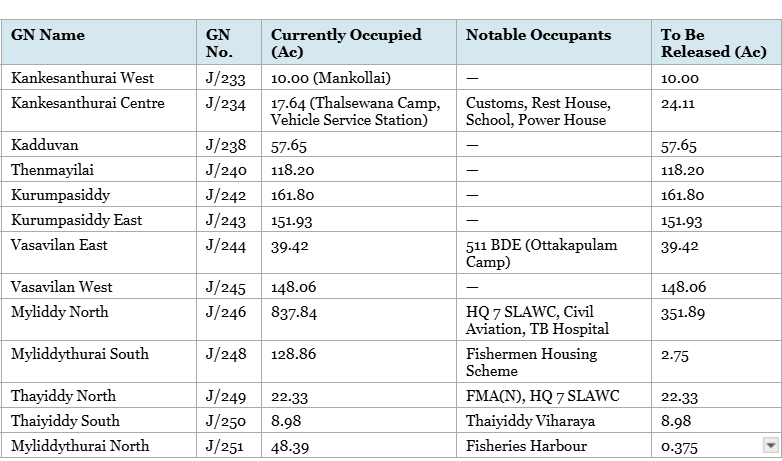
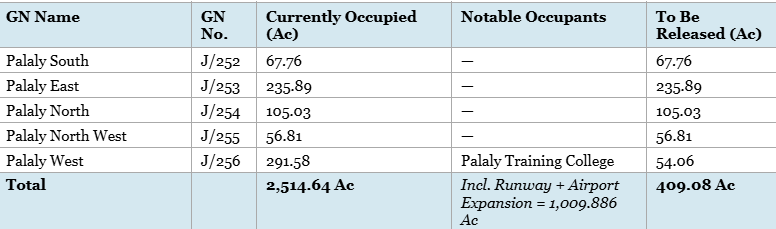
Land Currently Occupied by Army & Air Force — To Be Released
Total occupied: 2,514.64 Acres | To be released: details below
The Palaly Corridor: A Case Study in Complexity
The Valikamam North land schedule — drawn from the Divisional Secretariat’s own records — lays bare how the appropriation was structured and why it resists easy resolution. Across 18 GN divisions in the Kankesanturai–Palaly corridor, the total occupied footprint stands at approximately 2,514 acres. Within that figure, private land, state land, army camps, air force installations, civil aviation authority land, a TB hospital, a fishermen’s housing scheme, and a women’s army corps headquarters coexist on what were once civilian fields and homesteads.
In early 2024, the Ministry of Ports, Shipping and Aviation called Expressions of Interest for the expansion of Jaffna International Airport, with the Ministry Secretary confirming the goal was to accommodate wide-body A330 aircraft. The current runway of 1,400 metres handles only ATR 72 regional flights; an A330-capable runway would require at least 3,200 metres plus safety overruns. If that expansion proceeds, it will require resolving land tenure over hundreds of acres in the Palaly corridor — land that is simultaneously claimed by the military, listed for release, and still subject to unrevoked gazette notifications.
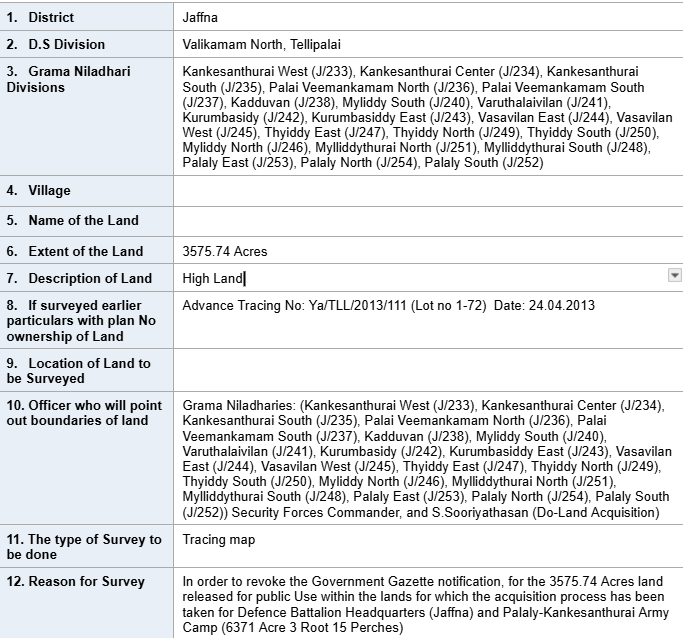
The gazette notification at the heart of the Valikamam North problem was issued in April and May 2013, formally acquiring 6,371 acres, 1 rood and 15 perches for a Defence Battalion Headquarters. Landowners took the state to the Supreme Court. 3575.74 acres within the acquired land was subsequently released.
In January 2023, at a discussion chaired by the President, an order was issued to revoke the notification. Letters followed — from the Divisional Secretariat to the Senior Land Surveyor, from the district to the Ministry of Tourism and Lands in Battaramulla — requesting tracing maps and procedural guidance. As of 2025, the gazette has not been revoked, the surveys have not been completed, and the land has not been returned.
File No: LLD/DO(J)/LA/PAL/01-01-survey requisition to release 3575.74 Acres
Illegal Occupation by the Administration Itself
The land problem in Jaffna is not only about the military. The administration’s own buildings have compounded the crisis. A review of Divisional Secretariat offices in Jaffna District found that 13 out of 16 DS buildings are constructed on — or in illegal occupation of — private land.
Divisional Secretariat Offices: Land Occupation Status — Jaffna District (Selected)
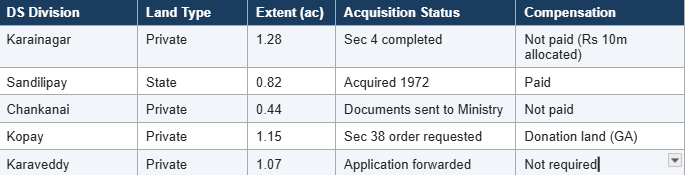
In at least one instance, a court ordered the administration to cease occupation, vacate the premises, and hand over the property. The administration did the reverse.
What Needs to Happen
The longer these grievances remain unaddressed, the more they calcify into structural liability. Tens of thousands of LDO permit holders and poverty-qualified families already carry legally cognisable entitlements under the 13th Amendment.
Legislative reform along the lines of India’s 2013 Land Acquisition Act — mandating solatium, rehabilitation, and consent mechanisms — is increasingly the comparative benchmark courts and advocacy bodies invoke.
Resolving these claims proactively is far less costly than contesting a growing body of litigation, and far less damaging than the reputational and constitutional consequences of a State seen to systematically undermine the customary rights of an entire community.
The constitutional framework is, for the most part, adequate — which makes it imperative it’s used. The Governor holds genuine powers over land settlement, allocation, and development planning and must show allocation of lands for development. The landless poor have waited through multiple administrations. Old permit lands must be recycled. Land use planning — the kind that designates development sites, habitats, forests, and a provincial green agricultural and environmental land bank — must become a reality.
The 2013 gazette notification was not revoked when the President ordered it in January 2023. Revoking the gazette, completing the surveys, and publishing the results are not complex asks — they are the minimum the state owes landowners who went to the Supreme Court and won a presidential order in their favour.
The tri-services and Police have legitimate tenure needs too; there is enough state land to accommodate them without keeping a single acre of private land off the table. The Palaly airbase, other tri-services detachments, Police Department facilities, the naval facility at Kankesanthurai, and a coast guard presence in the north constitute legitimate security requirements and should be accommodated from state lands.
The army should be right-sized for genuine threats: a highly capable rapid reaction force; strengthened naval and coast guard capacity for maritime threat response; and an intelligence apparatus reoriented from Tamil political monitoring toward maritime domain awareness, counter-narcotics, and counter-radicalisation. Regional security cooperation — with India, the Maldives, and through multilateral frameworks — should replace the inward-looking garrison model.
The argument that reconciliation and demilitarisation of the north are concessions to Tamil nationalism inverts the strategic logic. Political legitimacy — earned by addressing genuine grievances — is ultimately the most durable form of national security.
The provincial cadre of land development officers — recommended by a previous Governor, apparently never actioned — is the kind of thing that costs very little and signals a great deal. Its absence speaks for itself. Where the state occupies private land for its own offices illegally without paying compensation, it must regularise its position — or vacate.
Courts’ orders must be obeyed. Human Rights Watch and Tamil civil society organisations have repeatedly documented the gap between government promises and delivery; that gap cannot be explained away by bureaucratic complexity alone.
The airport expansion ambition is legitimate and potentially transformative for Jaffna’s economy. Similar considerations would occur in Vavuniya airfield and remnants in Mannar. But it cannot be built on a foundation of unresolved land claims. If the state wants to develop Palaly into an A330-capable hub, it must first complete the business it began in 2013: survey, gazette revocation, title settlement, and compensation. In that order.
The land question in the North is not unsolvable. The data exists. The legal authority exists. The administrative procedures exist. What has been missing, in too many administrations, is the sustained political will and Executive stewardship to see them through.