
By Jeevan Thiagarajah
Few countries carry as much history to the square kilometre as Sri Lanka. More than 250,000 archaeological sites have been identified. Eight places are on the World Heritage list. The forest meditation monasteries of Ritigala and Arankele, the Pancha Ishwarams of Shiva on our coasts, the Dutch-era Wolvendaal Church, the Ketchchimalai Mosque at Beruwala where Arab traders are said to have first landed, and Sri Pada, venerated by Buddhists, Hindus, Christians and Muslims alike: all of this lies on one small island. Behind it stands a Department of Archaeology whose record of survey goes back to 1890, one of the longest in South Asia.
Yet a pilgrim, a schoolchild or a visitor from abroad with a phone in hand still cannot find most of these places, learn their story, or see the objects taken from them. That is not a reason for lament. It is the size of the opportunity. Much of the hard work, the scholarship, the restoration and the devotion, has already been done. What remains is to connect it, open it up and celebrate it. Here is what that could look like.
One register, one map, every site
Imagine a single national register in Sinhala, Tamil and English, in which every site has a permanent number, a GPS pin, a photograph and a history. A "near me" button for the family planning a weekend outing. A QR code at the gate that brings up the site's story and an audio guide in the visitor's own language. A citable record for the scholar. A quick check for the planner, who can see before approving a road or a quarry whether a protected site lies in its path.
None of this needs to be invented. England's national list holds over 400,000 entries, published openly as map data. Arches, the software behind many such registers, is free and open-source. The one safeguard we must build in is that the exact locations of unguarded ruins stay restricted, so that the map serves visitors and not looters.
Bringing objects home
Some of our most beautiful heritage sits far from the place that gave it meaning. The Nataraja and Uma-Maheshvara bronzes excavated at Polonnaruwa's Siva Devale No. 1 are in the Colombo National Museum. Every museum object can be linked, online and on the ground, to the site it came from, and every site to its objects. The Department's 27 archaeological museums, the National Museums and the Central Cultural Fund's site museums can become stops on the journey rather than separate destinations.
Kerala has shown how this works. Its Muziris Heritage Project ties the Pattanam excavations to more than 25 museums, heritage walks and boat routes, with nineteen state departments working as one. Mantai, Seethawaka, Kantarodai and Beruwala could each have a small interpretation centre of the same kind.
Trails people want to finish
Japan's Shikoku pilgrimage links 88 temples on a 1,200-kilometre circuit. Pilgrims carry a stamp book and receive a certificate at the end, and scattered temples have become a journey people want to complete. Sri Lanka has the material for a dozen such trails: the Solosmasthana, the sixteen sacred places of Buddhism; a meditation trail through the forest monasteries and cave hermitages of the dry zone; a Sri Lankan Sivan trail of eleven Shiva temples; the heritage mosques of the west coast; the feasts of Madhu, Talawila and Kochchikade; the royal capitals from Anuradhapura to Nallur; the forts of the coast; the ambalamas along the old roads.
Best of all would be district trails that join the sacred places of several faiths with the forts and tanks beside them, so that a visitor sees, in one journey, the history we share. In time, a Sri Lankan route could be twinned with a circuit abroad, as Japan's Kumano Kodō is twinned with Spain's Camino de Santiago.
Thiruketheeswaram: a temple town in the making
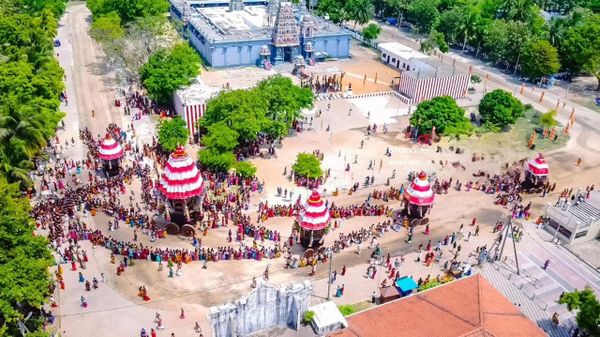
What a community can achieve is already visible at Mantai, in Mannar. Thiruketheeswaram, the Dakshina Kailasam, was praised in the hymns of the 7th-century Saint Thirugnanasambanthar and flourished with the ancient port of Mantota under the Cholas. The Portuguese destroyed it and carried away its stones. Its revival began with Arumuga Navalar in 1872. In 1894, an excavation recovered the ancient Siva Lingam, a Nandi, and a Ganesha image. Since 1948, its trust has rebuilt the complex, including forty surrounding shrines, in granite, crowned by the Grand Maha Kumbhabhishekam of July 2022. Maha Sivarathiri now draws more than half a million devotees.
The next chapter is just as ambitious. The 21 pilgrim rests lost in 1983 can be rebuilt as affordable halls for families and school groups. The Palavi Tank and the temple moat can be restored as a small tank cascade, recharging the freshwater lens beneath the estate. Dense, native Miyawaki forest can shade the approaches, with each pilgrim invited to sponsor a sapling and have their name recorded against it. A flower belt can grow vilvam, jasmine and hibiscus for daily worship. A sanctuary for rescued cattle can supply ghee for the temple lamps and milk for abhishekam, with surplus fodder sold to Mannar's dairy farmers. Here a sacred site becomes climate infrastructure, a source of livelihoods and a gateway, anchoring a national trail with the Mantai excavations as its archaeological stop.
Kayts: a whole island as heritage
Kayts offers a different kind of possibility. Its heritage is not one great monument but an entire island. Two 12th-century inscriptions, issued by opposing sides, name its port Ooraath-thurai: one an edict of Parakramabahu I protecting foreign traders, the other a Chola record of ships and troops assembled there. The island has the octagonal sea fort of Hammenhiel, old churches and temples, a mosque said to date from 1553, 53 historic ponds, and merchant houses such as the Thambiayah Quadrangle, twenty rooms around a central well.
Much of it is privately owned, and many owners live abroad. Heritage custodianship can work here. The owner keeps full title. A national heritage trust restores the property, runs it as a heritage stay, café or museum, pays the owner an annual fee, and after twenty or thirty years hands it back restored. Japan's NIPPONIA has revived 234 old buildings this way as hotels spread across whole towns. We even have our own precedent in the Galle Heritage Foundation, created by law in 1994. Kayts, with visitor numbers kept within what its single aquifer can bear, could be the country's first Heritage Island.
Students, sounds and stories
No department has the staff to record a quarter of a million sites. Our students can help, and learn their shared heritage by doing it. Picture mixed teams from Sinhala, Tamil, Muslim and Christian schools in the same district documenting one another's sacred places, photographing inscriptions, interviewing elders and recording temple bells, the nadaswaram and thavil, pirith chanting, the azan, church choirs and festival drums. Their work, checked and credited by name, would form a "Sounds of Heritage" map and become the audio guides on the trails. India's INTACH heritage clubs already reach 3,000 schools.
Owners as partners, not suspects
Much of our heritage is held privately: walauwas, ancestral homes, family kovils, old wells and bridges. Owners often keep quiet for fear that reporting will cost them their property. The answer is recognition before restriction. A free, voluntary register, separate from gazetting, can offer badges and QR plaques at four levels: Recorded, Verified, Conserved, and Heritage Stay. With them come free advice, a place on the trails, priority for grants and, with the Treasury's support, tax relief for certified upkeep. Japan has registered over 7,400 buildings on a light voluntary tier with tax reductions of up to half. The United States' historic tax credit has drawn some USD 235 billion of private investment since 1976.
Sponsors and investors, including our diaspora, can fund signage, lighting, water, trail guides and restorations, with every rupee ring-fenced, audited and listed publicly, no branding on monuments, no rights over sacred spaces, and the owner always paid first.
Letting sacred places live again
Some ancient shrines stand in ruins while devotees nearby long to worship there. A living temple has daily custodians, and international guidance now treats faith communities as partners in caring for living heritage. Under clear rules, worship can resume at suitable sites with new idols of temple quality, made by accredited sthapathis in the Swamimalai bronze tradition and properly consecrated, while the ancient originals stay safe in museum care and any new structure remains reversible.
The realm of the possible
None of this asks Sri Lanka to copy any single country. It asks us to combine what has worked best elsewhere and join it to what we already have: the scholarship of our archaeologists, the devotion of our temple trusts, mosques, churches and viharas, the energy of our students, and the goodwill of a diaspora that wants to give back.
A first year could see the register and map launched, a pilot pilgrim trail opened with its stamp book, the first private homes badged, and the first restoration begun at Kayts. Our heritage is not a burden to be guarded behind fences. It is an inheritance to be found, walked, heard, shared and celebrated.
Jeevan Thiagarajah is a former Governor of the Northern Province and co-editor of Sacred Shrines of Sri Lanka: A Profile of Hindu Temples.