
By Aruliniyan Mahalingam
In one of Alagu Subramaniam’s stories, a woman named Mrs. Ramasamy is riding home to Atchuvely in a bullock cart. She has just left her daughter, Parvathy, at a girls’ school in Jaffna town, and she will not see her for three months. She is crying. The carter, Subbu, asks her to stop, because anyone who sees her in tears will think he has wronged her.
Subramaniam gave her reply in English:
“Don’t talk nonsense. You are like a father to me. You are an old man, you would never do a thing like that.”
The carter, “peeved at the suggestion that he was incapable,” swears by Siva that he would never do such a thing, adds that he is not too old, and names a witness to his strength: a “big-breasted grass seller.”
In the Tamil translation published this year, Mrs. Ramasamy says “விசர்க்கதை, கதையாத.” The carter ends his boast with “ஓம், அவ சொல்லுவா.” Both lines are in the spoken Tamil of the Jaffna peninsula. Subramaniam’s characters are Tamil speakers whom he wrote in English. In the translation, they speak Tamil, and the particular Tamil of the place where the story is set.
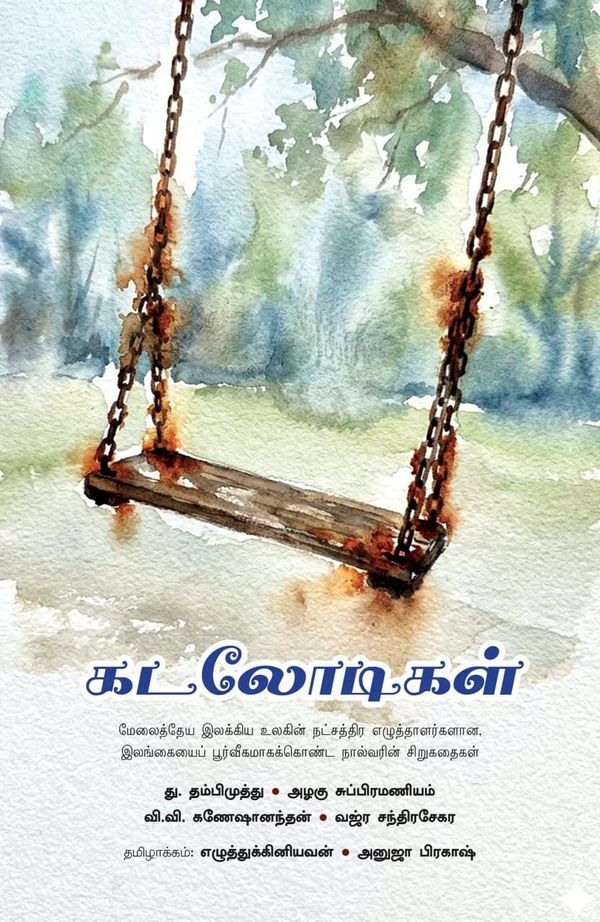
The collection is called “Kaṭalōṭikaḷ” (கடலோடிகள், “Seafarers”). It gathers ten stories by four writers of Sri Lankan origin who made their names overseas, writing in English. Two belong to the middle of the last century: Subramaniam, a Jaffna barrister who moved in London’s Bloomsbury circle and helped found the magazine Indian Writing, and Thurairajah Tambimuttu, who founded Poetry London and published a story in The New Yorker in 1954. The other two are contemporaries: V. V. Ganeshananthan, whose novel “Brotherless Night” won the Women’s Prize for Fiction in 2024, and Vajra Chandrasekera, whose “The Saint of Bright Doors” won the Nebula Award for Best Novel.
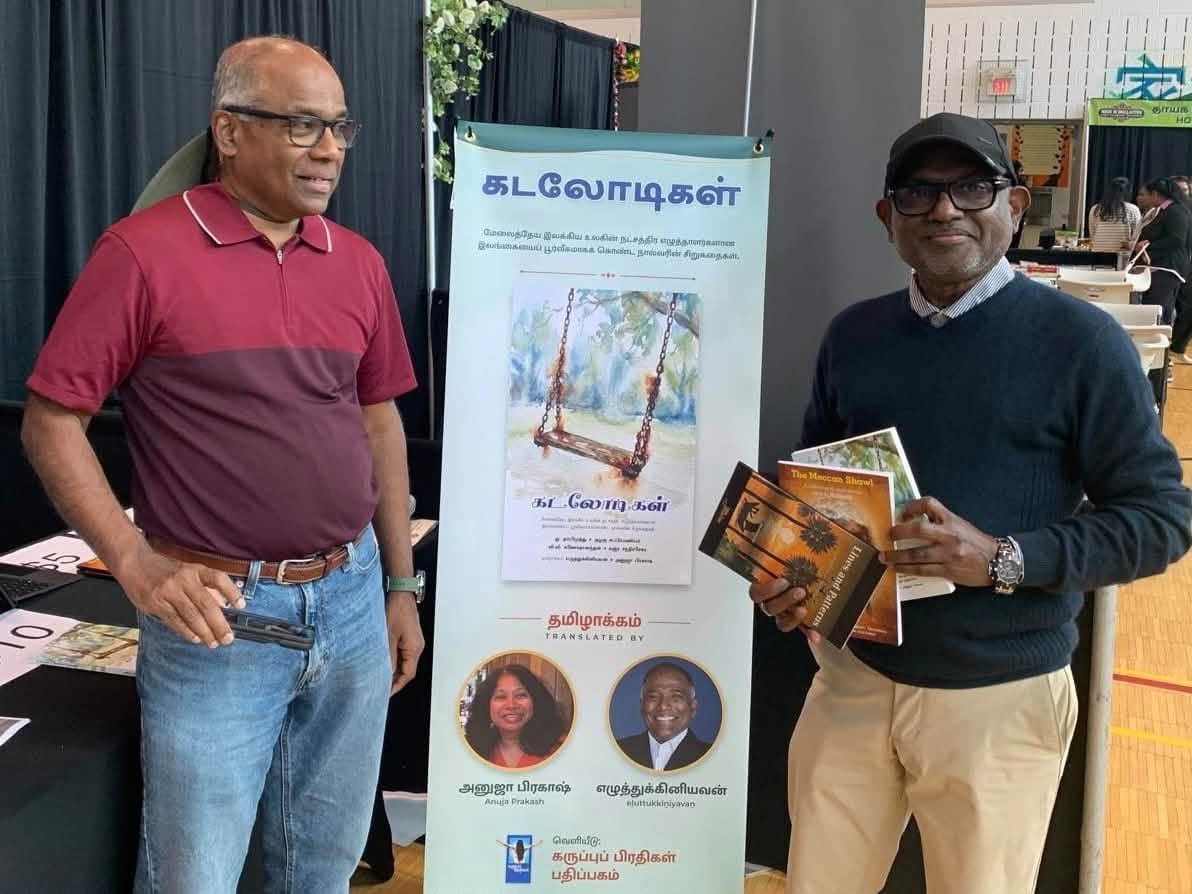
The translators are Anuja Prakash, who holds a degree in business, and eḻuttukkiṉiyavaṉ, the pen name of N. Asokan, a computer scientist at the University of Waterloo. The book was published by Karuppu Pirathigal, a Chennai-based publishing house.
It was launched on Oct. 24 at the Toronto Tamil Book Fair, in a one-hour session at the Malvern Family Resource Centre in Scarborough.
Kaalam Selvam spoke first, in Tamil. He has edited the Toronto literary magazine Kaalam for decades, and he began by telling the audience that he did not intend to discuss the book. What mattered, he said, was that they buy it and read it, and find its faults and its merits for themselves. “I am not a writer,” he said. “I am a good reader.”
He said he had encountered two of these writers only later in life and had found their work difficult to read in English. Tambimuttu came from Atchuvely, and Selvam said he knew him well.
Then, as the room laughed, he added that no one should conclude the two of them had been at school together. Tambimuttu was born in 1915.
Selvam had heard of Tambimuttu long before he read him. He recalled a month he once spent in Jaffna with the critic A. J. Canagaratna, a friend of Tambimuttu’s, who often spoke of him. The fiction came later, and in translation.
Toward the end of his remarks, he asked about the translators. “Where have they been all this time?” The question drew applause. The next speaker, Sumangala Kailasapathy, opened by asking it again.
An answer came near the end of the session, when Toronto-based Tamil writer P. A. Jeyakaran asked how the translators had discovered these stories and why they had chosen these ten. Asokan said he had initially worked in the opposite direction, translating stories by A. Muttulingam and Shobasakthi into English for second-generation Tamil children in Canada, who know the culture but cannot read the language. He has also translated stories by Kuppilan I. Shanmugan and S. L. M. Hanifa. Jaffna Monitor has published his translations of all four writers. In one of his frequent conversations with Muttulingam, the older writer asked him whether he knew that Tambimuttu had published a story in The New Yorker.
Asokan said he did not want to translate without permission, so he traced Tambimuttu’s daughter, Shakuntala. She told him she had more of her father’s stories, some of them not available anywhere else. Later, he said, M. S. Kanakaratnam told him about Alagu Subramaniam. The project grew from there into a single volume reaching across three generations and roughly a hundred years, made of writers who had been celebrated in English and were largely unread in Tamil.
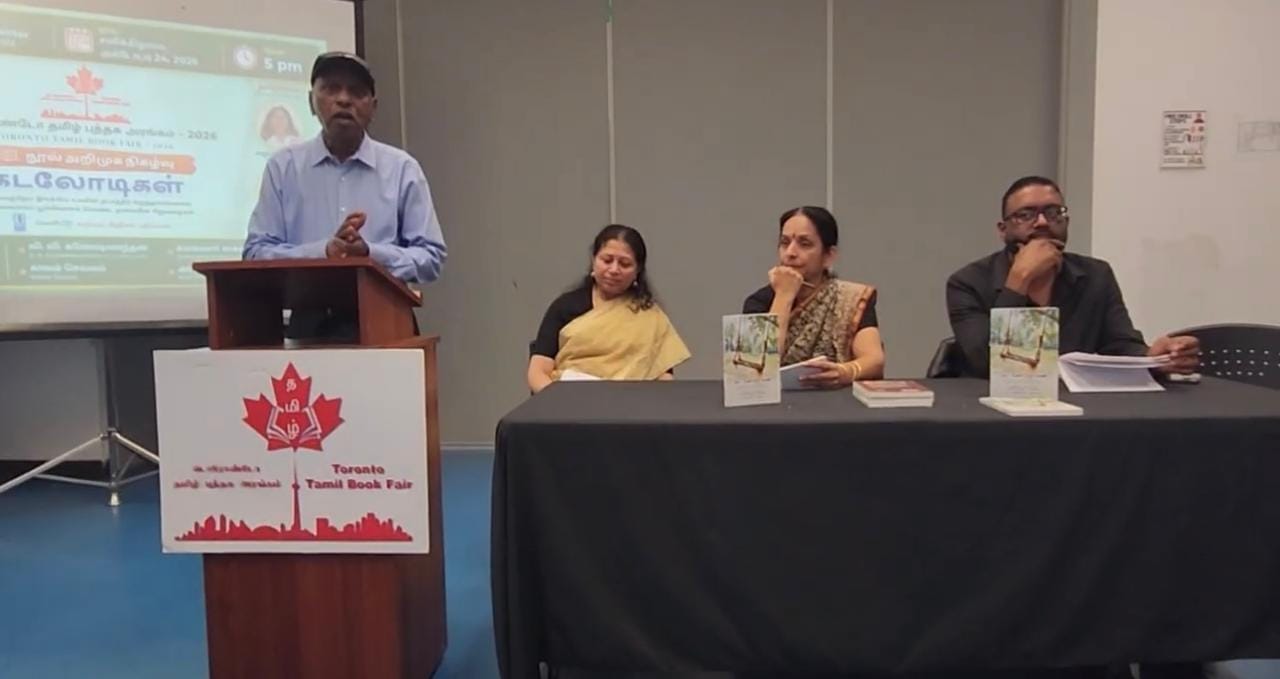
Arunmozhivarman, a Toronto-based writer, read from a prepared essay. He began with a question that, he said, readers and critics naturally face when approaching a translation: “Are we going to talk about the content of these stories, about their literary aesthetics, or about the craft of a translation that has absorbed the original and carried it into Tamil?” he asked. “In truth, ‘Kaṭalōṭikaḷ’ demands an extended conversation on all three.”
He divided the writers by the war. Tambimuttu and Subramaniam wrote before Sri Lanka’s ethnic conflict hardened into armed struggle and then full war. Ganeshananthan and Chandrasekera write inside what followed. The older pair, he said, grew up in Ceylon and rebuilt that life in fiction through nanaviṭai, the Tamil word he used for nostalgia.
He also treated the older stories as records of a society meeting colonial rule and modernity at once. “The Big Girl” turns on a family’s unease about sending a daughter from the village to study in town. Other passages record the part washermen once played in arranging marriages. In the exchange between Mrs. Ramasamy and Subbu, Arunmozhivarman saw something beyond the distance between employer and servant: the authority a male-dominated society extended even to a carter, who answers his employer with a boast about his own strength. He described this as the intersection of social hierarchies.
In a review of the collection, writer Elanko made a related point about tone. Tambimuttu and Subramaniam mock the manners of the well-off, he wrote, and approach people at the margins with sympathy. Selvam said much the same about caste in Tambimuttu. “He did not write it for the sake of saying it,” Selvam said. “He wrote what he saw.” Subramaniam’s “The Convert,” about a teacher who changes his religion to keep his job but cannot stop calling on Siva, struck Elanko as both serious and very funny.
The passage in Arunmozhivarman’s essay that reaches furthest concerns a minor character. In one of Subramaniam’s stories, a Muslim umbrella seller named Maraikkayar advertises his goods by borrowing a famous verse from the Bhagavad Gita, in which Krishna promises to return whenever righteousness declines. Maraikkayar changes the god. “Whenever righteousness declines, and injustice rises,” he tells the crowd, “Murugan will come!”
Arunmozhivarman read it as evidence of how central Murugan was to Saiva life in Jaffna at the time, and of how little Krishna worship had taken hold among ordinary people. In the written version of his essay, he set that reading against the spread, over recent decades, of Krishna, Hanuman and Perumal worship across Sri Lanka, which he called a “cultural invasion.” For readers who make that comparison, he wrote, the story shows how far religious practice on the island has moved within a century. The argument rests on a single comic line in a work of fiction, and the conclusion about the present is his.
Ganeshananthan, who teaches in the University of Minnesota’s M.F.A. program, could not attend in person. The session included a recorded conversation with Asokan, in which she described where her two stories came from.
The second of them, “Gardening,” was written during a fellowship in Berlin. It is told by a young boy whose family returns to the house they were displaced from. “To him, it’s actually not a memory,” she said. “It’s a new place. He’s never seen it before.” In the garden he finds a bone and does not know what to do with it. Set beside the older stories in the volume, the boy lacks what Tambimuttu and Subramaniam wrote from. They had a Jaffna to remember. He arrives at a house he has never seen.
Her other story, “The Missing Are Considered Dead,” takes its title from a remark she associated with two leaders, Ranil Wickremesinghe and Gotabaya Rajapaksa, which she said was made “in Sinhala and then translated into English in a headline.” Both men made remarks to that effect: Wickremesinghe, then prime minister, at a Thai Pongal gathering in Jaffna in January 2016, and Rajapaksa, as president, in a statement issued by his office in January 2020. “The notion of saying that to a crowd of people, not in their language, when talking about their loved ones,” she said, “I just found really troubling.”
The story follows a woman in the Eastern Province whose husband is abducted when their son is an infant. Ganeshananthan said she had learned that the wives of the disappeared could be made to wait for compensation, and that the wait forced a choice between hoping longer and taking money the family needed. Writers often give a story a clock to create suspense, she said. “This is a clock that the government is giving you. And it’s a terrible clock.”
Kailasapathy, a former member of the Ann Arbor City Council and the daughter of the late Tamil scholar K. Kailasapathy, spent her time on the two younger writers. She began with a disclosure. “Anu and Asokan are my dear, close friends,” she said, “so if I lack objectivity, it is due to the love I have for them.” Ganeshananthan’s novels, she said, are largely about the middle class, while the women in these two stories are the working poor, the mothers, wives and sisters of missing men. “These are survival stories,” she said, “but they don’t show women just as victims.” And she warned the audience about the translation. “If your chest contracts and your throat goes dry, I’m not surprised.”
Chandrasekera’s two stories, including “The Translator, at Low Tide,” first published in Clarkesworld in 2020 and a finalist for the 2021 Theodore Sturgeon Memorial Award, are works of climate fiction. “Initially, you’ll probably think it’s kind of a telescopic view into the future,” Kailasapathy said. “But when you start reading it, you realize he’s actually holding a mirror to us.” She described a passage in which the poor, crowded onto the lower floors of high-rises as the water climbs, observe that the smoke from the burning streets does not reach the people at the top. One of the stories ends, she said, with a rusted seesaw tilted to one side, because the children who once played on it now have other work.
The central figure of “The Translator, at Low Tide” is a translator, and Kailasapathy said Chandrasekera was alert to the temptation of that work. “It is so easy to hide yourself in literature,” she said, “or live in the world of literature when the world is burning.” Her own conclusion was practical. Literature should empower people, she said, but real change comes when they become political. “Run for office!”
Asokan made a smaller claim for the same stories. To his knowledge, he said, they are the first climate fiction published in Tamil. “Read it and give us your feedback.”
Selvam and Arunmozhivarman agreed about what the translators had achieved. Selvam said they had kept the colloquial speech of Jaffna while staying faithful to the facts of the lives it describes, and that the stories read as though they had been written in Tamil. Arunmozhivarman put the principle more formally. “Translation is not merely moving words from a source language into a target language,” he said. In his account, a translation gives the full experience of the original only when it carries the culture, the way of life and the context behind the words.
He used the cart scene to show it. In his essay, he drew out a detail a reader might pass over: a mother from Atchuvely expected not to see her daughter in Jaffna town for three months, which, he wrote, says something about travel at the time. He also placed the book against current Tamil publishing, which is producing translations in large numbers. He criticized a recent habit of relying entirely on tools such as artificial intelligence, which he said had produced serious errors of language and meaning, and he called “Kaṭalōṭikaḷ” an “organic translation” and “an unavoidable and important arrival in the history of Eelam literature and in the field of translation.”
Elanko, who also praised the translations for reading like Tamil originals, drew the opposite conclusion from the same quality. In his view, the characters’ dialogue leans too heavily on Jaffna dialect, and a move toward standard written Tamil would have produced tighter stories. He said explicitly that he did not mean this as a fault, only as something the translators might consider.
Prakash, for her part, said this was her first translation. She credited her Tamil to her teachers, graduates of the University of Jaffna.
Kailasapathy had explained at the start why she was speaking in English. She had been asked to, she said, and she could see many people of the next generation in the room who would otherwise be left out. The book being launched was a book of Tamil translations. Asokan had begun his own work for the same listeners, carrying Tamil stories into English for readers who could not reach them otherwise.
In a longer version of the conversation with Asokan, posted online, Ganeshananthan said she would like to read more work by women writers of earlier generations. Asokan told her he was looking for a woman writer from Sri Lanka whose Tamil work he could translate into English.
This account is based on a video recording of the Oct. 24 launch at the Toronto Tamil Book Fair; a recorded conversation between V. V. Ganeshananthan and N. Asokan; Arunmozhivarman’s written essay; and Elanko’s published review. Remarks made in Tamil have been translated by Jaffna Monitor.
Editor’s note:
“Kaṭalōṭikaḷ” is distributed in Sri Lanka by Sabry of Fathima Books Centre (WhatsApp +94 77 080 7787; fathimabookscentre@gmail.com). In India it is available from commonfolks.in; in Canada from Kaalam Selvam (tamilbook.kalam@gmail.com); and in Britain and Europe from Fowzer Mahroof (WhatsApp +44 7817 262980).
A book introduction and discussion will be held in Batticaloa on Sunday, Dec. 13. For details, contact Sabry.