
People becoming unaccounted for as a direct result of, or in connection with armed conflicts and other situations of violence is unfortunately, a common phenomenon throughout the world. The continuous emotional struggle endured by families of missing persons is an incomparable suffering.
Absence of credible answers on the fate and whereabouts of their missing relatives drives the families to search relentlessly for meaning and for: knowledge of the exact circumstances of the disappearance; Families face the dual challenge of carrying on with their daily lives and, at the same time, dealing with the absence of their loved one. Moreover, the uncertainty over their relative’s fate leaves them perpetually torn between hope and despair. The 2011 report of the Lessons Learnt and Reconciliation Commission (LLRC) in Sri Lanka recommended that “a comprehensive approach Absence of credible answers on the fate and whereabouts of their missing relatives drives the families to search relentlessly for meaning and for: knowledge of the exact to address the issue of missing persons should be found as a matter of urgency as it would otherwise present a serious obstacle to any inclusive and long-term process of reconciliation”.
Adopting all feasible measures to account for persons reported missing as a result of armed conflict, and providing their family members with all available information thereon, is a legal obligation imposed on states by International Humanitarian Law (IHL). Families of missing persons constitute a sub-group of victims of armed conflict, and as a general rule, some of their needs are shared by some or all other victims. Nonetheless, families of missing persons face a specific reality of having to wait for an answer about the fate of their missing relative(s), and in light of that develop specific needs.
Therefore, it is essential to assess the needs of missing persons’ families before embarking upon any action in their or their missing relatives’ favour.
The needs expressed by the families of the Missing can be broadly categorised as:• The need to know the fate and whereabouts of the missing person, as well as circumstantial information related to his/her disappearance • Emotional needs • Economic needs • Legal and administrative needs • Needs relating to acknowledgement and justice. The families of missing persons often want acknowledgement of: • the missing person’s dignity and intrinsic value; • the fact that the disappearance took place; • the perpetrators’ responsibility; and• the steps that need to be taken to address the occurrence of disappearances.
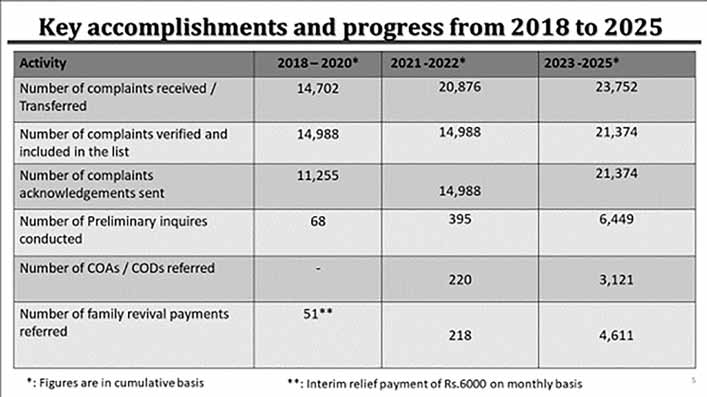
The Office on Missing Persons (Establishment, Administration and Discharge of Functions) Act No. 14 of 2016 (OMP Act) was enacted in August 2016. On 28 February, 2018, His Excellency the then President, Maithripala Sirisena, on the recommendations of the Constitutional Council board members as the Commissioners established the Office of Missing Persons (OMP). The OMP has categorized its data of 14, 988 cases into three major phases, prioritizing the incidents of the missing persons that have occurred more recently. The first phase: cases between 2000-2021l; Second phase: cases between 1981-1999; Third phase: cases occurred before 1980
The Act outlines the functions of the Office (OMP Act, Section 13): To search for and trace missing persons and to clarify the circumstances; To make recommendations to the relevant authorities to ensure non recurrence; To protect the rights and interests of missing persons and their relatives and To identify proper avenues of redress; to collate data from existing sources and centralize all available information in a database.
In accordance with the Cabinet decision dated 14th March 2022, the OMP has managed to conduct a total of 6,449 inquiries. The inquiries led to the following outcomes:
- 2,521 families referred to Registrar General to obtain Certificates of Absence. o 428 families referred to Registrar General to obtain Certificates of Death.
- 3,752 families supported with family revival payments. (Annexure 03)
- 18 missing people were located and reported to the relevant authorities.
- 1,280 complaints referred to relevant agencies for further investigations.
- Complaints regarding missing and disappeared persons received directly by the OMP’s Head Office (2018-2023) NO of files 1,377
- -Complaints regarding missing and disappeared persons received directly by the four Regional Offices of the OMP (2018-2023) 1,354
- - Reports regarding missing and disappeared persons received from MNIR 14,702- The lists of armed forces personnel who went missing in Action, forwarded by Sri Lanka Army 3257
- - The lists of armed forces personnel who went missing in Action, forwarded by Sri Lanka Navy 452
- - The lists of armed forces personnel who went missing in Action, forwarded by and Sri Lanka Air Force 34
- - Reports regarding missing and disappeared persons received Sri Lanka Police 5,307
- - Reports regarding missing and disappeared persons received from WGEID 12,664- Reported to various institutions and commissions (unverified) 39, 417
The need to address the effects include:
1) Psychosocial issues of the members of the family, consequent to the loss of the family member,
2) Post traumatic condition of the relatives of Missing Persons,
3) The next–of–kin’s belief that their loved one/ones are still living and being held in custody,
4) Inability to exercise the legal rights of the missing persons in their absence and absence of a death certificate,
5) Reluctance of relatives to obtain Death Certificates/Temporary Death Certificates due to the fact that the missing person/persons will come back home one day and due to misinformation given by NGOs and some people for monetary gains,
6) Abuse of the rights of Women and Children,
7) The existence of a large number of widows due to missing of their husbands, who were the bread winners in the family, on–availability of a permanent source of income/meaningful livelihood for them,
9) Difficulties in continuing educational needs of the children,
10) The presence of disabled person/persons in the family and difficulties in feeding them and fulfil their day to day needs including medical treatments and related facilities. Some of them are either elder brother or sister or both who were the bread winners in the family,
11) The huge responsibility of women in Women‐Headed Households towards maintaining the family by fulfilling their day to day needs. This has become a serious issue to the women who have no proper income and no relatives to help them,
12) Drug Abuse, increasing trend of consumption of liquor and related crimes,
13) Culture related issues,
14) Loss of self–esteem and dignity
Understanding Suffering
People who have undergone terrible ordeals have the unshakable convictions that Only someone who has endured the same experience can properly understand others and when the extent of their suffering has been fully grasped enables them to share it uninhibitedly. This attitude helps people to form bonds of solidarity, which in turn may alleviate their suffering and help them to eventually social ties.
Ending Psycho Social Isolation
When affected persons share their experiences with others, family members come to realize that they are not the only ones carrying such a burden. They can talk freely about personal experiences and more importantly mention their missing relatives without fear or burdening others. Being able to express their distress of their relatives’ absence can have a significant impact on their ability to cope.
Symbolic measures to be initiated immediately
• A National Day to remember all the victims of the conflict should be declared.
• The government should issue a public apology in recognition of past violence and initiate political and constitutional reform to resolve the conflict Commence discussions across Sri Lanka on what should be part of a memorialization initiative, with space provided to remember and acknowledge the violence of the past.
Source ( KEY ISSUES TO CONSIDER FOR TRUTH, JUSTICE AND REPARATIONS IN THE IMMEDIATE AND LONG TERM Centre for Policy Alternatives (CPA) May 2015)