

By Che Ran
The Easter Sunday bombings were one of the darkest days in Sri Lankan history.
On 21 April 2019, suicide bombers walked into churches filled with families celebrating the resurrection of Christ and into luxury hotels serving breakfast. More than 260 people were killed. Hundreds more were injured. Children died in their mothers’ arms. Entire families disappeared in a matter of seconds.
It was an atrocity.
The people responsible—whether they built the bombs, funded them, or knowingly ignored warnings—must be held accountable. No serious person disputes that.
And yet, as Sri Lanka triumphantly announces convictions and death sentences, another question echoes from the beaches of Mullivaikkal.
Where was this passion seventeen years ago?
Where was this urgency when tens of thousands of Tamil civilians were trapped in an ever-shrinking strip of land in the northeast in 2009?
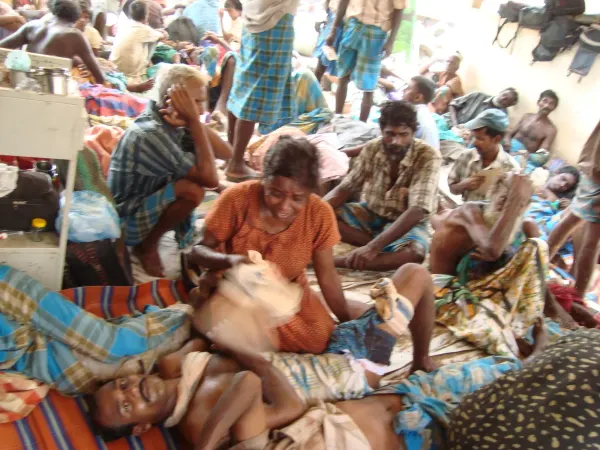
Where was this determination when hospitals that had provided their coordinates were repeatedly hit? When so-called “No Fire Zones” became some of the deadliest places on earth? When families dug bunkers with their bare hands and watched children die from shelling, starvation and untreated wounds?
The United Nations itself estimated that at least 40,000 civilians may have died in the final months of the war. Other estimates are far higher. UN experts, journalists, satellite imagery, eyewitness testimony, mobile-phone footage and humanitarian workers have spent years documenting allegations of indiscriminate shelling, executions and enforced disappearances.
Think about the contrast.
For Easter Sunday, Sri Lanka spent seven years investigating whether intelligence warnings were ignored.
For Mullivaikkal, mothers have spent seventeen years standing on roadsides holding photographs of children who never came home.
For Easter Sunday, there are courtrooms, press conferences, speeches and promises.
For Mullivaikkal, there are protests, military checkpoints and graves that may never be found.
For Easter Sunday, politicians speak solemnly about justice.
For Mullivaikkal, they speak about moving on.
The absurdity is breathtaking.
Sri Lanka has demonstrated that it can prosecute senior officials for failing to prevent a crime. It has shown that the machinery of the state—judges, prosecutors, investigators, and the media—can move with astonishing force when there is political will.
Yet somehow, when it comes to the allegations surrounding the final months of the civil war, we are told the truth is too complicated.
Too many years have passed.
Too much uncertainty.
Too many questions.
Really?
Thousands of videos exist. UN reports exist. Satellite images exist. Survivors exist. Doctors exist. Aid workers exist. Soldiers exist. Entire families still carry the scars of what they witnessed.
The same state that insists it can reconstruct the chain of command surrounding Easter Sunday somehow asks us to believe that the events of 2009 are simply too mysterious to investigate.
It is impossible not to see the selective morality at work.
This is not an argument against justice for Easter Sunday. The victims deserve justice. Every church destroyed, every child killed, every family shattered deserves answers.
But justice that stops at the doors of St. Anthony’s Shrine and never reaches Mullivaikkal is not justice.
It is politics.
A country cannot build reconciliation on selective memory.
It cannot ask Tamils to celebrate accountability while the largest and most painful chapter of their history remains unresolved.
Imagine telling the families of Easter victims to simply forget and move on.
Imagine telling them that asking questions threatens national unity.
Imagine telling them that justice is inconvenient.
That is precisely what thousands of Tamil families have heard for nearly two decades.
Sri Lanka loves to say that all lives matter equally.
Prove it.
Investigate every allegation. Open every archive. Examine every battlefield order. Follow every chain of command. Let judges decide what happened.
Because if justice is truly blind, it cannot stop at Easter Sunday.
It must travel north, to a narrow stretch of beach called Mullivaikkal, where thousands of families are still waiting for the country to acknowledge that their dead mattered too.